Reviewing a GRS certificate is not a matter of copying a supplier name into an Amazon listing. The certificate scope, recycled material, transaction record, product or SKU, and proposed page wording must be reconciled one by one. This article is based on Textile Exchange public materials on the GRS, RCS, certification and claims. The applicable version, certification body and destination-market requirements must be checked against current official documents.
An ASIN is an Amazon catalogue identifier, not the certification object of a GRS certificate. A supplier Scope Certificate or Transaction Certificate may be upstream evidence, but the supplier name alone does not prove that a brand, listing or ASIN has the same product claim. It also does not establish CPF display or a platform outcome.
1. Separate the four evidence objects
Certificate holder and sites: Check the organisation, sites, processing or trading activities, product categories, status and dates shown on the Scope Certificate. The certified supplier, manufacturer, brand, seller and importer may be different legal entities; reconcile them with the actual transaction and claim responsibility.
Material and product scope: Record the recycled-material type, origin information, calculation basis, processing steps, finished-product description, colour or specification and batch. A model, formulation, packaging component or new supplier not listed in the scope should not be added by assuming that a brand or product family is equivalent.
Transaction evidence: Under the current certification system, review the TC or electronic transaction record for the parties, product description, quantity, date, recycled content and upstream/downstream connection. A TC is not a universal authorisation detached from its transaction context; mark the item for review when the product or batch does not correspond.
Page claim: List every sentence proposed for the page and identify whether it describes a material attribute, a product, a supply chain or a certification programme. Evidence for one scope must not be expanded into an unconditional claim about a whole brand or range.
2. Keep the 20% and 50% GRS boundaries separate
Textile Exchange public materials distinguish the GRS threshold for standard use from the consumer-labelling boundary. Products with at least 20% recycled material can be used as a GRS business-to-business tool; consumer-facing GRS product labelling or product-level claims generally require at least 50% recycled material, together with the applicable certification, supply-chain and claims requirements. Twenty percent does not mean that any page may use a GRS label, and fifty percent does not mean that a platform must accept or display the claim.
Keep the recycled-material category, percentage calculation, product composition, processing chain and supporting certificates or transaction records. Check the current Claims Policy for names, labels and logo use. Do not turn GRS certification into a claim that every material is recycled, that the product has no environmental risk, or that another unsupported conclusion follows.
3. GRS and RCS have different evidence boundaries
RCS primarily verifies recycled material and chain of custody. GRS adds social, environmental-processing and chemical requirements. Their names, scopes, content thresholds and consumer-facing claim rules are not interchangeable. Start with the product, proposed claim and supply-chain facts, then select the standard that actually addresses them.
When a page mentions both GRS and RCS, record each standard’s certificate scope, material or product object and permitted claim separately. Without current certification-body documentation, a GRS certificate should not be rewritten as automatically including RCS or covering every downstream product.
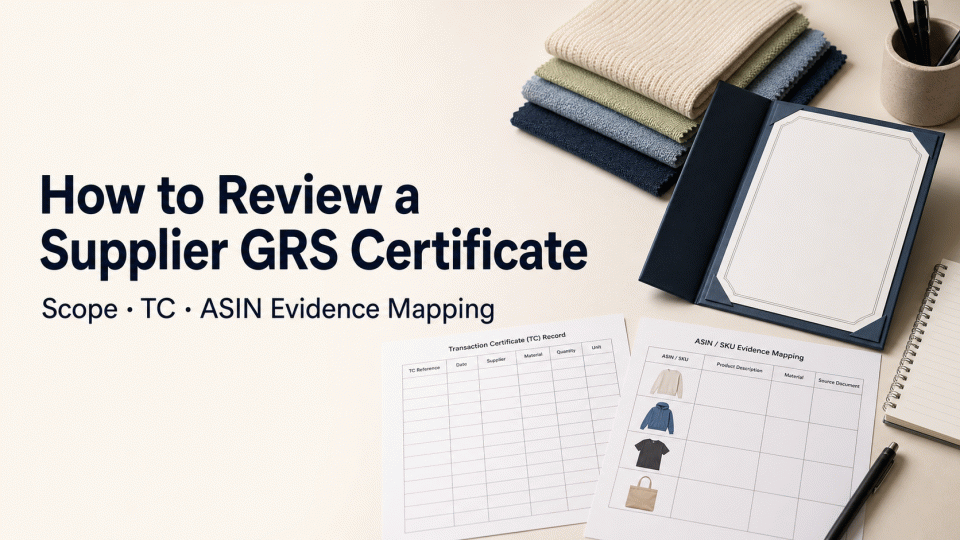
4. Build a supplier-document–product–ASIN map
| Field | Manual check | Do not infer |
|---|---|---|
| Scope Certificate | Holder, sites, product categories, activities, status and dates | Every SKU from the supplier or every product from the brand |
| TC or eTransaction | Parties, product, quantity, batch/date and chain | An unrelated ASIN or an unlisted finished-product attribute |
| Listing and ASIN | SKU, variation, ASIN, model, material, packaging and exact page sentence | Automatic CPF recognition or platform display |
Use one row for each ASIN or SKU. Keep the supplier file name, certificate number, holder, product scope, recycled content, batch or transaction record, current evidence status and proposed page sentence. Recheck the map when the model, variation, packaging or material changes; mark a mismatch for review instead of filling it with a parent-listing value, product-family name or verbal assurance.
5. Check wording and logo use before publication
Before using the GRS name, product claim, label or logo, review the current Textile Exchange Claims Policy, Logo Use and Claims Guide, certification-body requirements and destination-market environmental-claim rules. Write only at the level supported by the evidence, such as “the record identifies recycled material for this batch”; do not write an unrecorded certification-body or platform conclusion.
Document review is not certification, platform review, market access or a sales result. 绿色方舟(深圳)认证有限公司 may help organise certificate fields, supply-chain records, product information and page wording, but it does not replace a certification body, Amazon or a regulator’s decision.
Sources: Textile Exchange GRS-101 Global Recycled Standard, official GRS/RCS FAQs, GRS standards pages, Scope and Transaction Certificate materials, and claims resources. Standards, certification systems and platform workflows can change; check the current official version and the specific certificate before use.