
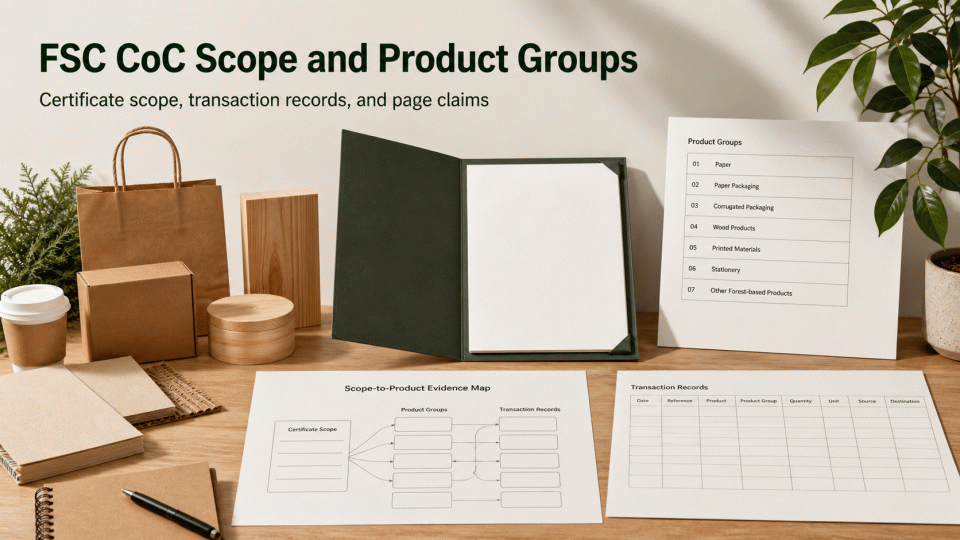
An FSC Chain of Custody (CoC) review is not a matter of attaching one certificate to every item. The practical question is whether the certificate holder, certificate scope, product group, purchase and sales records, and the wording used on a product page point to the same product and activity. This is a documentation framework, not a certification decision, and it does not mean that any particular product is FSC certified.
1. Separate the Certificate Holder from the Product Scope
Record the organization name, address, certificate code, status, applicable standard and certificate type exactly as shown. The scope describes which forest-based materials or product groups the organization can manage within defined activities, and where the certified chain of custody starts and ends. Brand owners, traders, manufacturers and multisite organizations may have different roles; a supplier name or brand name alone does not establish coverage.
Break each target SKU into product name, forest-based material, processing steps, selling entity and claim context. Then compare those fields with the public product groups in the certificate record. Paper, paper packaging, printed materials and wood products are examples only; the certificate's actual product groups and transaction records control the conclusion.
2. Where Product-Group Mismatches Commonly Appear
Typical mismatches include a certificate covering paper stock while the finished package is presented as covered; a scope covering wooden components while an entire paper-and-wood set is treated as one product group; a supplier scope covering its sales activity but not a brand owner's later repacking, relabelling or claims; and different materials, sites or selling entities being merged into one SKU scope.
When products are mixed, processed, repackaged or relabelled, record who owns the material, who performs the processing, who issues the sales document and which step supports the claim. Having an FSC certificate does not automatically make every downstream item eligible for an FSC claim.
3. Build an Evidence Map Around the Scope
Organization records: certificate holder, operating address, production or storage sites, brand authorization and invoicing entity.
Product records: SKU, product name, material composition, product group, site, packaging and label version, and the exact wording proposed for the page.
Transaction records: purchase orders, invoices, delivery or transport records, supplier certificate details, product-group mapping and the applicable FSC claim. The file should show how the material or product connects from the supplier to the sales document.
Control system: confirm whether the certificate and transaction documents use a transfer, percentage or credit system. Do not mix claims from different systems or replace a specific claim basis with the phrase “the supplier has a certificate.”
4. Review FSC Claims and Marketplace Copy Separately
Use the FSC certificate database to check status, holder and public scope. Use transaction records to support the relevant product or batch. Review the page copy sentence by sentence against that evidence. A certificate scan, a supplier statement or one transaction document does not by itself show that every SKU under a brand may use an FSC claim.
If the page also uses claims such as “sustainable,” “eco-friendly” or “recycled,” give each claim its own basis. Do not merge FSC CoC, another certification, a marketplace program or a legal obligation into one conclusion. Programs such as Amazon Climate Pledge Friendly (CPF) must be checked against their own current rules; an FSC scope does not replace a marketplace eligibility review.
5. A Practical Order for Resolving an Inconsistency
First, pause the proposed FSC claim and preserve the original certificate, contracts and transaction records. Second, compare status, holder, sites and product groups with the certificate database. Third, confirm processing, packaging, relabelling and invoicing steps with the supplier or certificate holder. Fourth, map each SKU to a product group and transaction record. Fifth, ask the certificate holder or an independent certification body whether the scope, control system or wording needs to change.
Until the mapping is complete, a page may use factual product descriptions that stay within the evidence, but it should not turn “under review” or “the supplier holds a certificate” into “this product is FSC certified.” 绿色方舟(深圳)认证有限公司 can help organize records and claim boundaries; the certification decision belongs to an independent certification body.
6. File Contents and Factual Boundaries
For each SKU, keep a one-page map containing certificate code and status, holder, sites, product group, material source, transaction records, control system, label or page claim, review date and open questions. FSC's official explanation states that CoC certification is assessed by independent certification bodies and that FSC offices do not issue certificates directly. Cost, duration and any scope extension depend on the organization, products and certification-body assessment.
This article is based on FSC's official Chain of Custody explanation, CoC certification requirements and FSC Product Classification materials. Standards, certificate records and marketplace rules can change, so return to the relevant official documents and the current certificate record before publishing or submitting a claim.


