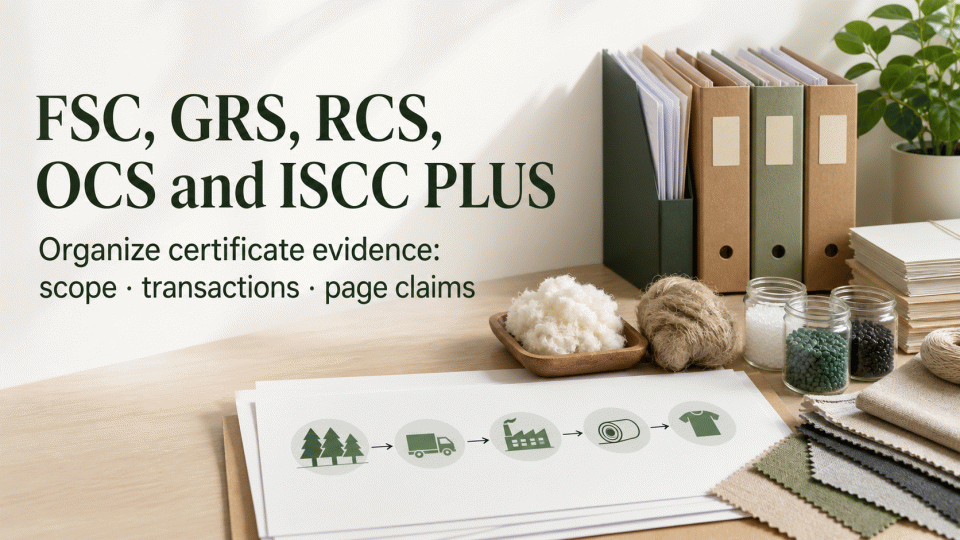
FSC, GRS, RCS, OCS and ISCC PLUS address different material inputs, chain-of-custody controls and claim boundaries. A product described as recycled, organic or sustainable does not make these schemes interchangeable. Based on public materials from FSC, Textile Exchange and ISCC, this article sets out a document-selection and matching method. Confirm the current scheme documents, certification body, certificate status and transaction records for the specific product. This article does not promise certification, platform acceptance, buyer approval or any outcome.
Keep four boundaries separate: FSC mainly addresses forest-based material and chain of custody; GRS/RCS address recycled material and textile supply-chain requirements; OCS addresses organic material content and traceability; ISCC PLUS addresses covered alternative feedstocks, sustainability characteristics and chain-of-custody controls. A scheme name alone does not prove that a SKU, batch or page claim is covered.
1. Route the review by material and intended claim
Fix the product model, material composition, production site, market, supplier and intended page claim before selecting a scheme. Forest-based paper, wood or other forest-based products should first be checked against FSC product groups and chain-of-custody boundaries. Recycled polyester, recycled cotton and other recycled fibres may require a GRS or RCS review. Organic fibres call for an OCS review. Bio-based, circular or other alternative-feedstock products may call for ISCC PLUS, but ISCC PLUS does not replace mandatory product rules or market-access files.
“We need one certificate” is not a sufficient product assessment. Break each claim into material origin, processing, transaction batch, product group, label permission and target page, and state which items are supported by a supplier, which are owned by the applicant and which require confirmation from the certification body or buyer.
2. FSC: match the CoC holder, product group and transactions
FSC Chain of Custody (CoC) tracks and controls the identification of forest-based material from sourcing through processing and distribution. Start with the certificate holder, sites, product classifications, product groups, input materials and permitted FSC claims. Then connect purchase documents, production batches, sales documents and label or trademark records. A supplier’s FSC certificate does not automatically extend to every finished product, processor or page claim.
FSC explains that CoC certification is performed by independent accredited certification bodies and requires certificate holders to identify and track eligible material. A useful file therefore includes the certificate number, legal entity, sites, product groups, status-check date, purchase and sales records and the finished-product mapping. Reclaimed material, controlled wood, multi-site operations, repacking or relabelling may have additional requirements; check the applicable FSC documents and certification body instead of expanding the scope from a product photograph or supplier statement.
3. GRS and RCS: separate recycled content, processing scope and transaction evidence
GRS (Global Recycled Standard) and RCS (Recycled Claim Standard) both concern recycled material and supply-chain traceability, but their additional requirements and claim conditions are not identical. Confirm the material and product scope first, then review the recycled input, processing sites, Transaction Certificates or electronic transaction records, Scope Certificate and applicable label or claim rules.
Do not use a supplier Scope Certificate as a substitute for finished-product transaction evidence, and do not turn “contains recycled material” into a claim that the whole product is certified under a particular standard. Match the certificate holder, facilities, product category, material name, recycled source, batch or quantity, transaction direction, date and status. Percentages, marks and claim conditions depend on the current Textile Exchange standard and product situation, so check the current standard and labelling rules before publication.
4. OCS: organic-content evidence is not a complete product claim
OCS (Organic Content Standard) is used to review organic material content and traceability from input to finished product. The file should identify the organic input, supply-chain sites, processing, product scope, transaction records and finished-product composition. Separate the organic component from conventional fibres, trims, dyeing, sewing and packaging, then check that the label and marketing language stay within the supported evidence.
“Organic,” “natural,” “sustainable” and “chemical-free” are not synonyms. An OCS document does not automatically establish product safety, environmental performance, social compliance, coverage of every trim or compliance of packaging. If a product carries GRS, RCS or another claim as well, maintain a separate evidence path for each material and scheme instead of merging different marks and conclusions into one certificate.
5. ISCC PLUS: check the scheme, feedstock attributes and chain of custody
ISCC describes ISCC PLUS as a voluntary scheme for global markets that can cover certain alternative feedstocks and sustainability characteristics. Confirm that the file concerns ISCC PLUS rather than ISCC EU or another ISCC scheme. Then check feedstock category, certified sites, economic activities, processing or trading scope, chain-of-custody method, traceability records and Sustainability Declarations where applicable. Similar names do not make different schemes interchangeable.
When a mass-balance chain of custody is used, record the applicable site, scope, inputs, outputs, balancing period, material characteristics and quantity calculations. ISCC’s public guidance states that mass-balance bookkeeping is subject to defined spatial and scope boundaries and must be supported by physical receipt and complete records. Do not rewrite a mass-balance claim as a statement that every molecule in the finished product came from the same sustainable input, and do not treat ISCC PLUS as an automatic product-safety, legal-compliance or platform-green-label conclusion.
6. Bring the certificate file back to the SKU and page
For each SKU, keep a traceable record of the product and variant, material recipe, supplier, production site, market, page claim, selected scheme, certificate holder, sites and product scope, SC/TC or transaction records, input and batch details, quantity or mass-balance records, label permission, status-check date and open questions. Recheck the mapping after a supplier, factory, formulation, package, product group, page wording or market changes.
Before publication, read the title, summary, body and cover as a customer would. The title should describe a document-selection and evidence-matching reference, not a guaranteed certification or platform result. Keep schemes, legal duties, marketplace rules and buyer-specific requirements separate. The services of 绿色方舟(深圳)认证有限公司 are document-organisation and review references, not a certification decision by FSC, Textile Exchange, ISCC, a marketplace or a regulator.
Sources and boundary: FSC Chain of Custody materials; Textile Exchange GRS, RCS and OCS standards and labelling materials; and ISCC System materials on certification schemes, ISCC PLUS and chain of custody. Standards, versions, certificate databases, labelling conditions and buyer requirements can change. Confirm the current primary documents, certificate status, transaction records and professional advice for the specific product.