
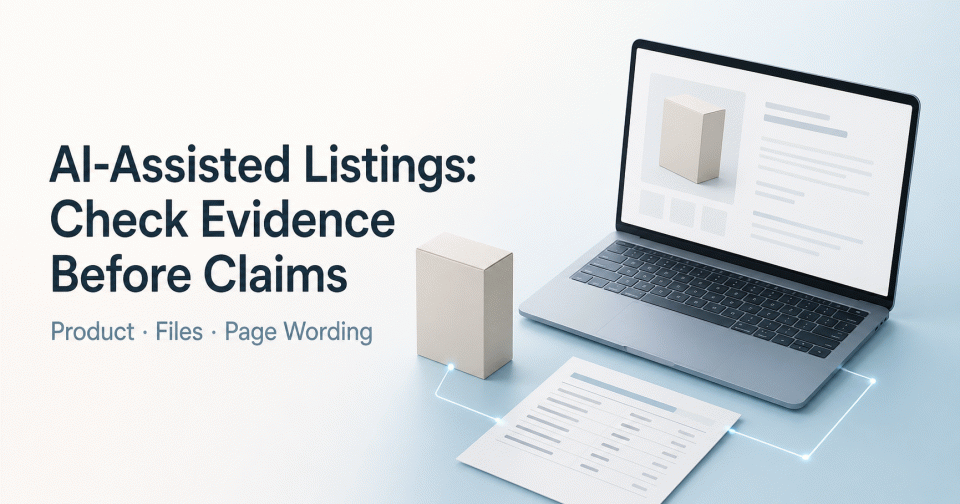
AI can help organise keywords, compare wording and flag missing fields, but it cannot replace product facts, marketplace policies, applicable law or source documents. Each material listing statement should lead back to a specific product, version, market and retrievable source.
1. What AI may assist with—and what it must not decide
AI is useful for turning existing records into a field map, comparing the same SKU across the title, bullets, A+ modules and images, and flagging inconsistent units, model names, materials or warnings. It should not invent test results, certification status, market coverage, regulatory conclusions, rankings, sales figures or expected outcomes.
During manual review, keep at least five keys together: brand or responsible entity, SKU/model, product version, target market and page field. A supplier file, another variant or an older version cannot be reused merely because the name looks similar.
2. Separate product facts, evidence files and claims
Build a product–evidence–claim table. Record the model, dimensions, formulation or materials, packaging version and variation in the product column. Record specifications, labels, test or assessment files, supply-chain records, document entity, scope, version and date in the evidence column. Record each proposed title, bullet, image or A+ statement separately in the claim column.
“Contains a material,” “suitable for a use,” “tested to a standard,” “recyclable” and “reduces emissions” do not require the same evidence. The existence of a certificate does not by itself establish a platform label for the current SKU, and a supplier statement is not a licence to copy an unlimited claim onto a brand page.
3. Four manual checks for an AI draft
- Fact check: trace every sentence to a specification, BOM, label, photograph or production record; remove or hold anything that cannot be confirmed.
- Scope check: identify whether the claim covers one model, a product family, packaging, a material or an organisation, and remove any broader wording.
- Market check: open the current official regulation, marketplace help page and category guide for the sales country; do not treat one market’s file as universal evidence.
- Wording check: avoid broad or outcome-based language such as “green,” “risk-free,” “fully compliant” or “guaranteed”; state the comparator, boundary, unit and source for a comparison.
The U.S. Federal Trade Commission’s Green Guides state that environmental claims should be supported by competent and reliable scientific evidence and caution against broad, unqualified environmental-benefit claims. That guidance does not replace another market’s law or turn an environmental file into an Amazon programme decision.
4. Four common AI-draft failures
Inference presented as fact: the model fills in a material, performance, certification or market conclusion from a common category pattern. Return the sentence to its source file.
Adjacent rules merged together: packaging, chemicals, product safety, customs, marketplace programmes and private buyer standards have different owners and evidence boundaries; keep separate records.
Old policy treated as current: marketplace fields, image requirements and category rules can change. Reopen the applicable official page before submission and record its version or access date.
Optimisation treated as a promise: keyword suggestions, readability scores or A/B observations cannot promise ranking, traffic, conversion, review outcomes or sales performance.
5. A pre-submission evidence sheet
- Product: SKU/model, variation, materials or formulation, packaging and label version.
- Entities: brand owner, manufacturer, importer or marketplace account entity, and the names appearing in each file.
- Evidence: specifications, tests or assessments, authorisations and supply-chain records, with scope, version, date and original source.
- Page: map the title, bullets, description, image text, A+ modules and keywords to the supporting evidence.
- Review: have a person confirm the facts, market, marketplace fields and claim boundary; unsupported sentences stay out of the final copy.
Sources and scope note
This reference uses Amazon’s Product Detail Page Rules and Amazon product listing guidance, together with the U.S. Federal Trade Commission’s Environmental Claims: Summary of the Green Guides. Marketplace policies, category guides and target-market requirements must be checked against the current official page and the specific product file at submission. 绿色方舟(深圳)认证有限公司 may help organise records and review page wording, but it does not replace a marketplace, certifier or regulator’s decision.


