
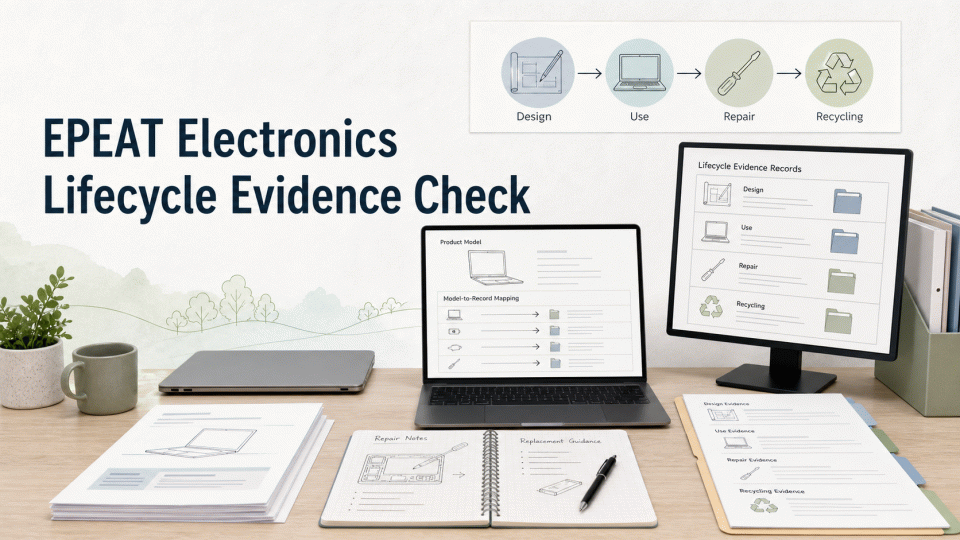
EPEAT, the Electronic Product Environmental Assessment Tool, is an ecolabel and product-registration system used in sustainable electronics procurement. It is not a generic synonym for “green electronics,” and it is not the same as a single energy-efficiency test. The Global Electronics Council (GEC) manages the EPEAT program; the U.S. Environmental Protection Agency (EPA) identifies it as a tool for finding greener electronics.
1. What EPEAT actually covers
GEC explains that products are registered against applicable required and optional EPEAT criteria. The criteria address lifecycle impacts that can include design and production, energy use, repairability, and end-of-life management. The rating must stay tied to the product record and category: Bronze meets the required criteria for the applicable category, while Silver and Gold also depend on the relevant share of optional criteria. A rating should not be quoted without the current Registry entry.
EPEAT should not be substituted for ENERGY STAR or another program. A product may have an energy, recycled-content, or repairability attribute without being an EPEAT-Registered Product. Do not turn a verified attribute into a broad “EPEAT certified” or “fully sustainable” claim.
2. The smallest review unit is the model
- Product identity: record the brand, marketing model, product category, configuration, and variant. Match the page to the Registry record.
- Registry evidence: save the Registry URL, search date, rating, and category. Do not rely on an undated supplier screenshot.
- Responsible party: reconcile the participating manufacturer or brand information with the product record and sales page. A supplier statement does not automatically register another brand or model.
- Criteria scope: split the intended claim into its object—design, materials, energy, durability, repair, supply chain, or end-of-life—and map it to the applicable required or optional criteria and supporting evidence.
3. Build a product-to-evidence table
For each model, create one row containing the model and configuration, EPEAT category, Registry link and search date, rating, exact claim sentence, mapped criterion, evidence-file name, evidence owner, version or date, reviewer, and open points.
Depending on the product category, evidence may include specifications, design or material records, energy-use information, repair or upgrade documentation, take-back or recycling arrangements, supply-chain records, and conformity materials requested by GEC or an approved conformity-assurance body. Requirements differ by category. Use the current EPEAT criteria, program documents, and CAB guidance instead of assuming a universal report age or applying a checklist from another regulation or platform.
4. Keep product claims within their evidence
A defensible statement can describe a verified fact, for example: “The model listed on this page has a corresponding entry in the EPEAT Registry,” together with the model, category, rating, and search date. Recheck the statement if the model, configuration, or registration status changes.
Avoid describing EPEAT as a customs requirement, an automatic approval for Amazon or another platform, or a guarantee of a commercial or regulatory outcome. Do not extend a registered rating to an unregistered product line, or claim a fixed percentage of carbon reduction, approval, procurement, or market access. EPEAT is a procurement and environmental-performance information tool; it does not replace product safety, chemicals, energy, producer-responsibility, or advertising requirements in a target market.
5. Four checks before publication
- Search the EPEAT Registry using the final model and configuration and retain the search evidence.
- Break the page copy into individual claims and match each sentence to the product, criterion, and evidence without expanding a brand, series, or supplier file.
- Check the rating, category, name, URL, and date; remove wording that the current record cannot support.
- Have product, procurement, and compliance reviewers read the Chinese and English versions to confirm that EPEAT is not being presented as a substitute for another legal duty or as an outcome promise.
Sources and service boundary
This reference uses the Global Electronics Council EPEAT Registry, product-listing guidance, and the EPA page on identifying greener electronics. Program rules, product categories, Registry entries, and conformity materials may change; check the applicable official page before a submission or claim. 绿色方舟(深圳)认证有限公司 can help map products, documents, and page wording, but does not replace decisions by GEC, a conformity-assurance body, or a market authority.


