
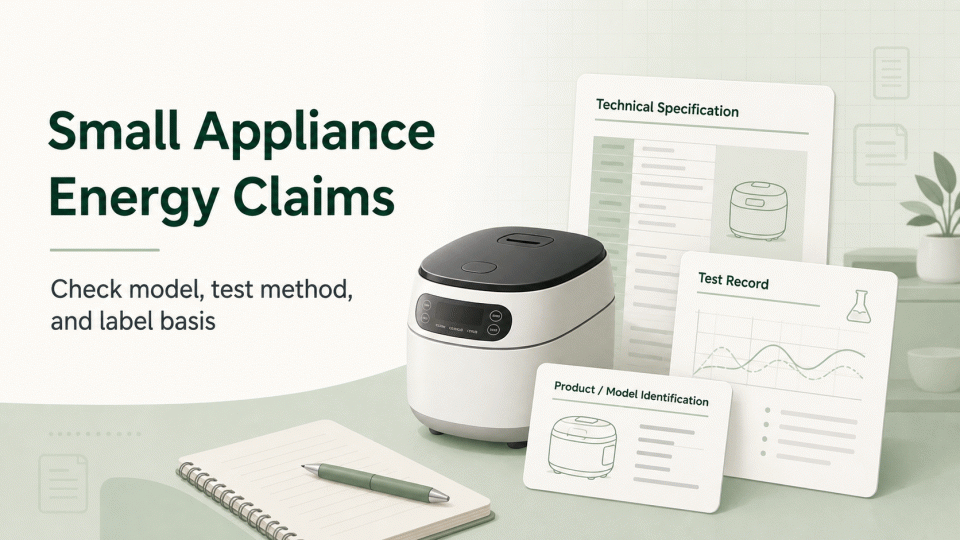
Words such as “energy-saving,” “low energy use,” and “efficient” should be tied to a defined product, operating condition, and market rule. For a small appliance, start with the exact model and function, confirm the applicable requirements in the target market, and make sure every public sentence can be traced to specifications, test records, or an applicable label basis.
1. Define the product and the claim
Do not treat “small household appliance” as one regulatory category. Record the product name, basic model, variants, rated power, operating modes, voltage, capacity or dimensions, key functions, and whether the claim concerns standby use, operating use, energy per cycle, energy per service, or a comparison with another model. A model change, control-program change, or material component change should trigger a fresh scope review.
Also lock the market, importer or other responsible entity, sales channel, and page language. In the EU, energy labels and ecodesign requirements are organized by product group, with product-specific scope and information fields. In the United States, the Department of Energy sets standards, test procedures, and certification requirements for covered products and equipment.
2. Break “efficiency” into checkable evidence
- Product scope: retain the applicable regulation, product-group page, or technical guidance, including exclusions and exceptions.
- Test method: record the standard or regulation version, operating mode, conditions, sample setup, sample count, units, and report date; do not keep only an “efficient” conclusion.
- Model mapping: match the basic model and relevant variants in the report to the SKU, nameplate, packaging, instructions, and online model identifier.
- Labels and wording: where an energy label applies, check the format, display information, source values, and product-group scope. For comparative or environmental wording, retain the comparator, boundary, and calculation basis.
- Responsible entity: preserve manufacturer, importer, or other responsible-party information and its link to the product records; do not treat a supplier’s generic file as evidence for a different model.
3. EU: start with the product group and EPREL link
The European Commission’s Energy Efficient Products resources organize energy-label and ecodesign information by product group; some products also involve information in the EPREL database. Start from the relevant product-group page and confirm whether a label is required, which fields must be supplied or displayed, and which information duties apply to suppliers and dealers. Similar-looking appliances do not automatically share the same label class or energy metric.
Before publication, maintain a five-column map: product model, product-group rule, label or database field, test record, and page sentence. If a sentence cannot be traced to a specific record, rewrite it as a verifiable product description or hold the claim for review.
4. US: separate DOE standards from FTC labeling
The U.S. Department of Energy maintains product coverage, minimum standards, test procedures, certification, and enforcement guidance for covered appliance and equipment categories. Not every small appliance follows the same framework. FTC EnergyGuide materials address applicable product and labeling duties. First confirm coverage, then check the current test procedure and label rule; a test report by itself does not establish that a rule applies.
For annual energy use, operating-cost, or efficiency comparisons, retain the test conditions, units, calculation method, and comparator. A value measured under a defined laboratory method should not be rewritten as a guaranteed saving for every household.
5. Common mismatches and practical corrections
- Different model identifiers: place the report model, nameplate, packaging, and backend SKU in one reconciliation table; do not merge unexplained variants.
- Unclear test method: restore the method version, mode, conditions, and units. If only a conclusion page is available, do not extend the claim beyond it.
- Label treated as an approval badge: distinguish an energy label, a product compliance file, and a third-party certification; do not turn a label class into a statement that the whole product has “passed.”
- Missing comparator: retain the benchmark, date, and calculation boundary. Without a verifiable comparator, remove “more efficient,” “best,” or similar comparative wording.
- Cross-market copying: keep EU, US, and other market files separate. Evidence prepared for one market does not automatically establish duties in another.
6. Minimum evidence pack before publication
For each proposed energy claim, retain a product-and-model list, market and scope assessment, test method and complete report, key specifications and sample configuration, applicable label or database fields, the page sentence and its evidence, document version, and review date. Materials prepared by Greenark (Shenzhen) Certification Co., Ltd. should also keep “evidence review completed” separate from any final regulatory conclusion by the target market.
Sources: European Commission Energy Efficient Products; U.S. DOE Appliance Standards Guidance; U.S. DOE Implementation, Certification and Enforcement; FTC EnergyGuide Labels. Apply the current official rules and product-group guidance for the actual market and product.


