
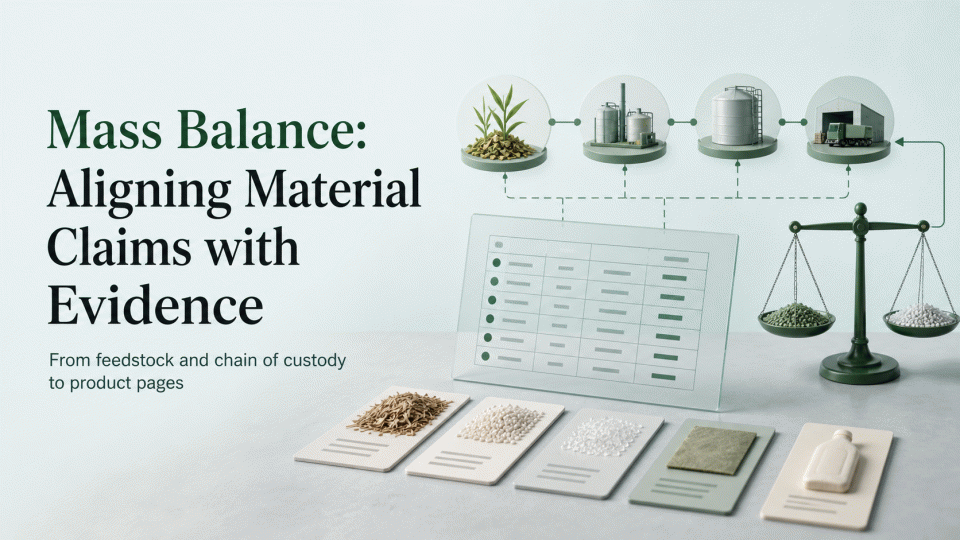
Mass balance is not a shortcut for adding “bio-based” or “circular” language to a product page. It is a chain-of-custody option in which certified and conventional feedstocks may be physically mixed in a process, while the operator keeps verifiable records of inputs, outputs, and the certified share that can be attributed to products. ISCC PLUS is a voluntary certification scheme for global markets; the usable claim still depends on the relationship between the certificate, transactions, product, and wording.
1. Confirm the ISCC PLUS object and certificate scope
ISCC PLUS can cover alternative feedstocks used in the bioeconomy and circular economy. Before drafting a claim, confirm the supply-chain participants, certificate status, raw-material category, processing and trading scope, and whether the intended statement concerns a company-level activity or a specific product, package, or formulation. Similar certificate names do not prove that the raw-material category, site, product group, or transaction chain is the same.
Create a claim-object register with: product or SKU, material or component, feedstock category, certificate number and holder, chain-of-custody option, certified share stated in the evidence, target market, and page location. Without these fields, a supplier’s general wording should not be turned directly into a product claim.
2. Mass balance is different from other chain-of-custody options
ISCC PLUS provides chain-of-custody options including physical segregation, controlled blending, and mass balance. Physical segregation keeps certified and non-certified materials separate through the supply chain. Controlled blending requires the actual control and measurement method to be checked before making a physical-content statement. Mass balance uses verifiable bookkeeping to connect certified feedstock input with an equivalent attributable quantity of product output.
A page should therefore not simply say “100% green material,” “made entirely from bio-based material,” or “the product is certified feedstock.” A mass-balance statement should identify the raw-material category, chain-of-custody option, certified component or product scope, and only the share supported by the evidence. Any ISCC mark or prescribed wording also requires a check against the current logos-and-claims rules and authorization requirements.
3. Connect four evidence groups
A mass-balance review should not stop at one certificate. Organize the evidence in four groups:
Feedstock and category: the raw-material category, supplier declaration, purchasing or receipt records, and evidence that the input is within the applicable ISCC PLUS scope.
Chain of custody and quantity: input, conversion, loss, output, inventory, and allocation records. The bookkeeping should explain how the certified share moves through the system rather than presenting an unexplained final number.
Certificates and transactions: certificate scopes, transaction documents, sustainability declarations, or other applicable records, with matching entities, sites, product groups, and dates.
Product and page: formulation or BOM, packaging or label information, SKU mapping, and the proposed copy. The claim object must not exceed the product or component covered by the documents.
4. Four questions for page wording
Review each sentence before release: Which chain-of-custody option is being used? Which raw-material category is involved? What certified component or product scope is covered? Is the stated share supported by the records and the applicable rules? Do not expand a supply-chain claim into a claim about product performance, carbon emissions, biodegradability, or a broad “more sustainable” conclusion.
If the page uses an ISCC mark, certification name, or a clear product-level environmental implication, check the current mark version, authorized user, official wording requirements, and placement. “Bio-based,” “circular,” and “mass balance” should refer to the same object, scope, and chain-of-custody terminology used in the supporting records.
5. A release-review register
Use five columns for the final manual review: page sentence — product/SKU — certified feedstock and component — certificate, transaction, and bookkeeping evidence — permitted qualifiers. If the entity or product scope does not match, the quantity cannot be explained, the certificate status is unclear, or the wording exceeds the official rules, hold that sentence instead of hiding the gap behind broader words such as “green” or “sustainable.”
This reference page is based on the public ISCC PLUS scheme materials, mass-balance guidance, and logos-and-claims rules. Certification, audit conclusions, and claim permissions depend on the applicable document version, certification-body assessment, and product-specific evidence. 绿色方舟(深圳)认证有限公司 does not present this page as a certification result or a fixed-timeline commitment.


