
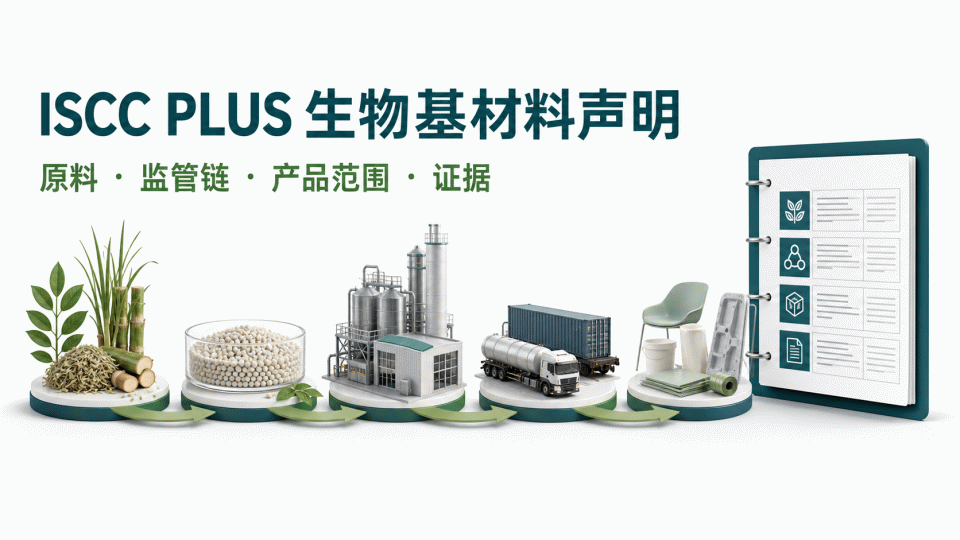
“Bio-based” and “sustainable material” are not standalone labels. This reference page separates an ISCC PLUS review into five objects: feedstock category, certified supply-chain scope, chain-of-custody method, mass-balance records, and the wording used on a product page. The practical question is what the evidence supports for a particular material or product.
1. What ISCC PLUS addresses
ISCC PLUS is a voluntary certification system for verifying sustainability characteristics of alternative feedstocks and tracing those characteristics through supply chains. It is not a universal environmental approval for every product, and it does not replace mandatory market rules, product-safety requirements, or a buyer’s own review. The conclusion must be tied to the certificate, certified sites, and product scope.
ISCC PLUS provides chain-of-custody options including physical segregation, controlled blending, and mass balance. They describe different ways of handling, mixing, recording, and allocating material characteristics. A page claim should not turn one method into another.
2. Start with feedstock category and certificate scope
At minimum, record the alternative-feedstock category, certified entity, site, certificate number and validity, covered processing activities, product or material categories, and the sustainability information that may be transferred. A supplier’s statement that it “has ISCC” does not prove that a brand, formula, packaging component, or finished good is covered by the same scope.
Match the certificate scope to the SKU, bill of materials, material name, packaging component, and purchase batch. If the entity, site, product category, or supply-chain node changes, review the scope again instead of carrying forward an old document.
3. Mass balance is not the same as physical content
Under mass balance, certified and non-certified materials may be physically mixed during production, storage, or transport while the sustainability characteristics remain linked through verifiable bookkeeping. A mass-balance record therefore should not be rewritten as a statement that the finished good is physically made entirely from bio-based feedstock, or as a physical-segregation claim.
Check incoming, outgoing, and inventory records and confirm that allocated certified quantities do not exceed the traceable source quantity. Identify the finished-good component or material to which the characteristic is assigned. If a percentage is used, define whether it refers to the whole product, packaging, or a specific component and follow the applicable ISCC claim rules.
4. Review page claims and logos separately
A page should identify the feedstock category, chain-of-custody method, certified product or component, and the entity and records supporting the statement. Avoid broad conclusions such as “fully green,” “zero fossil,” “natural,” or “sustainable with no impact” unless the evidence and applicable rules support that exact wording.
ISCC logos and product claims have separate usage requirements; product-level use can also involve licensing and approval. Without verified authorization, do not place an ISCC graphic logo on a page or treat a supplier’s certificate image as proof of brand authorization. The cover for this page uses no official graphic logo.
5. Five checks before submission or publication
1. Define the object: state whether the evidence concerns feedstock, resin, fibre, packaging, or a finished good.
2. Match the scope: compare the certified entity, site, product category, SKU, bill of materials, and supply-chain nodes.
3. Verify the chain: confirm that the real handling method matches physical segregation, controlled blending, or mass balance in the records.
4. Test each sentence: link every claim to a certificate, transaction record, supplier declaration, or mass-balance record; remove unsupported conclusions.
5. Check authorization: for an ISCC logo, package artwork, or brand-facing claim, confirm the applicable permission and approval requirements in the ISCC logos-and-claims document.
References: ISCC PLUS certification, the ISCC PLUS Mass Balance Guidance, and ISCC 208 Logos and Claims. Use the applicable current system documents, certificate, and authorization record for the final conclusion. 绿色方舟(深圳)认证有限公司 can help organize an evidence review within the documented scope; it does not replace the independent decision of a certification body, regulator, or platform.


