
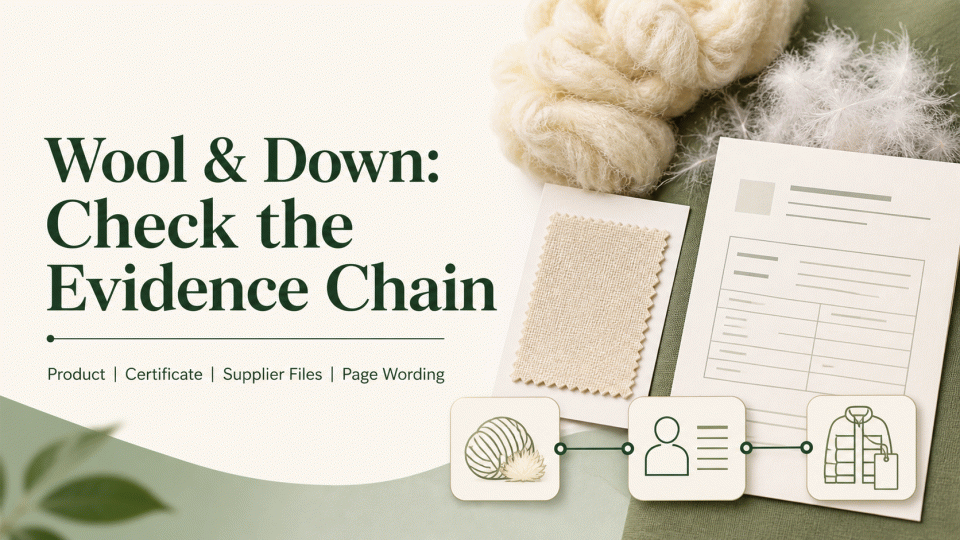
For winter apparel, home textiles and outdoor goods containing down or wool, a responsible, certified or material-origin statement should not be based on a supplier sentence or a certificate image alone. Review the specific product, material content, supply-chain sites, certificate scope, transaction records and exact proposed page sentence in one evidence record.
1. Confirm the material and product scope
Record the SKU, style or model, finished-good category, the component containing down or wool, material composition, supplier and production site. Down filling, wool fabric, trims, lining and packaging may require different evidence. They are not interchangeable simply because they have the same brand or supplier name.
Create a product–material–document–page-sentence register containing at least the material and percentage, relevant component, standard and version, certified entity and site, certificate number and scope, supply-chain records, applicable claim or logo rules, and the complete sentence proposed for publication. Assess synthetic fibers, dyes, trims and packaging separately; an animal-fiber certificate does not substantiate them automatically.
2. Distinguish RWS, RDS and chain-of-custody records
Textile Exchange describes the Responsible Wool Standard (RWS) as addressing sheep welfare, land management and related social requirements, with certification and chain-of-custody controls from farm through the supply chain. The Responsible Down Standard (RDS) applies to down-related animal-welfare and supply-chain requirements. They are different standards; an RWS document cannot substitute for an RDS document.
Check each relevant stage: farm or raw-material source, trader, spinning or filling, weaving or garment production, brand and page owner. Confirm whether each stage is within the applicable certification scope and whether material movement is documented. The Content Claim Standard (CCS) uses documents such as Scope Certificates (SC) and Transaction Certificates (TC) to support checks on material flow, quantities and claims; the applicable records still depend on the relevant standard and certification-body requirements.
3. Align certificates with transaction evidence
Entity and site: Compare the company, address, site and supplying entity on the certificate with purchase contracts, invoices and delivery records.
Product and material: Check product categories, material names, processing steps and certification scope to confirm that they cover the relevant fabric, filling or finished-good component.
Quantity and batch: Link purchase, production and delivery quantities to the applicable TC or transaction record, retaining batch, date and product identifiers. If the quantities do not reconcile, do not fill the gap by adding a percentage to the page claim.
Version and status: Record the review date, certificate status, standard version and certification body. When a certificate or claims rule changes, reassess the sentence instead of reusing an old screenshot.
4. Connect each page statement to evidence
Ask four questions for every sentence: which fiber does it describe? Which SKU and component does it cover? Which certificate or transaction record supports it? Does it turn material origin, animal welfare or chain of custody into an environmental outcome that has not been substantiated? If one answer is unclear, narrow or remove the sentence.
Textile Exchange’s claims and labeling resources distinguish organization claims, product-related claims and label information. For RWS, RDS and similar standards, check certification eligibility, certified-material percentage, brand license information, certification body and any applicable approval process. Without the relevant basis, do not place a standard graphic logo on the page or use expanded wording such as “entire range,” “100%,” “fully responsible” or “zero impact.”
5. Minimum review before submission
Confirm that product photos and the BOM identify the material component; certificate entity, site, standard and scope match the supply chain; SC, TC, invoices and delivery records explain one another; material percentages and batches have not been inflated; title, bullets, images and labels do not imply outcomes beyond the evidence; and any logo or claim has been checked under the applicable brand, certification-body or policy process.
Sources and limits
This reference is based on Textile Exchange’s public resources for RWS, RDS, farm certification, the Content Claim Standard and claims and labeling. Products, markets, customers and platforms may impose additional requirements. This page is not a substitute for market-specific legal advice, a certification-body audit or an individual platform review.
Sources: Responsible Wool Standard; Farm Certification; Content Claim Standard; Labeling & Standards Claims.


