
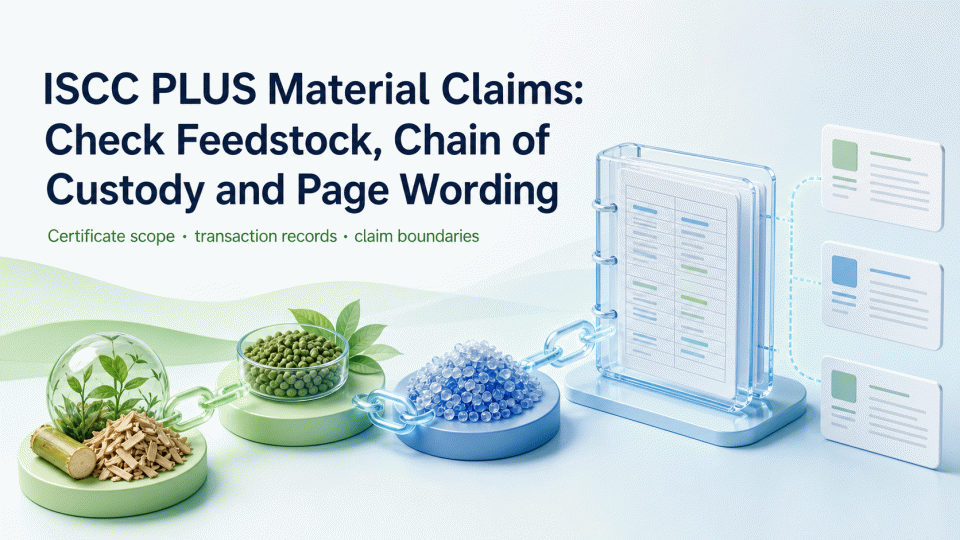
ISCC PLUS is a voluntary certification scheme for verifying sustainability characteristics of alternative feedstocks. When preparing a material or plastic-product claim, do not rely on a supplier certificate alone. Review the certified entity, site, feedstock category, product scope, chain-of-custody method, transaction records and proposed page sentence as one evidence record.
1. Define the product and material scope
Start with the specific SKU, polymer or formulation, relevant finished-good component, production site, supply-chain actors and target market. ISCC explains that relevant elements of the supply chain must be covered by certification. A factory certificate, a feedstock document and a brand page therefore cannot be treated as interchangeable because their names look similar.
Create a product–material–document register containing at least: product name and model; material or component; applicable feedstock category; certified entity, site and address; certificate number and scope; chain-of-custody method; transaction or delivery evidence; and the exact page sentence proposed. Check HS codes, packaging rules and import requirements separately for the target market; using ISCC PLUS does not automatically place a product in one regulatory route.
2. The chain-of-custody method controls the claim
ISCC PLUS supports physical segregation, controlled blending and mass balance. Keep the method consistent across the certificate, transaction records and page copy. Do not describe one method as another.
Physical segregation: materials with different attributes remain physically separated, with records showing their source, movement and related product.
Controlled blending: materials may be blended under the applicable system requirements, while quantities, attributes and output allocation remain verifiable.
Mass balance: certified and non-certified materials may be physically mixed during storage, transport or processing, while the quantity and sustainability characteristics of alternative feedstock are tracked through bookkeeping. Mass balance should not be described as a physically separable certified ingredient in the finished product or as an unrestricted physical-content percentage.
3. Connect every page sentence to evidence
Entity and scope: certified entity, site, certificate number and status, product or material scope, and relevant supply-chain elements.
Material and transactions: feedstock category, input and output quantities, purchase and delivery records, applicable transaction certificates, and the link between inputs and outputs.
Product and page: SKU, model, formulation or BOM, the relevant product or packaging component, page images, title, bullets and exact detail-page sentences. Environmental-effect or greenhouse-gas wording needs its own substantiation rather than an automatic inference from ISCC status.
The same scheme name does not mean the same scope. Check the entity, address, site, product category, feedstock category, chain-of-custody method and dates. Without specific evidence, do not publish expanded wording such as “entire range,” “100%,” “zero fossil” or “fully recyclable.”
4. ISCC logos and claims are not decorative assets
ISCC’s Logos and Claims document requires communication to reflect items such as feedstock category, certified share, chain-of-custody method and certified product component. Brand owners using a finished-product logo or claim may also need to meet licensing conditions. New or revised artwork involving an ISCC graphic logo or finished-product claim should follow the official process. Without the relevant certification, licence or approval basis, do not place an ISCC graphic logo on a cover, package or webpage.
Review each sentence with four questions: does it describe sourcing, chain of custody, a product component or an environmental effect? Which SKU and supply-chain record supports it? Has mass balance been presented incorrectly as physical content? Does it imply an outcome that the evidence does not establish? If one answer is unclear, narrow or remove the sentence.
Sources and limits
This reference is based on ISCC System’s ISCC PLUS overview, chain-of-custody options, Mass Balance Guidance and ISCC 208 Logos and Claims. Products, markets and platforms may impose additional requirements. This page is not a substitute for market-specific legal advice, a certification-body audit or an individual platform review.
Sources: ISCC PLUS; ISCC chain-of-custody options; ISCC mass-balance requirements; ISCC 208 Logos and Claims.


