
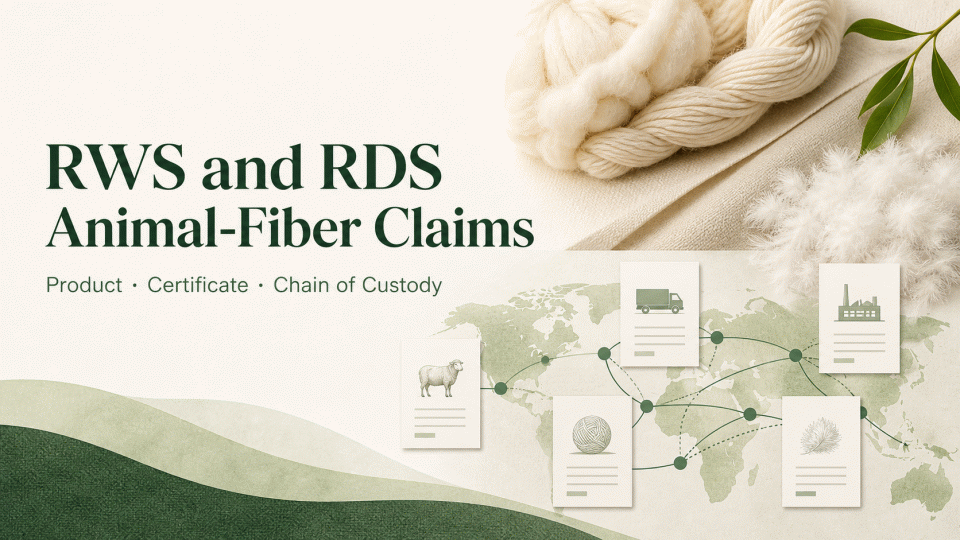
Wool and down are both animal-derived materials, but RWS and RDS are different standards. A broad word such as “natural” or “responsible” cannot replace product-level evidence. Before publishing a claim, map the material, standard scope, supply-chain sites, transaction records and exact wording.
1. Separate RWS, RDS and the product material
RWS (Responsible Wool Standard) applies to wool. Textile Exchange describes its focus as sheep welfare, land management and traceability through the wool supply chain. The standard covers relevant wool supply-chain sites, while recycled wool is outside its certification scope. Whether a product may use the RWS name or label still depends on certification coverage, material composition and the applicable claims policy.
RDS (Responsible Down Standard) applies to down and feathers from ducks and geese. Its boundaries include animal welfare, the prohibition of live plucking and force-feeding, and chain-of-custody controls for certified material. A filled product, shell fabric, trim and finished article should not be treated as one undifferentiated claim: identify the component to which the claim relates.
RWS and RDS do not mean that every animal fiber is certified. Wool, down, feathers, leather, cashmere and alpaca are different material categories. If the material is outside the relevant scope, stop using the standard name and confirm the appropriate route instead.
2. Fields to capture from the certificate file
Build a product–material–site–document–claim register. At minimum, record:
- Product: style or model, color or configuration, wool/down/feather component, material percentage and whether trims are included.
- Certified entity: legal name, certification body, certificate number, scope and applicable standard version.
- Supply-chain sites: farm, first processing, spinning or down processing, fabric or filling production, assembly and the last business-to-business seller where relevant.
- Transaction evidence: purchase orders, invoices, batch or production records, transport documents and, where applicable, Scope Certificates and Transaction Certificates.
- Claim basis: the exact page or label sentence, the material component it describes, certification coverage, artwork approval record and responsible entity.
A supplier certificate is evidence to review, not automatic permission to claim. The entity, scope, standard and transaction trail must explain the current SKU. A supplier having “a certificate” does not prove that every product, batch or page statement qualifies.
3. How to review chain of custody and composition claims
Chain-of-custody records show how certified material moves from an eligible source through supply-chain sites into a product. Check whether each transfer of ownership or physical receipt has a corresponding record, whether batch and quantity information reconciles, whether certified and non-certified material were mixed without explanation, and whether the finished composition supports the wording used online.
For a statement such as “contains RWS wool” or “contains RDS certified down,” do not stop at the raw-material supplier’s scope certificate. Confirm the product-specific conditions, the sites covered by chain of custody, and the treatment of artwork and copy under the claims policy. Where percentages, marks, certification-body details or licensing information are required, use the current policy and certification-body instructions rather than inventing missing details.
The animal-welfare focus is not interchangeable. RWS land-management language should not be transferred to an RDS claim, and an RDS down-origin statement should not be transferred to a wool product. Comparisons may help internal review, but customer-facing wording must return to the relevant standard.
4. Five checks before publishing a page or label
- Identify whether the claim concerns wool, down or feathers, and list the relevant product components.
- Map each component to the RWS or RDS scope, certified entity and supply-chain sites.
- Review the Scope Certificate, Transaction Certificate and batch or quantity records, keeping their versions and review dates.
- Break every statement in the title, summary, body, label and artwork into a separate claim; check that “natural,” “responsible” or “sustainable” is not presented as an unqualified result.
- Have the final artwork and wording checked by the responsible entity and, where required, its certification body. If evidence is missing, keep the item as an internal open point rather than publishing first.
5. Sources and maintenance boundary
This page is based on Textile Exchange public materials for RWS, RDS, the Content Claim Standard and Standards Claims Policy. Standards, claims policies and transition arrangements may change. For a live project, use the applicable version, certification-body requirements and product-specific evidence. This page is not legal advice for a target market and does not promise certification eligibility, platform treatment or a market outcome.
Sources: What is the Responsible Wool Standard?, Responsible Down Standard, Textile Exchange Standards, and Labeling & Standards Claims.


