
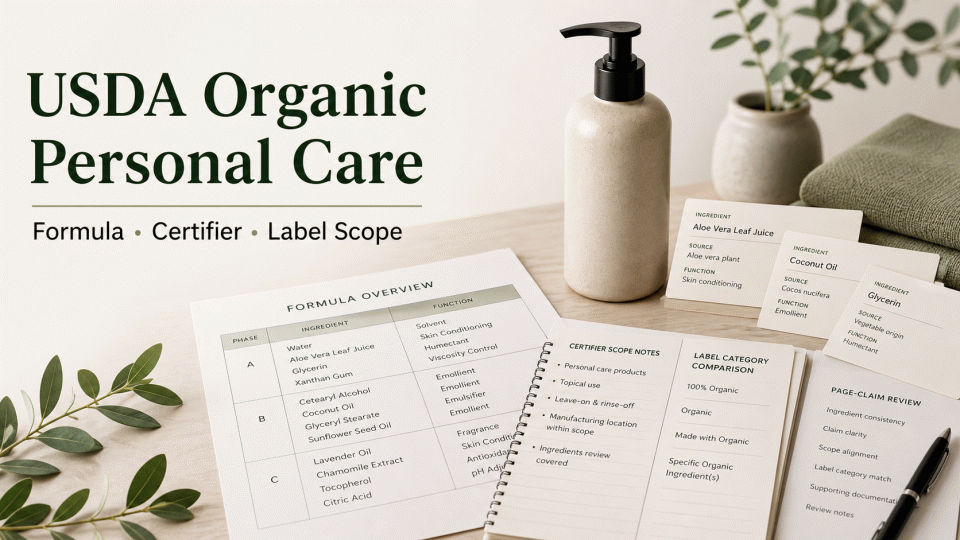
Lotions, hair care, body care, and other personal care products may fall within the USDA National Organic Program (NOP) framework when they contain agricultural ingredients and meet the applicable production, handling, processing, and labeling requirements. “Contains organic ingredients,” “may use an organic claim,” and “the finished product is certified under USDA/NOP” are different statements and must be checked separately.
This page is a documentation framework, not a certification decision. It does not replace USDA rules, U.S. Food and Drug Administration requirements, state requirements, or the review of an accredited certifying agent.
1. Confirm the product scope before reviewing claims
USDA Agricultural Marketing Service explains that cosmetics, body care, and personal care products containing or made from agricultural ingredients may be eligible for NOP certification when they meet the relevant standards. The certification path for agricultural ingredient producers, handlers, and the final-product manufacturer should be checked against the actual product flow and certifier requirements.
Start with a product record: SKU, formula version, ingredient names and sources, calculation basis, production and handling locations, final packaging, and target market. “Natural,” “plant-based,” or “clean” should not be converted into “USDA organic” without a separate review.
2. Match the label category to the organic-content scope
USDA AMS describes four labeling categories. Water and salt receive specific treatment in the calculation, so a percentage should not be applied without reviewing the complete rule set.
- 100 percent organic: subject to the applicable composition rules, with water and salt treated as specified by the regulations.
- Organic: generally at least 95% organic ingredients, excluding water and salt, with restrictions on the remaining ingredients.
- Made with organic specified ingredients or food groups: generally at least 70% organic ingredients, excluding water and salt, with additional composition and claim restrictions. The finished product must not be represented as organic.
- Less than 70%: the principal display panel may not represent the finished product as organic; qualifying organic ingredients may be identified in the ingredient statement under the applicable rules.
These categories are not grades of product performance, safety, efficacy, or market access. Product composition, allowed substances, ingredient statements, principal display panel (PDP), and information panel (IP) requirements should be checked against 7 CFR Part 205 and the certifier’s review.
3. Map formula evidence to the responsible entities
Build a product–ingredient–document–claim register containing the formula and version, supplier and lot evidence, organic documentation for agricultural ingredients, the basis for non-agricultural ingredients, processing aids, production and handling steps, final manufacturer, label artwork, and proposed claims. A supplier document does not automatically establish the certification or labeling status of the finished product.
For each organic statement, record its location: PDP, IP, ingredient statement, product title, product-detail page, image text, or advertising. Then identify whether the statement refers to the finished product, a specific ingredient, or a specified ingredient group. Check that a “made with” statement has not been expanded into a finished-product organic claim.
4. Review packaging and digital product pages separately
USDA AMS distinguishes the principal display panel, which is most likely to be seen at purchase, from the information panel, which includes the ingredient statement and other product information. A practical review sequence is:
- Highlight organic, 100 percent organic, made with organic, and organic ingredient wording, and identify the object of each statement.
- Compare the formula calculation, ingredient statement, and proposed category in one evidence table.
- Check whether the applicable certifier identification and label-review information appear in the required place; do not treat a certifier code alone as proof that the label is complete.
- Read the package, product page, image text, and advertising independently. Remove wording that turns an ingredient attribute into a finished-product attribute or an organic claim into a safety or performance promise.
5. Suggested evidence checklist
Product: SKU, formula version, specification, packaging, and target market.
Ingredients: complete ingredient statement, agricultural-origin assessment, supplier and lot evidence, calculation worksheet, and the basis for allowed or substituted ingredients.
Entities: agricultural production and handling steps, final manufacturer, brand or distributor, and how each entity relates to the certification scope.
Claims: packaging PDP/IP, ingredient statement, website title and description, product-image wording, advertising, and certifier review records.
Boundary: FDA, state, import, and platform requirements should be listed separately. They should not be treated as automatic USDA/NOP conclusions; the applicable requirements can depend on the product, sales channel, and current rules.
Sources and limitations
This page is based on USDA Agricultural Marketing Service guidance for Cosmetics, Body Care, and Personal Care Products, Labeling Organic Products, and Labeling Requirements for the U.S. Organic Market. 绿色方舟(深圳)认证有限公司 may help organize a review register, but it does not replace USDA, an accredited certifying agent, or another competent authority’s decision for a specific product.


