
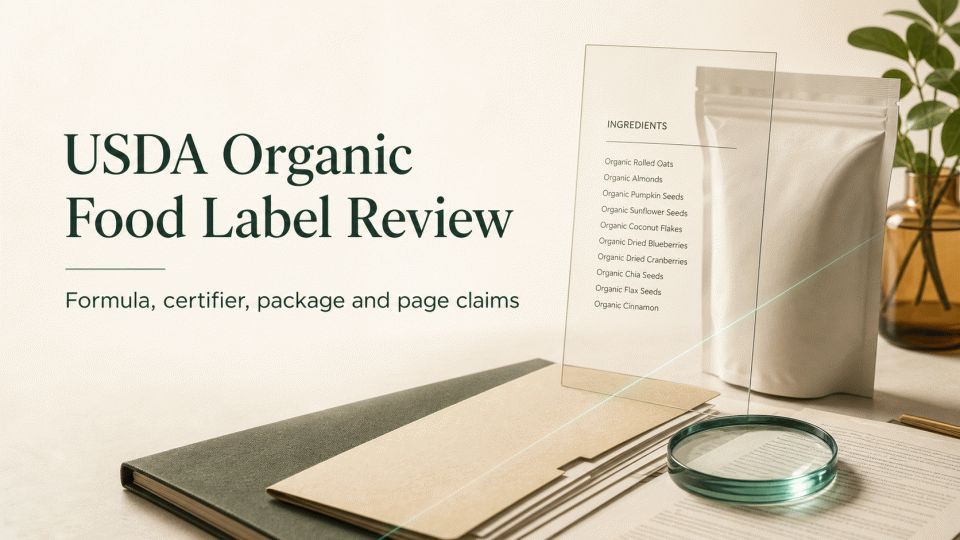
For brands, food processors and importers preparing to sell or describe food as organic in the United States, the useful starting point is one evidence map covering the formula, handling and labeling entities, label panels and online wording. This reference is based on public USDA Agricultural Marketing Service (AMS) and National Organic Program (NOP) materials. It helps organize the review; it does not decide whether a particular SKU is certified, may display a mark, or will be accepted by a platform.
Identify the operation behind the claim
USDA organic certification covers crop and livestock production as well as handling and processing activities. If an operation formulates, processes, packages, repackages, labels, stores or sells an organic agricultural product, first identify the entity responsible for that activity and check whether certification, an exemption or an exclusion applies. When a product or ingredient is represented as organic, the final product will generally need review through a USDA-accredited certifying agent under the applicable rules. A supplier certificate is not automatically a universal certificate for a brand owner, processor or every SKU.
Map the formula to the labeling category
Lock the formula version first, including how salt and water are treated in the calculation, then compare it with the NOP categories:
- “100 percent organic”: all ingredients other than salt and water are organic; the organic claim and USDA organic seal may be used where the rules allow.
- “organic”: at least 95% of the ingredients, excluding salt and water, are organic; the remaining ingredients must meet the applicable restrictions, including National List requirements.
- “made with organic (specified ingredients or food groups)”: at least 70% of the ingredients are organic; the principal display panel may name up to three specified ingredients or food groups, but the finished product may not be represented as “organic” and may not use the USDA organic seal.
- Below 70%: the product cannot be represented as organic on the principal display panel; qualifying organic ingredients may be identified in the ingredient statement under the applicable rules, without the USDA organic seal.
These percentages describe label categories, not a certification outcome. The review still needs to cover non-agricultural ingredients, agricultural sourcing, the calculation record and handling controls that prevent commingling or contact with prohibited substances.
Review the front panel, information panel and product page
Separate the package and page into three review surfaces. The principal display panel (PDP) is the part most likely to be seen at purchase. The information panel (IP) normally carries the ingredient statement, handler or distributor information and certifier information. The product detail page, advertising images and seller content should then be checked sentence by sentence against the approved label version. For U.S. retail packaging, the rules generally require a “certified organic by [certifying agent name]” statement on the information panel; confirm the exact wording and placement under 7 CFR Part 205 Subpart D and the certifier’s review. Do not rely only on a certifier code, and do not expand an online ingredient reference into a broader front-panel product claim.
Alcoholic beverages, honey, pet food and cross-border transactions may involve additional requirements. USDA also notes that its organic labeling rules do not replace FDA, FSIS, TTB or other applicable labeling and approval requirements.
Build an evidence register that returns to source records
For each SKU, keep a versioned register rather than a generic compliance pack: product and formula version, each ingredient and supplier, the basis for non-agricultural ingredients, final handling or packing entity, certifier and certificate scope, organic-content calculation, PDP/IP artwork, lot or shipping records, product-page and advertising captures, and the review record for any formula, packaging, facility or supplier change. Names on the certificate, label, ingredient statement and retail pack should reconcile. If a statement cannot be traced to a source record, it should not be presented as an organic claim.
A human pre-release boundary check
Before release, ask: Which USDA labeling category applies? Is the formula calculation supported? Does the certifier name match the final handler or distributor? Do the PDP, IP and product page use the same permitted category language? Is the USDA seal limited to a category and label version that has been reviewed? Terms such as “natural,” “clean” or “free from” are separate claims and should be checked under the applicable market rules; they are not automatically equivalent to “organic.” 绿色方舟(深圳)认证有限公司 can help organize the product–entity–label–page evidence map, while the permitted label wording remains subject to the applicable rules, certifier review and actual product records.
Sources
USDA AMS: Labeling Organic Products; Labeling Requirements for the U.S. Organic Market; Do I Need to Be Certified Organic?; Organic Standards. Regulations and certifier requirements can change, so review the current version before release.


