
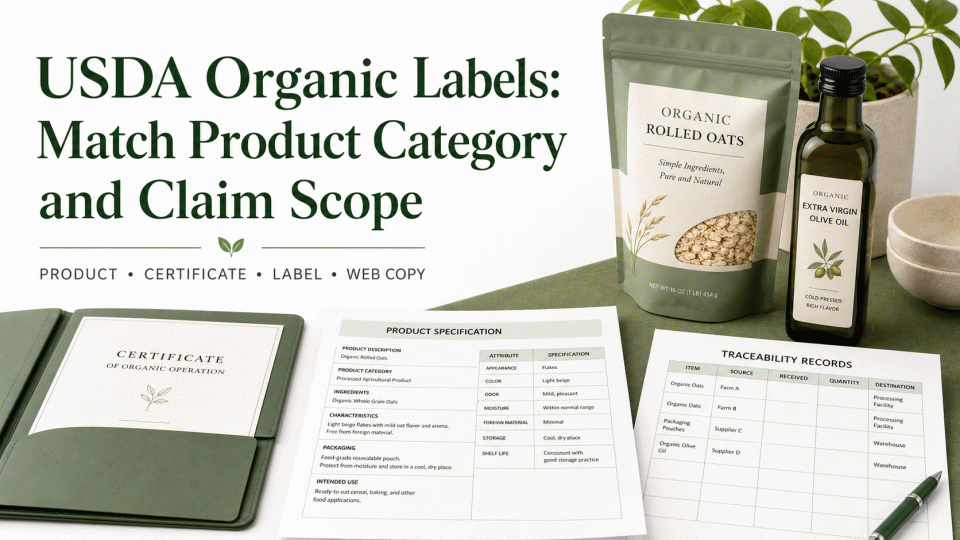
The word “organic” is not a free-standing product description. For products sold or represented in the U.S. market, a USDA/NOP review should start with the product’s regulatory category, formulation, responsible operation, label panels, and web copy. This article focuses on USDA organic labeling and evidence alignment; it does not replace FDA, FSIS, TTB, or other market-specific requirements.
1. Confirm whether the USDA/NOP framework applies
USDA organic rules address specified production, handling, processing, and labeling activities for agricultural products and products containing agricultural ingredients. A business that wants to make an organic claim for a product or ingredient will generally need the relevant operation to be overseen by a USDA-accredited certifying agent, subject to the detailed rules and any applicable exemption. Personal care products, textiles, and other categories may also involve separate rules or voluntary standards; an organic raw material does not by itself make the finished product a USDA organic product.
Start a SKU register with four fields: product and SKU, product form and formulation, proposed organic wording, and target market. Link each entry to the formulation version, supplier or handler, certificate scope, and final packaging version. This separates an organic ingredient claim from a finished-product USDA labeling claim.
2. Keep the labeling categories distinct
100 percent organic: subject to the applicable requirements, ingredients must be 100 percent organic apart from salt and water, and processing aids must meet the rule. Organic: at least 95 percent of the product, excluding salt and water, must be certified organic, with restrictions on the remaining ingredients. Made with organic ingredients: at least 70 percent must be organic, and the claim must identify specified ingredients or food groups as allowed. Products below 70 percent may generally identify specific organic ingredients in the ingredient statement, but should not present the finished product on the principal display panel as organic.
Percentage alone is not the whole review. Check allowed nonorganic ingredients, ingredient-statement references, wording on the principal display panel (PDP) and information panel (IP), and whether the USDA organic seal is permitted for the category. Do not broaden “made with organic” into “organic product.”
3. Map the certificate to the formulation and package
For each SKU, keep a versioned evidence file containing the current formulation and ingredient list, production or handling location, certified operation and certifier, certificate scope and status, purchase or lot records, final artwork, and the relevant web-copy version. The key question is not how many files exist, but whether each file identifies who performed which activity, at which location, for which product or scope.
If the product is repacked, relabeled, processed, or otherwise handled after the supplier’s activity, list that operation separately. Compare the legal name, address, product or activity scope, and certification body shown on the certificate with the finished product. A related company, brand, or supplier certificate should not be used as a substitute without confirmation.
4. Read the package and web copy as one claim set
Review the final package and listing panel by panel: product name, ingredient statement, organic-ingredient references, front-panel wording, certifier statement, mark usage, text inside images, search snippets, and variant pages. Web copy is not outside the review simply because it is not printed on the package; it must remain consistent with the verified product scope and evidence.
Record where each phrase such as “organic,” “100% organic,” or “made with organic” appears and what evidence supports it. For textiles, cosmetics, and other non-food products, confirm the applicable product rules and standards separately. USDA organic ingredients, another organic standard, and USDA labeling of the finished product are not interchangeable. Alcohol, meat, poultry, eggs, and other special categories may require additional agency review.
5. Sources and limits
This reference is based on USDA Agricultural Marketing Service materials: Labeling Organic Products, Labeling Requirements for the U.S. Organic Market, Organic Standards, and 7 CFR Part 205 Subpart D. Current official rules, the certifier’s review of the specific label, and other mandatory requirements for the target market take priority over this summary.
绿色方舟(深圳)认证有限公司 can help organize the relationship between product records, certificates, labels, and web claims. Whether a particular claim may be used depends on the product facts, applicable rules, certifier review, and final evidence. This article does not promise certification, platform placement, customs treatment, or a fixed processing time.


