
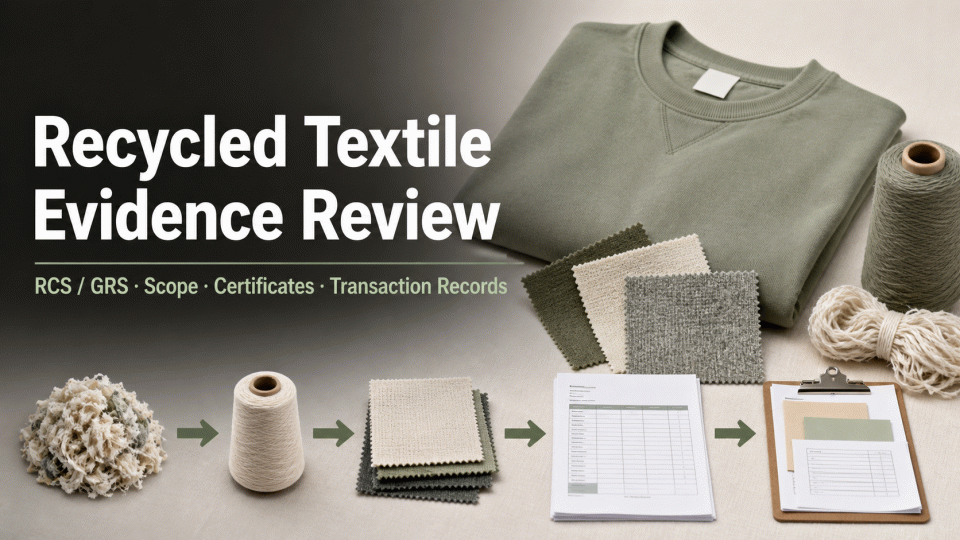
For apparel made with recycled fibres, a certificate alone is not the whole evidence story. The product, material composition, certified entities, supply-chain transactions and proposed page wording must be matched field by field. This reference uses Textile Exchange materials on the Recycled Claim Standard (RCS) and Global Recycled Standard (GRS); it does not replace the laws or buyer requirements applicable in the sales market.
1. Separate the RCS and GRS scopes
RCS primarily verifies recycled input and chain of custody, tracing the material from the recycling source through the supply chain. GRS also addresses recycled material and chain of custody, while adding social, environmental and chemical requirements for relevant processing stages. Both are voluntary third-party standards. Neither should be presented as a substitute for product-safety, labelling, chemical, environmental-claim or other legal requirements in a destination market.
Do not turn “the factory is certified” or “the fabric supplier is certified” into “this garment is certified.” Check the certified organization, sites, process categories, materials and product groups. The current SKU or fabric lot must fall within the documented scope, and product labels or claims must meet the applicable chain and claims rules.
2. Build a product-to-evidence register
For each style or fabric version, record the SKU, style and colour, fibre composition, recycled input and material category, suppliers and processing sites, certified entity, Scope Certificate number and scope, purchase and sales documents, the applicable Transaction Certificate or current system transaction record, and the proposed label and webpage sentence.
Certificates, invoices, delivery notes, batch or order data should tell the same story. A blended product needs its fibre components and percentages recorded. A supplier document should not be stretched across different formulas, sites or finished-garment SKUs. If the evidence covers fabric only, keep the claim limited to the fabric or the documented material rather than expanding it to the garment, packaging or brand.
3. Review chain-of-custody and transaction records
Textile Exchange describes chain of custody as the documentation and certification path for certified material through supply-chain stages. Review the relevant route from the recycling source through spinning, weaving or knitting, dyeing and finishing, garment production and sale. Keep the operators and sites, certificate scope, product description, quantities, dates and transaction relationship traceable at each step.
A Scope Certificate describes the scope covered by an organization or site. A Transaction Certificate records a particular transaction or delivery. They are different records and should not be substituted for one another. If eTrackit or another current system is used, follow the current instructions from Textile Exchange and the certification body and retain records that can be traced back to the transaction.
4. Control wording on pages and labels
Make the claim object explicit, for example: “This style uses recycled material verified through the RCS/GRS chain of custody,” only where the records cover that fabric and wording. Do not present RCS or GRS as a universal certification of the garment, company, factory or brand. Do not turn a recycled-material statement into a broader conclusion such as “eco-friendly,” “non-polluting,” “sustainable,” or an official regulatory endorsement.
Before using a mark, label or standard name, check Textile Exchange’s current trademark and claims policies, consumer-protection rules in the sales market, and any platform or buyer format. Certification status, product scope, transaction records and label authorization are separate fields; one verified field does not prove the others.
5. Manual review checklist for apparel sellers
- Does the current SKU, fabric version and fibre composition match the certified product scope?
- Do the certified entity, processing site and supplier names match the order and delivery records?
- Are the Scope Certificate and transaction record retained as separate, coherent records?
- Does the proposed sentence describe fabric, garment, packaging or company, and stay within the evidence boundary?
- Have label, trademark and recycled-content statements been checked against current official policy and local law?
- Will the evidence be reviewed again after a material, supplier, site, formula or wording change?
Sources and boundary note
This reference uses Textile Exchange’s RCS and GRS overview, chain-of-custody explanation, RCS FAQ, claims policy and related standard documents. Standard versions, certification systems, label policies, local laws and platform requirements can change; recheck the current official document and the specific evidence before use. 绿色方舟(深圳)认证有限公司 provides a documentation and review framework and does not make a certification-body, regulator or platform decision.


