
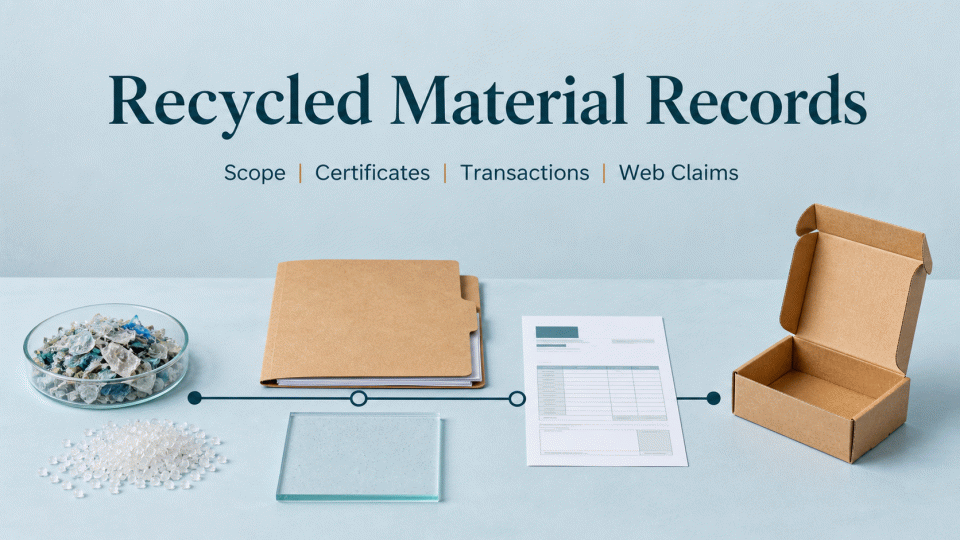
“Recycled material” is not a standalone conclusion that can be detached from a product and its records. For bags, footwear and packaging, first identify the material standard, product scope, certified organization and transaction lot. Then check whether the wording on a web page or package matches that evidence.
This reference framework is based on Textile Exchange materials for the Recycled Claim Standard (RCS), Global Recycled Standard (GRS) and their shared Content Claim Standard (CCS). RCS and GRS are voluntary, third-party certification standards for material claims and chain of custody; they do not replace laws or platform requirements that may separately apply in a market.
1. Separate RCS, GRS and CCS
RCS is primarily used to verify and track recycled raw material through the supply chain. It focuses on recycled material and chain of custody, and does not cover chemicals, social performance or environmental performance in processing. GRS also verifies recycled raw material and chain of custody, while adding social, environmental and chemical requirements for processing and a higher recycled-content threshold. CCS is the common chain-of-custody foundation: it addresses product flow, records, volume reconciliation and segregation from input to finished product.
A product with an RCS certificate should not automatically be described as meeting every GRS requirement. Nor should an RCS or GRS certificate be presented as the complete legal evidence for selling bags, footwear or packaging in a particular market. Record standard scope, market law and buyer requirements in separate fields.
2. Build a product-to-record scope table
Use one row for each SKU rather than grouping everything under a brand or a “recycled collection”. At minimum, record:
- Product: bag, upper, sole, lining, webbing, zipper, carton, hangtag or transport packaging, with the product code, version and key components.
- Material: the specific recycled input, pre-consumer or post-consumer status, component weight or composition, and any components outside the claim scope.
- Certified organization: the legal entity, site, product group and standard shown on the Scope Certificate, checked against the actual supplier and processing steps.
- Records: purchase and sales documents, batch or delivery details, Transaction Certificate (TC) or eTransaction, BOM, invoices and transport records.
- Wording: the exact language used on the web page, package, hangtag and catalogue, and whether a material fact has been enlarged into a claim about the entire product, brand or environmental outcome.
For bags and footwear, separate the main claimed material from trims and accessories. For packaging, distinguish product packaging, transport packaging and statements about the packaging itself. If a component is not covered by the certificate or transaction record, do not describe the entire product as having the same scope.
3. Match certificates with transaction records
A Scope Certificate describes an organization, site and product group within a certification scope. It does not by itself prove that every shipment has the same material content or is eligible for a consumer-facing label. At transaction level, check the supplier, buyer, product description, quantity, batch or delivery details, and the corresponding TC or eTransaction.
Keep these fields in one ledger: SC number and organization, product group, material, transaction reference, seller and buyer, shipment date, quantity, recycled-material type, batch link, invoice or transport number, and final SKU. Do not rely on a PDF alone; reconcile it with purchasing, production and sales records.
A certificate screenshot or a statement without product and transaction details should be recorded as an open document request, not treated as complete support for a finished-product claim. When standard versions, certification scope or transaction systems change, use the current Textile Exchange and certification-body documents and record the review date.
4. Bring web and package wording back to the evidence
Break each statement into three questions: which material is being described, which part of the product is covered, and where is the supporting record? “The upper contains recycled fibre” is not the same as “the entire shoe is made from recycled material”. “The packaging contains recycled material” does not give the product itself the same attribute.
For RCS or GRS names, marks and consumer-facing claims, use Textile Exchange claims and labelling documents to check eligibility, chain of custody, authorization and exact wording. Do not turn a material fact into “more sustainable”, “zero impact”, “guaranteed lower carbon” or another conclusion that would require additional life-cycle, environmental or legal support.
Use one claim ledger for the web page, hangtag, package and buyer quotation: original wording, proposed wording, SKU or component, supporting record, market, reviewer and review date. Remove unsupported wording or replace it with a verifiable material description.
5. Five manual checks before submission
- Does the product scope match the Scope Certificate, the actual BOM and the page images?
- Do the organization, site and transaction chain match the supplier, processor and buyer?
- Is the pre-consumer or post-consumer status, content or component scope supported by records?
- Can the SC, TC/eTransaction, invoice, transport record and batch point to one another?
- Does the web, package and label wording stay within the evidence, while market law and buyer requirements remain separately documented?
Sources: Textile Exchange: RCS and GRS; RCS-101; GRS-101; CCS chain-of-custody overview. Standards and claims policies may change; use the current official version and certification-body requirements for a live project.


