
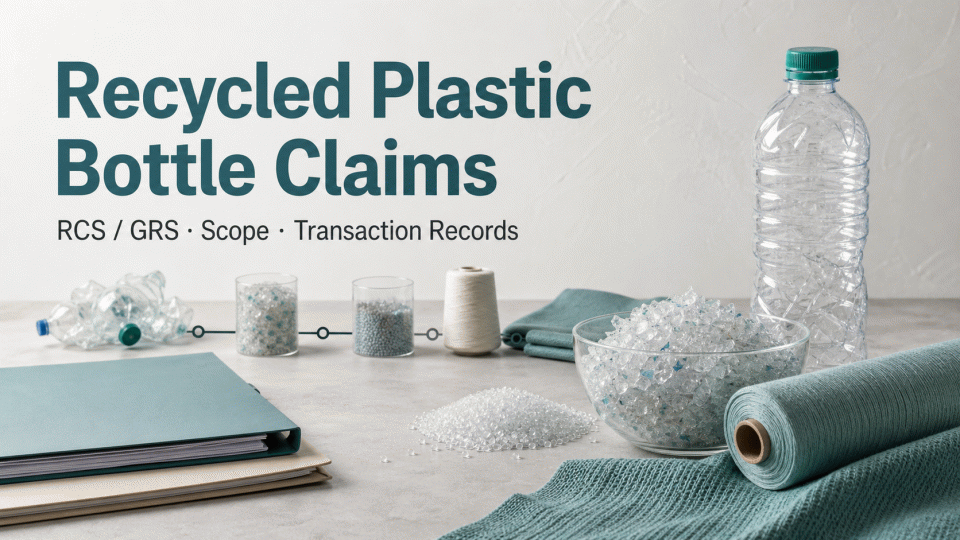
If a product or yarn is described as using recycled plastic bottles, the claim should not rest on a supplier statement alone. Review the source material, certified entity, product scope and transaction records as one evidence chain. RCS and GRS are voluntary Textile Exchange standards; they are not a universal customs, marketplace or market-entry approval.
1. What RCS and GRS cover
RCS (Recycled Claim Standard) verifies and tracks recycled input and chain of custody. It focuses on whether the recycled material meets the applicable definition and whether its movement through the supply chain is documented. RCS does not by itself cover social, environmental or chemical management at processing sites.
GRS (Global Recycled Standard) also covers recycled input and chain of custody, and adds social, environmental and chemical requirements for processing. It should not be presented as a generic “green certification”; the applicable scope remains the scope stated in the certificate and standard documents.
Neither standard is a one-size-fits-all document for every product, site or market. Match the legal entity or site, product group, material scope and current status to the actual supply chain.
2. Build a product-to-evidence register
For each SKU or shipment, retain at least:
- Material description: recycled polyester flakes, pellets, yarn, fabric or a garment component. Do not expand “contains recycled material” into “the whole product is made from bottles.”
- Source and conversion steps: record the relevant recycling, processing and transfer stages, supported where applicable by purchase orders, invoices and shipping records.
- Certificate details: verify the certified entity, standard (RCS or GRS), certificate number, product/material scope, site and current status.
- Transaction records: retain the applicable Scope Certificate, Transaction Certificate and other records required by the standard; a document title is not a substitute for checking its scope.
- Page and packaging wording: align product pages, hangtags, packaging and buyer materials with the verified material facts and claim permissions.
3. Do not treat Scope and Transaction Certificates as interchangeable
A Scope Certificate describes the certified activities and scope of an organization or site, including relevant products, materials and processing. It does not alone prove that a particular shipment moved through the chain from supplier to buyer. A Transaction Certificate records a particular transaction or shipment and must still be read alongside the product description, quantities, dates, parties and applicable standard.
After receiving a supplier certificate, check whether the named entity is the actual trading party, whether the product description covers the SKU, whether the material is the same, whether the transaction record connects to the order or shipment, and whether the proposed claim stays within the documents.
4. Common wording errors
Turning source into a percentage. “Recycled plastic bottle source” does not automatically establish a fixed recycled-content percentage. Any percentage needs matching product records and standard evidence.
Using RCS and GRS as synonyms. Their coverage is different. A supplier’s reference to “GRS material” does not remove the need to check the actual certificates and transaction records, and RCS tracking should not be described as all GRS processing requirements.
Turning a standard claim into a compliance outcome. RCS/GRS evidence does not replace product safety, labeling, packaging or marketplace requirements in a target market. Describe only verified material and standard facts; do not promise approval, a green label, continued listing or a regulatory result.
Skipping claims and label review. Consumer-facing standard names, labels and marks must follow current Textile Exchange claims and labeling rules and the certification body’s requirements. Where that review is incomplete, use a precise, limited material description.
5. Final manual review
- Map the relationship between the bottle source, recycled polymer, yarn/fabric and finished SKU.
- Read each certificate and transaction record; check entity, site, product scope, standard name and status.
- Compare every material statement on the page, hangtag, packaging and buyer quote with the evidence register.
- Keep RCS/GRS evidence separate from other market or platform requirements; one certificate does not replace another requirement.
Sources and scope note
This reference uses Textile Exchange’s RCS/GRS overview, RCS FAQ, GRS FAQ and publicly available claims-policy materials. Standards, claims and labeling requirements may change; confirm the current documents, certification-body requirements and transaction evidence before use.
绿色方舟(深圳)认证有限公司 can help organize evidence by product, entity and transaction record. Whether a specific claim is appropriate still depends on the actual evidence and applicable rules.


