
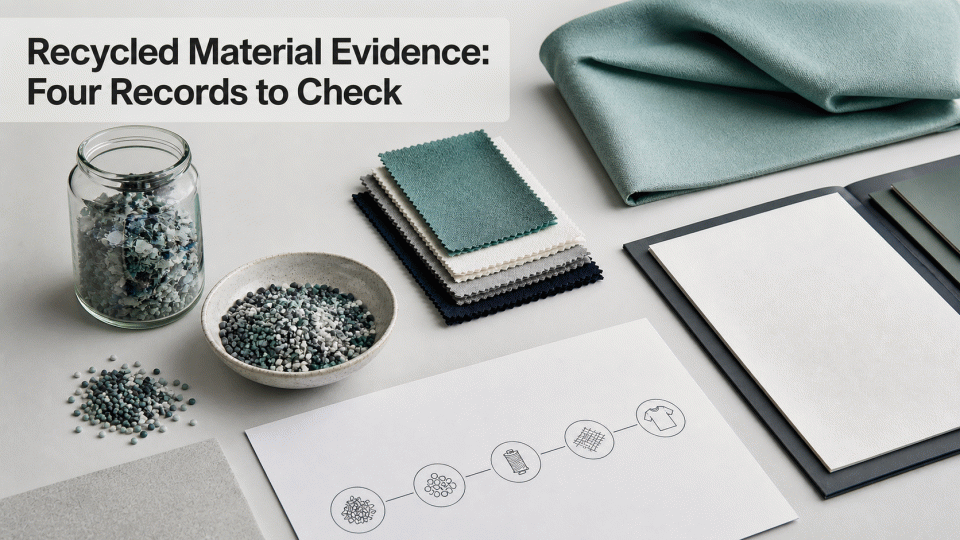
A recycled-material claim is only as useful as the evidence behind the specific product, material and supply-chain step it describes. Using Textile Exchange’s Recycled Claim Standard (RCS) and Global Recycled Standard (GRS) as examples, this guide sets out a practical evidence review for product records and web copy.
1. Define the product and material scope
Start a product-to-material register covering the SKU, product name, material, recycled input type, supplier, production site, finished form and intended standard. Bags, footwear components, apparel fabrics, plastic parts and packaging cannot be treated as interchangeable simply because they share a brand or factory.
Separate the components within the claim scope from those outside it. Fabric, thread, filling, coating, trims and packaging may come from different supply chains. If a page says that a product contains recycled material, the claimed component and material should be traceable back to the supporting records.
2. Evidence set one: certificate and scope
Check the certificate holder, certified site, standard name, status, product group or material scope, certification body and validity information. Match the legal entity and site to the contract, purchasing records, production step and product page; a certificate title alone is not enough.
RCS focuses on recycled input and chain of custody. GRS adds social, environmental and chemical requirements for processing. Textile Exchange’s public FAQ also distinguishes recycled-content thresholds by use: RCS is intended for products containing at least 5% recycled material; GRS has a 20% standard threshold, while consumer-facing GRS product labeling has a 50% threshold. Treat these as current standard guidance, not as a blanket conclusion for every product or claim.
3. Evidence set two: transaction records and chain of custody
Keep purchase orders, invoices, delivery or transport records, batch or quantity records, production issue records and finished-goods dispatch records in one chain. Where applicable, check whether the Scope Certificate and Transaction Certificate cover the relevant transaction, material, quantity, parties and date. A supplier’s general certificate is not a substitute for transaction evidence.
For mixing, loss, conversion or multiple sites, retain the calculation basis and revision history. Link material lots to product lots and to the wording used on the page. If the evidence is narrower than the proposed claim, narrow the wording; do not use “entire range,” “100%,” or “fully traceable” to cover a missing record.
4. Evidence set three: product composition records
Prepare the product specification, BOM or formula, material supplier statement, production site and change history. For textiles, record fiber composition and component-level materials. For plastics or composite products, record the resin, components and recycled input relationship. Names, versions, SKUs and dates should reconcile with the certificate scope and transaction records.
If the page also discusses product safety, food contact, packaging or a mandatory rule in a particular market, build that evidence separately. An RCS or GRS certificate should not be presented as a substitute for those requirements.
5. Evidence set four: page wording and approval record
Before publication, version the proposed product name, material name, standard reference, content wording, certificate or label reference and scope. The statement must align with the current certificate, transaction records and Textile Exchange claims policy. If an RCS or GRS mark is used, follow the applicable labeling and claims requirements and obtain any required review or approval.
Keep a record of the page text, evidence reference, reviewer, review date and revision. Without support, broad phrases such as “certified product,” “eco-friendly product,” “fully traceable,” or “compliant with all regulations” should be replaced with a limited factual statement naming the material, standard and scope.
6. Four questions before publication
Which SKU, material and component does the page describe? Do the certificate holder, site, product group and transaction records match? Are the content wording, standard name and mark supported by the current claims policy? Which product-safety, packaging, customs, platform or buyer requirements still need separate review?


