
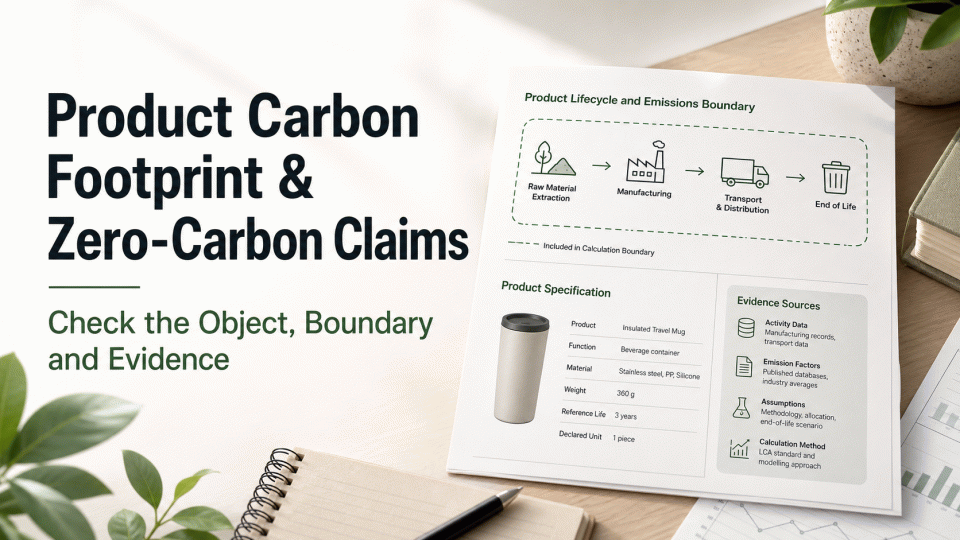
“Zero-carbon”, “low-carbon” and “carbon footprint” are not interchangeable marketing phrases. Before a product page or buyer document is published, define what the claim covers, which life-cycle stages are included, what data and method support it, and who reviewed the result. Without that evidence map, a product should not be described as zero-carbon or carbon neutral.
1. Separate the three subjects
A product carbon footprint (CFP) belongs to a defined product system and is normally expressed as carbon-dioxide equivalent. The study may cover the full life cycle, from raw-material acquisition to end of life, or a clearly labelled partial boundary. A product, an organisation, a project and an offsetting activity are different accounting subjects.
A reduction or low-carbon claim needs a comparison baseline, reference product or period, boundary and data source. “Lower than the previous version” is not the same proposition as “zero across the life cycle”; a partial result cannot silently support a broader claim.
A carbon-neutral or offsetting claim involves actions outside the product system under study. ISO 14067 does not cover offsetting or its communication. Any such claim requires separate checks of the project, quantity, timing, ownership or retirement records, and the applicable claims rules.
2. Turn the boundary into an auditable record
Create a product–claim–evidence register with at least the following fields:
Subject and functional unit: record the model, formula or material version, sales configuration and functional unit, such as one product, one packaging unit or a defined service amount. Do not mix results from different specifications.
System boundary: mark whether raw materials, manufacturing, packaging, transport, storage, use and end of life are included. Explain exclusions. A partial CFP should be labelled as partial in the title, charts and page copy.
Activity data and emission factors: retain records for material weight, energy, transport, use scenarios and waste treatment, together with the source, version, unit and geography of each emission factor. Separate supplier estimates, industry averages and measured data.
Allocation and assumptions: for shared production, co-products, recycled inputs or shared transport, record the allocation rule, alternatives and sensitivity impact. Do not retain only the most favourable result.
Data quality and review: document time, geography and technology representativeness, calculation-file versions, review comments and uncertainty. A third-party report or review statement must match the product, boundary and result; an institution name or certificate image alone is not a claim substantiation file.
3. Watch for wording that changes the claim
Writing “no emissions” when the study covers only selected stages, writing “full life cycle” for a partial CFP, or turning renewable-electricity use into “zero-carbon product” are scope jumps. A responsible page should show the subject, boundary, result unit, method or data basis, and limitations together.
“Carbon neutral”, “net zero” and “zero-carbon” may involve additional reduction pathways, removals, offsets or organisation-level commitments. Until those elements are separately checked, use narrower factual wording such as “a product carbon footprint was calculated for the stated boundary” or “the page reports an estimate for the selected life-cycle stages”.
For pages aimed at EU consumers, verify the specific legal instrument, claim category and status separately. The European Commission’s Green Claims page describes a policy direction centred on reliable, comparable and verifiable environmental information. A proposal, a voluntary label or an industry method should not be presented as a single law already applying to every product.
4. A four-step pre-publication check
Step 1 — Lock the subject. Put the SKU, version, production site and target market on the record cover. Confirm that the result has not been replaced by organisation-level or another-product data.
Step 2 — Lock the boundary and unit. Use the same functional unit and life-cycle boundary in the body, charts, report and short page copy. Any “full life cycle” or “zero emissions” statement needs matching calculation evidence.
Step 3 — Lock the evidence chain. Trace the result to calculation files, activity data, emission factors, supplier records, transport and use assumptions. State the scope of any external review; do not turn the existence of a review into a guarantee of the result.
Step 4 — Lock the page wording. Check the subject, baseline, scope, unit, period and limitations sentence by sentence. Remove unsupported absolutes and outcome promises such as “100%”, “completely emissions-free”, “guaranteed approval” or a fixed validity period.
5. Sources and scope note
This reference is based on the public summaries of ISO 14067:2018, the GHG Protocol Product Life Cycle Accounting and Reporting Standard, and the European Commission’s Green Claims information. Standards, market laws, platform rules and buyer requirements have different scopes; verify each project against its product, market and claim type.
ISO 14067:2018 GHG Protocol Product Standard European Commission: Green claims
绿色方舟(深圳)认证有限公司 can help organise a claim register by subject, life-cycle boundary and evidence file. The final position remains dependent on the applicable standard, target-market rules and project records actually available.


