
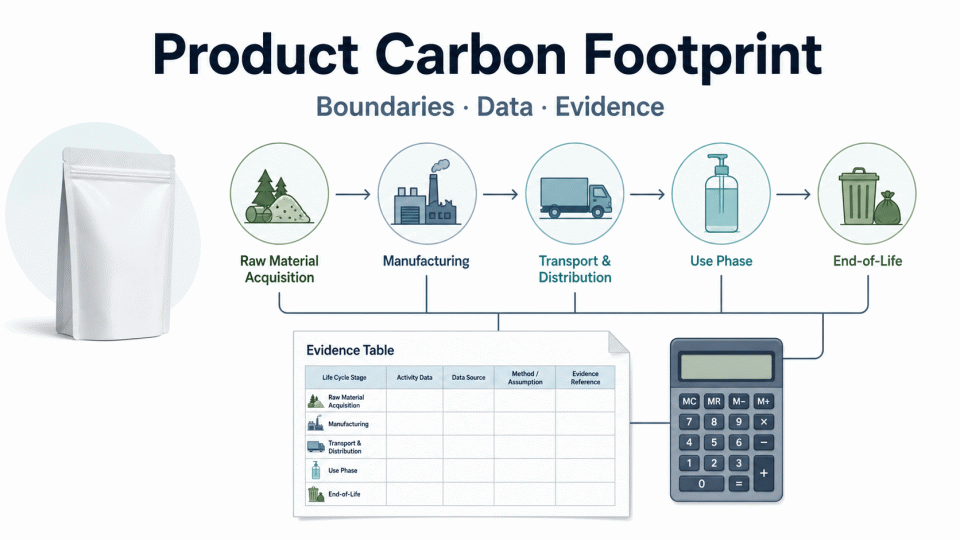
“Low carbon”, “carbon footprint” and “carbon neutral” are not interchangeable statements. Before a product page is drafted, identify whether the subject is a product, an organisation or a separate offset arrangement. Then connect the system boundary, activity data, emission factors, allocation rules and page wording. This is a documentation reference for product carbon footprint (CFP) work; it is not a finding about any SKU, certification or market outcome.
The reference uses ISO 14067:2018, the GHG Protocol Product Life Cycle Accounting and Reporting Standard, and the European Commission’s public material on environmental claims. ISO 14067 addresses the climate-change impact category for a product in a life-cycle-assessment framework. The GHG Protocol Product Standard helps users understand emissions across a product life cycle. The applicable standard, product-category rules, customer requirements and available data still determine a specific study.
1. Separate the three objects that are often mixed together
| Object | First question | Do not substitute it for |
|---|---|---|
| Product carbon footprint | What greenhouse-gas emissions or removals are associated with this product system within the defined boundary, expressed as CO₂e? | It does not automatically describe an organisation’s full inventory or every environmental impact. |
| Organisational inventory | How are emissions within the organisation’s organisational and operational boundaries classified, quantified and reported? | It does not automatically prove the CFP of a particular SKU. |
| Offset or carbon-neutral arrangement | Is there a separate activity outside the product system, and what scope and evidence support that statement? | An offset record should not be rewritten as “the product has no emissions”. |
2. Put the boundary in the first evidence table
A life-cycle boundary may cover raw-material acquisition, manufacturing, transport, use and end-of-life, or it may cover only selected stages for a defined purpose. A partial CFP is not the same as a full life-cycle result. State the start point, end point, exclusions and functional unit. “Full life cycle” or “carbon footprint completed” is too vague when the model, quantity, geography, period and included stages are not stated.
| Boundary field | Record | Page readback |
|---|---|---|
| Study subject | Product name, model/version, functional unit, quantity or use basis | Does the claim refer to the same product as the study? |
| Life-cycle stages | Materials, manufacturing, packaging, transport, use and end-of-life as applicable | Does “full life cycle” or “factory gate” match the documented boundary? |
| Geography and period | Suppliers, sites, energy mix, routes, data year and data version | Has old or unrelated data been presented as a current SKU fact? |
| Allocation and exclusions | Co-products, shared production, recycled inputs, waste treatment and exclusion reasons | Are assumptions that affect a comparison disclosed? |
3. Map data, method and evidence
A result does not arise automatically from a supplier statement or a generic certificate. Link each activity datum to its source, unit, period, emission factor, calculation method and product version. Mark estimates, proxies and uncertainty. A laboratory report, organisational certificate or material statement can be part of the evidence only when its subject, scope, date and quantity match the study.
- Product and functional unit: lock the SKU, specifications, composition, packaging and use assumptions.
- Activity data: collect applicable material mass, energy, output, transport, use-energy and end-of-life data.
- Data sources: record the supplier or site, boundary, period, source file and data-quality limits.
- Calculation method: record emission-factor sources, global-warming-potential version, allocation, conversion and rounding.
- Review and interpretation: document sensitive parameters, estimates, comparison baselines and open evidence gaps.
4. Match page wording to the strength of the evidence
The European Commission links credible environmental claims with methods that are substantiated, comparable and transparent. Its public material uses examples such as a product with a stated share of recycled plastic and a reduction compared with a baseline year. That policy material is not case-specific legal advice; an exporting team should still check the current rules of the target market.
| Page wording | It should point back to | Higher-risk replacement |
|---|---|---|
| “The partial CFP of model X is … kg CO₂e per functional unit.” | Subject, functional unit, boundary, period, method and result record | “Full-life-cycle zero carbon” or “naturally low carbon” |
| “Under this boundary, manufacturing contributes … of the result.” | Stage definition, denominator, allocation rule, calculation version and evidence | A percentage with no scope or baseline |
| “Product data collection is in progress.” | Completed stages, open data items and the internal version record | “Certified” or “guaranteed to pass” |
A CFP focuses on the climate-change impact category. It does not automatically cover water, toxicity, biodiversity, resource use or social impacts. Broader terms such as “green”, “eco-friendly” or “sustainable” require their own evidence and market-rule review; they should not be inferred from one CFP number.
5. Six pre-release readback checks
- Do the title, H1, summary and cover identify a product-carbon-footprint evidence review rather than a broad green result?
- Do the product model, functional unit, boundary, geography and data period match the underlying record?
- Can every important number be traced to a data source, emission factor, method version and calculation record?
- Do “reduced”, “lower” or “carbon neutral” statements identify the baseline, scope and any separate offset arrangement?
- Is the English page independently localised, with no Chinese residue, template heading or unsupported promise?
- Are missing records kept as open review items rather than rewritten as approval, certification or platform outcomes?
6. Scope note and official references
- ISO 14067:2018 — principles, requirements and guidance for quantifying and reporting a product carbon footprint.
- GHG Protocol Product Standard — a framework for understanding product life-cycle emissions and reduction opportunities.
- European Commission — Green claims — public policy material on substantiated, comparable and transparent environmental claims.
Greenark Certification (Shenzhen) Co., Ltd. recommends locking the product and boundary first, then building the data ledger, method record and page readback. This page does not replace target-market legal advice, product-category rules, independent review or a project-specific quantification study. Unsupported figures and conclusions should remain open review items.


