
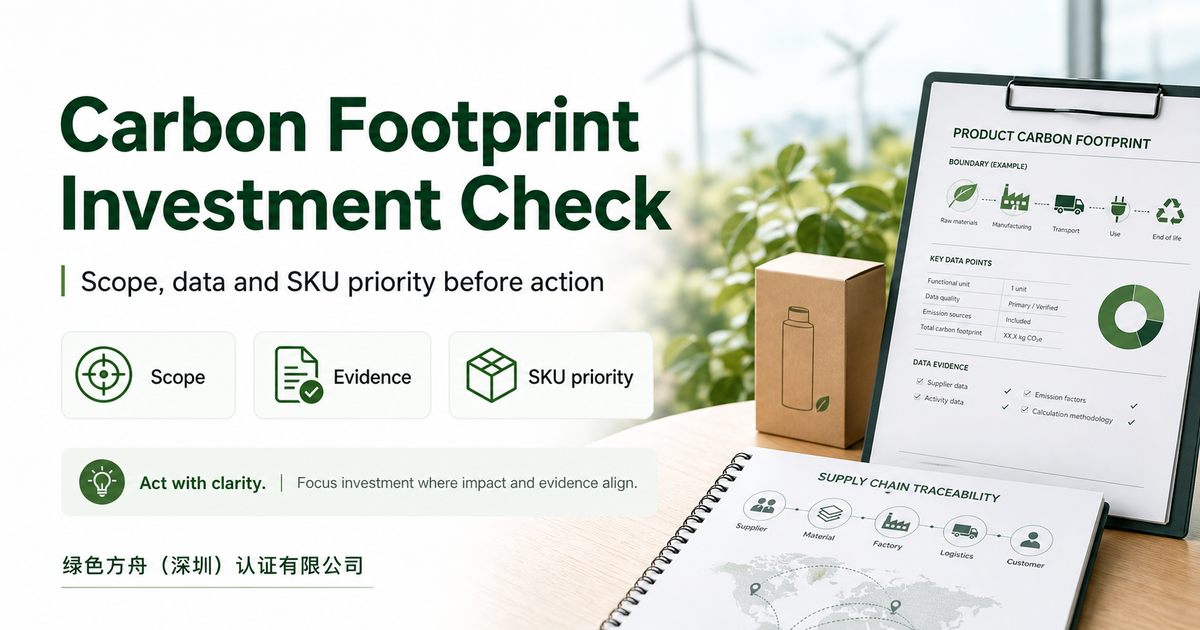
A product carbon footprint is not a supplier spreadsheet converted into one impressive number. Before starting the calculation, define the product, functional unit, system boundary, data sources, and accounting method, then decide which SKUs are ready for investment. This page is a preparation and evidence framework; it does not replace an applicable standard, customer rule, or market-specific requirement.
1. Separate a Product Footprint from Other Assessments
A product carbon footprint (CFP) concerns greenhouse-gas emissions and removals within an agreed product-system boundary, expressed as carbon-dioxide equivalents. ISO 14067:2018 sets principles, requirements, and guidance for quantifying and reporting a CFP or partial CFP in a life-cycle-assessment context. It addresses the climate-change impact category only; it is not a complete assessment of environmental or social performance.
The GHG Protocol Product Standard helps organisations understand emissions across a product life cycle, including raw materials, manufacturing, transport, storage, use, and disposal. Corporate inventories, value-chain inventories, product carbon footprints, and the European Commission’s Product Environmental Footprint method may use related life-cycle data, but their purposes, boundaries, impact categories, and reporting rules differ. One result should not be presented as another type of claim.
2. Put Five Boundary Fields in the Investment Table
Product and functional unit: Record the brand, model, version, materials or formulation, packaging configuration, and target market. State the functional unit, such as one product or a defined service delivered by the product. Without a clear functional unit, the result is difficult to interpret or compare.
Life-cycle boundary: State whether the study covers raw materials to factory gate, delivery to a warehouse, or the full life cycle through use and end of life. Document whether transport, energy, losses, packaging, and end-of-life treatment are included. A partial footprint must not be presented as a full life-cycle result.
Emissions and removals: List activity data and emission-factor sources for materials, energy, processes, transport, use, and end of life. If biogenic carbon, removals, or offsets are discussed, record their definitions, calculation treatment, and evidence separately. A CFP does not automatically mean carbon neutrality.
Data quality: For each data point, record the supplier, site, batch, or database source; time period; geography; technological representativeness; completeness; and uncertainty. A supplier estimate may be a provisional input, but it should not be described as measured or verified without support.
Method and review: Confirm the applicable standard, product-category rule, or customer method before fixing the calculation version, allocation principles, emission-factor version, assumptions, and sensitivity approach. If the result will be published, separately confirm whether independent verification, critical review, or a prescribed format is required.
3. Prioritise SKUs by Readiness, Not by Label
A SKU assessment table should include at least the model and version, BOM or key materials, production site, energy data, transport route, packaging, use-stage assumptions, end-of-life scenario, data sources, gaps, intended use, and owner. Priority should reflect a stable scope, traceable data, a defined use, and a result that can be explained—not whether a product has obtained a certificate.
Split products where materials, formulations, processes, factories, or packaging differ materially. Products under one brand cannot share a result merely because their names look similar. If similar SKUs are combined or sampled, document the representativeness rationale, coverage, and limits on extrapolation.
A practical triage has three levels: projects with an undefined scope or use need definition first; projects with core activity data but material gaps need a data plan and sensitivity analysis; projects with a stable boundary and adequate evidence can move to calculation, reporting, or verification planning. This is a project-management tool, not a prediction of any product result.
4. Turn Supply-Chain Files into Traceable Evidence
Organise the evidence in four layers: product files (specifications, BOM, functional unit, and version changes); factory files (output, energy, processes, and site); logistics and packaging files (material weights, transport modes, distances, and loss assumptions); and method files (boundary, emission factors, allocation, calculation workbook, versions, and review notes). Bind each file to a product, site, period, and source instead of retaining an unexplained total.
When supplier data arrives, check units, period, production denominator, material and energy coverage, site, estimation method, and supporting records. Keep an open-issue and follow-up log for gaps. A platform template, test report, or unrelated certificate is not a substitute for the life-cycle data needed for a product carbon footprint.
5. Match Public Wording to the Result Boundary
“A product carbon footprint has been calculated,” “verified,” “lower-carbon,” and “emissions were reduced by…” require different results, comparison baselines, methods, and evidence. Public wording should identify the subject, functional unit, system boundary, data period, method or standard, limitations, and verification status. A single number or green visual cannot carry that meaning on its own.
If the study covers only raw materials to factory gate, call it a partial CFP and state what is excluded. Comparisons require compatible functional units, boundaries, data quality, and methods. Under ISO 14067, carbon offsetting and communication of CFP information are outside the standard’s quantification scope; having CFP data therefore does not by itself prove an offset, carbon-neutral, or environmentally superior claim.
6. Minimum Pre-Submission Checklist
Before submission or publication, confirm that the product and version are unique; the functional unit and life-cycle boundary are explicit; activity data and emission factors are traceable; supplier estimates and database data are labelled; allocations, assumptions, and uncertainty are recorded; the required review or verification has occurred; and the public wording matches the coverage, method, and evidence. 绿色方舟(深圳)认证有限公司 can review the applicable scope against project materials, but this framework is not a project conclusion.
Sources
GHG Protocol, Product Standard; ISO 14067:2018, Greenhouse gases — Carbon footprint of products; and the European Commission’s Environmental Footprint methods. Always use the version, product-category rules, and project terms applicable to the study.


