
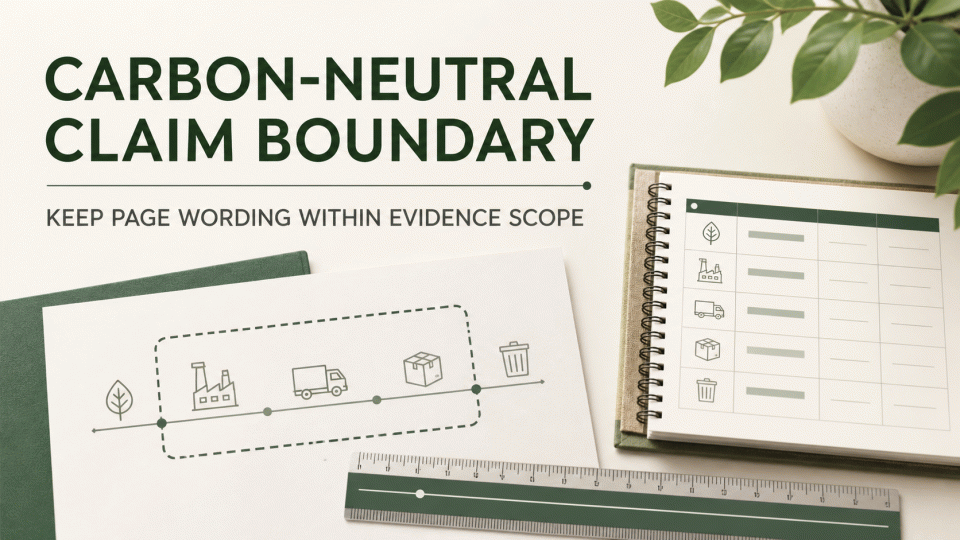
“Carbon neutral” is not established by placing one partial document on a product page. For a named entity, product, or service, the claim needs a defined boundary and period, quantified greenhouse-gas emissions, described reduction actions, and separately documented information about any treatment of residual emissions. This is a documentation reference, not a certification-body, regulator, or marketplace decision, and it does not promise an outcome.
1. Define the subject and boundary
State what the claim covers: a company, facility, brand, specific product, service, or event. Record the target market, claim period, model or SKU, life-cycle stages, and whether raw materials, manufacturing, transport, use, and end of life are included. An organisational inventory is not automatically evidence that a product is carbon neutral, and a product footprint is not automatically evidence for the whole company.
Comparative wording such as “lower carbon” also needs a consistent functional unit, system boundary, data quality, and comparison method. The GHG Protocol Product Standard helps users understand product life-cycle emissions and reduction opportunities; it is not, by itself, a complete framework for carbon-offset or carbon-neutral claims.
2. Build the emissions quantification trail
Keep a data-to-result record for each source: activity data and units, period, supplier or internal source, emission factor and version, formula, allocation method, assumptions, and uncertainty. Depending on the subject, review raw materials, production, energy, transport, storage, use, and end-of-life stages rather than relying on a single supplier statement.
Each file should reconcile to the relevant entity, facility, product version, batch, or period. Mark primary data, estimates, and database data separately. “A document exists” does not mean that all emissions are covered; unsupported percentages, boundaries, or reductions should not become page conclusions.
3. Separate reductions, offsets, and removals
Following the hierarchy described by ISO 14068-1:2023, document direct and value-chain reduction actions and their progress before separately recording information used to address residual emissions. Project identity, quantity, vintage, ownership, retirement or use status, standard, and registry details should match the claim subject and period.
“Supporting climate action,” “making a contribution,” and “this product is carbon neutral” are different statements. The page should explain the subject, emissions boundary, accounting method, reduction information, and the role of any offset or removal. Do not replace evidence with broad terms such as “zero emissions” or “no environmental impact.”
4. Make every page sentence traceable
Maintain a claim register containing the exact page wording, subject, market, period, boundary, supporting file, file version, review status, owner, and review date. Product name, model, quantity, period, unit, and figures should reconcile. If evidence covers only a component or life-cycle stage, keep that limitation in the wording.
For voluntary environmental claims directed at EU consumers, check the applicable consumer-protection and environmental-claim rules. European Commission materials describe the need for reliable, comparable, and verifiable substantiation; the legal status, scope, and national implementation of proposals or rules must be checked against current official information for the target market rather than presented as one global requirement.
5. Manual pre-publication checklist
□ The subject, market, period, and life-cycle boundary are clear; □ emissions data, factors, calculations, and assumptions are traceable; □ product and organisational accounting are not conflated; □ reductions, offsets, removals, and contribution claims are separated; □ figures, units, models, and file versions reconcile; □ the page does not expand the evidence with absolute wording; □ cited standards, rules, and project status are checked for the target market; □ the published version matches the manually reviewed version.
绿色方舟(深圳)认证有限公司 may support document organisation, claim-to-evidence mapping, and gap identification, but it does not replace a certification body, verifier, regulator, or marketplace decision. Sources: the GHG Protocol Product Life Cycle Accounting and Reporting Standard; ISO 14068-1:2023; and European Commission Green Claims materials.


