
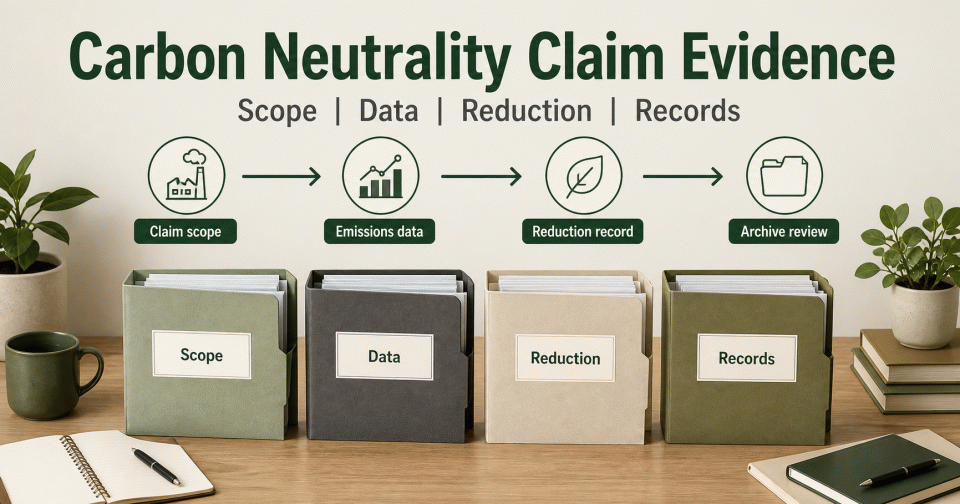
A carbon neutrality claim is not established by placing the words “carbon neutral” on a page. The evidence file should define the claim subject, accounting boundary, and reporting period, then connect emissions data, reduction actions, treatment of residual emissions, and the wording shown to readers.
1. Define the claim subject and boundary first
Start by stating what the claim refers to: an organisation, product, service, activity, or period of emissions. For a product claim, record the model, functional unit, life-cycle stages, geography, data year, and allocation method. For an organisational claim, define the organisational and operational boundaries and the reporting period.
Without a clear boundary, supplier materials, a product carbon footprint, and an organisational inventory can be incorrectly treated as the same evidence. The GHG Protocol Product Standard helps users understand emissions across a product life cycle; it does not by itself replace an organisational inventory or prove a carbon neutrality conclusion.
2. Keep emissions data and calculation methods together
The evidence register should identify activity data, emission factors, data sources, units, coverage period, estimation methods, allocation rules, and version history. Each entry should lead back to source records such as energy bills, purchasing or transport records, production data, supplier data, laboratory material, or life-cycle assessment files.
For a product claim, explain which life-cycle stages are included and which are outside the assessment. For an organisational claim, explain how direct emissions, purchased-energy indirect emissions, and relevant value-chain emissions are treated. A supplier certificate or a single test report is not a substitute for the applicable emissions accounting.
3. Document reduction before residual-emissions treatment
Keep reduction targets, actions, owners, implementation periods, baseline or comparison basis, and review records distinct from one another. ISO 14068-1:2023 addresses quantification, reduction, and the demonstration of carbon neutrality, with reductions within the value chain taking priority over offsetting in the hierarchy described by the standard.
The page should distinguish between quantified, ongoing, planned, and completed actions, and should state which residual emissions the claim covers. If offsets or removals are used, record the project scope, quantity, timing, ownership or retirement status, and applicable verification documents. Do not present a plan as an achieved outcome when the supporting records are not available.
4. Map every claim sentence to evidence
Create a claim-to-evidence table with the claim, evidence file, scope, date, and owner. For every important term, the reviewer should be able to answer who makes the claim, what it covers, which method supports it, which period the data represents, where the evidence is stored, and what limitations should be disclosed.
Terms such as “lower carbon,” “reduced emissions,” and “carbon neutral” should not omit the comparison basis, boundary, or treatment of residual emissions. The European Commission’s green-claims materials describe the need for robust, science-based, and verifiable substantiation, and distinguish implemented rules from policy proposals. Requirements should be checked separately for each target market; a proposal or an internal policy should not be presented as a universal legal conclusion.
5. Pre-publication evidence checklist
- Claim subject, functional unit or organisational boundary, geography, and reporting period.
- Emissions sources, activity data, emission factors, calculations, and version history.
- Reduction actions, baseline or comparison basis, implementation evidence, and review record.
- Residual-emissions treatment, relevant project or certificate records, and applicable verification material.
- Final page wording, limitations, evidence index, and approval record.
绿色方舟(深圳)认证有限公司 recommends completing the evidence register before choosing the environmental wording for a page. The register connects scope, data, calculations, reductions, and records; it is not itself a certification, regulatory approval, or guarantee of a market outcome.


