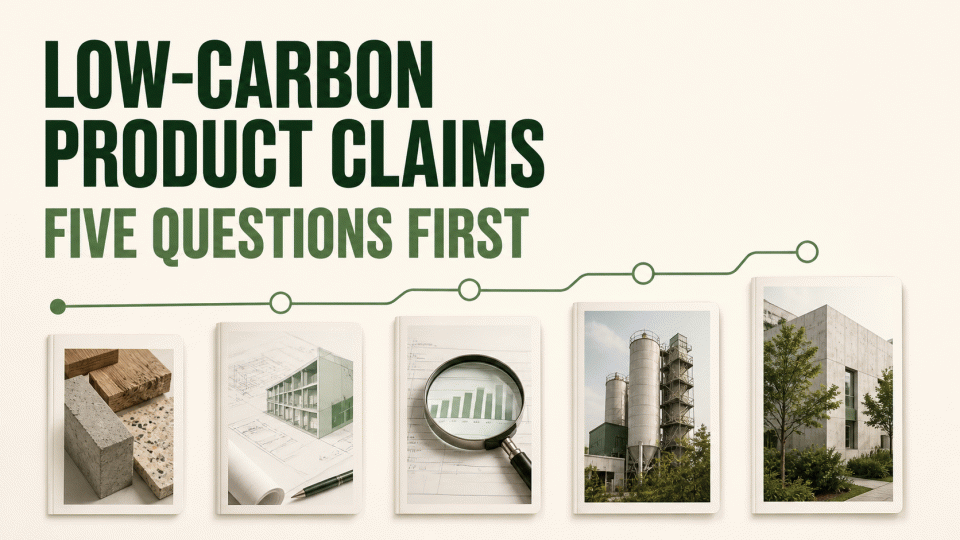
“Low-carbon product” is not established by one material record or one image. Before preparing an environmental statement, align the product, system boundary, data, evidence owners and wording. This article is a practical evidence checklist, not a substitute for the standards, laws or professional review applicable to a specific project.
1. Which product and which claim are you making?
Record the product name, model or SKU, functional unit, target market and exact claim. “Low carbon,” a product carbon footprint, a lower emission stage, and recycled-material content describe different evidence questions. A broad statement that a product is “better for the environment” does not automatically mean that its greenhouse-gas emissions are lower.
If the claim covers packaging, an input material or only one life-cycle stage, label that scope clearly. A partial carbon footprint should not be presented as a full product life-cycle conclusion.
2. Have the system boundary and functional unit been defined?
Following the logic of the GHG Protocol Product Standard and ISO 14067:2018, define which stages are included: raw-material acquisition, manufacturing, transport, use and end of life. Record the functional unit, time period, geography, allocation approach and exclusions.
Changing the boundary can change the result and its comparability. Factory-gate data should not be described as a full life-cycle result, and values based on different functional units should not be compared without an explained method.
3. Can each material data point be traced to a source?
Maintain a data ledger with the data item, value, unit, period, source, owner and calculation step. Identify whether energy, material, transport, use or end-of-life data are measured, supplier-provided, taken from a database factor or estimated. Keep the relevant version and assumptions.
Gaps can be documented as assumptions or uncertainty, but an estimate should not be presented as a measurement. A single supplier statement is not, by itself, evidence for the emissions of the complete product system.
4. Do the evidence owners and calculation method match?
Map each evidence type to its owner: factory energy records, supplier material data, logistics documents, product specifications, measurements and calculation files. The records should identify the same product, period and boundary. A standard can provide a method framework; it does not mean that this product has been certified or verified.
When using ISO 14067, the GHG Protocol or another method, record the version, scope and treatment of deviations. ISO 14067 addresses quantification and reporting for the climate-change impact category of a product; it does not automatically cover every environmental impact or establish a claim about offsets or communication results.
5. Can every sentence on the page be supported?
Break the copy into a claim register: wording, object, comparison baseline, boundary, evidence file, effective period and reviewer. Use qualified wording such as “calculated for the stated boundary under the stated method” only where the evidence supports it. Avoid broad phrases such as “zero carbon,” “completely sustainable” or “guaranteed compliant” without a specific, current basis.
For consumer-facing claims in the EU, separately check the product and consumer-protection rules currently applicable to the target market. The European Commission’s Green Claims page describes the need for robust, science-based and verifiable support; policy or proposal information on that page does not replace a current legal review for a particular product.
Minimum fields for the evidence sheet
- Product name, model, functional unit, target market and exact claim;
- Life-cycle boundary, period, geography, allocation and exclusions;
- Material, energy, transport, use and end-of-life data with source versions;
- Calculation file, assumptions, uncertainty, review record and change history;
- Page location, comparison baseline, limitations and evidence index.
Sources and scope note
Method references: GHG Protocol Product Standard, ISO 14067:2018, and the European Commission Green Claims overview. They frame the accounting, evidence and communication boundaries; each product still requires a separate review against its actual data, applicable standards and target market.