
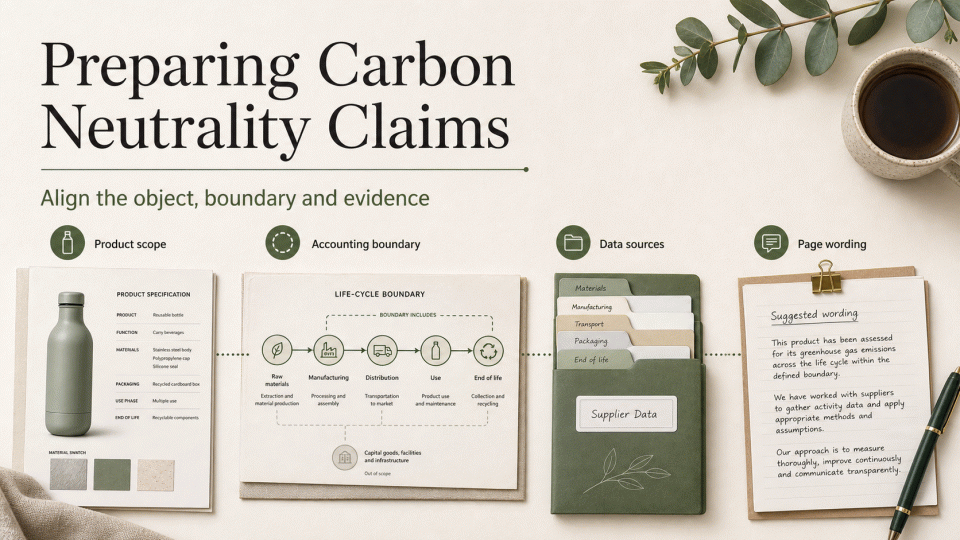
“Carbon neutral” and “low-carbon” are not conclusions that can be detached from the product, organisation and accounting method behind them. Before publishing a claim, define the claim object, accounting boundary, functional unit, data sources, and treatment of reductions, removals or offsets. Then test whether the wording is supported by the file.
1. Identify the subject of the claim
A company may deal with product carbon footprints, an organisational greenhouse-gas inventory, project reductions, and offset or removal arrangements. These are different subjects. A product claim should identify the product, model or product system; an organisational claim should state the organisational boundary and reporting period; an offset or removal statement needs its own project, quantity, timing and evidence. Corporate data should not be rewritten as a conclusion for every SKU, and a product footprint report should not be presented as proof that the whole company is carbon neutral.
Start a four-column register: claim object, responsible entity, covered product or organisation, and target market. Where a page serves more than one market, record additional rules for environmental claims, labels and verification instead of implying that one sentence is universally applicable.
2. State the accounting boundary and method
A product footprint should explain its life-cycle boundary: whether raw materials, manufacturing, transport, use and end of life are included, and why any stage is excluded. ISO 14067:2018 addresses quantification and reporting of a product carbon footprint and also recognises partial footprints. The GHG Protocol Product Standard is likewise designed for emissions and removals associated with a specific product across its life cycle. Different boundaries, functional units, allocation rules and emission-factor versions can produce different results, so a number without its method is incomplete.
“Carbon neutral” also involves the relationship among reductions, residual emissions and any offset or removal arrangement. A product-footprint calculation is not itself an offset and does not automatically establish a carbon-neutral claim. Keep the calculated footprint, reduction actions, residual-emissions treatment and claim wording as separate entries in the evidence file.
3. Build a traceable data and evidence index
Use the SKU or product system as the working unit. Retain the bill of materials, material weights, energy and process records, transport assumptions, packaging, use and end-of-life assumptions, supplier data, emission-factor versions and calculation files. Mark each input with its source, period, unit, owner and scope. Estimated data, industry averages and primary supplier data should not be presented as if they had the same evidentiary status.
Create an index linking each claim to its data, method, document and reviewer. Reports, invoices, purchasing records, production records and calculation sheets should reconcile to the same product, batch or period. If the data covers only one material, facility or packaging component, the page wording should stay within that boundary rather than becoming a product-wide or brand-wide conclusion.
4. Match page wording to evidence strength
Useful wording can state the covered stages, functional unit, data sources, exclusions and reporting period. A comparative claim should identify the comparator, baseline, method and whether the data is comparable. Words such as “reduced,” “lower,” “net zero” and “carbon neutral” require a separate evidence check for the relevant method and target market; a percentage or diagram should not create certainty that the underlying file cannot support.
Do not write that every SKU is carbon neutral, that a certificate automatically secures marketplace or regulatory recognition, that a submission will necessarily pass, or that one material record proves a complete life-cycle improvement. The European Commission’s green-claims materials describe the need for reliable, verifiable support for environmental claims; they do not by themselves decide whether a particular product claim is lawful in every market.
5. Manual review before publication
Check: (1) claim object and responsible entity; (2) product, SKU, batch or organisational boundary; (3) functional unit and life-cycle stages; (4) primary data, emission factors and calculation version; (5) exclusions, allocation rules and uncertainty; (6) reductions, offsets and removals kept distinct; (7) comparative or absolute wording supported by the file; and (8) whether page, packaging and label wording exceeds the accounting scope.
This article is a file-and-wording review framework, not a certification, verification or legal opinion. Whether a claim can be used depends on the applicable standards, target-market rules, accounting file, verification opinion and actual product scope. 绿色方舟(深圳)认证有限公司 can help map products, data, methods and page wording, but it does not replace a standard owner, verifier or authority’s decision.
Sources
GHG Protocol: Product Life Cycle Accounting and Reporting Standard; ISO 14067:2018: Greenhouse gases — Carbon footprint of products; European Commission: Green claims. Check the applicable versions and market requirements before use.


