
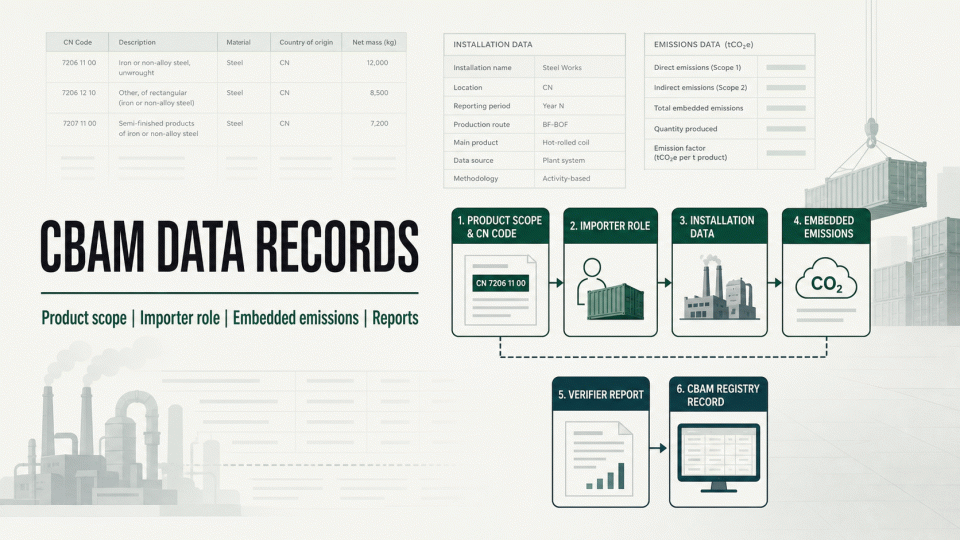
CBAM preparation starts by confirming whether a specific imported good falls within the applicable scope. The record set should then connect the declarant, quantity, country of origin, producing installation and embedded-emissions data. This page is a documentation framework for internal review; it does not replace the applicable EU rules, customs decisions or advice for a particular shipment.
Confirm the goods and the responsible role
CBAM scope is determined by the goods listed in the relevant legislation and annexes. Keep the product description, CN code, quantity, country of origin and import records together. Do not infer scope solely from a broad sector label such as steel or aluminium.
Record the roles separately. An EU importer or an indirect customs representative may be responsible for the authorised declarant function, while a non-EU producing installation generally provides production-process and emissions information. A supplier, brand owner, importer and customs representative are not automatically the same legal entity. Names, addresses and responsibilities should be traceable across the file set.
Link each good to its producing installation
Use at least one row for each relevant goods-and-installation combination. Useful fields include the product description, CN code, quantity and unit, country of origin, installation name and location, production route, reporting period, data owner, and whether actual emissions or default values are used. For complex goods, record relevant precursor materials and their producing installations.
The table is for traceability; it is not evidence that a product has passed an approval process or will automatically clear customs. Where goods come from more than one installation, keep the sources separate. Preserve version notes when the process, inputs or measurement boundary changes.
Document the embedded-emissions method
Regulation (EU) 2023/956 sets the methods for calculating embedded emissions. The file should explain the system boundary, production process, activity data, emission factors, precursors and the basis for using actual emissions or default values. A corporate inventory, a marketing carbon-footprint figure or an unexplained supplier estimate should not be inserted as CBAM data without establishing the relevant method and boundary.
For an actual-emissions route, retain installation data, calculation workpapers, source measurements or energy records, allocation rules and supporting evidence. For default values, record the applicable rule and version. The data owner should be able to explain how production activity becomes a value for the imported goods, rather than submitting an unsupported aggregate number.
Separate reports, verification and retention
Keep three document groups distinct: import and goods records such as quantity and origin; installation and emissions evidence such as process data, emission factors, precursors and calculations; and, where applicable, verification reports and declaration records. A verification report should point to the installation, reporting period, goods quantities, emissions method and verifier information.
The Regulation requires an authorised CBAM declarant to keep records needed to calculate embedded emissions in sufficient detail for verification and review. Apply the retention period in the rules in force for the relevant declaration, including any applicable verification report. Do not substitute generic “24-month certificate validity” language for the CBAM record-retention requirements.
Run four boundary checks before submission
- Scope: Do the product description, CN code, origin and quantity agree with customs and purchasing records?
- Roles: Are the importer, indirect customs representative, producing installation and data owner clearly identified and matched to the documents?
- Data: Can the emissions boundary, process period, units, precursors and actual/default-value route be traced?
- Version: If legislation, implementing rules, default values or registry requirements changed, is the applicable version and reasoning retained?
Use the European Commission CBAM definitive-regime and CBAM Registry pages, together with Regulation (EU) 2023/956 on EUR-Lex, as the primary references. The applicable CN code, role, declaration route and verification arrangement must be checked against the rules and competent-authority requirements in force for the specific goods.


