
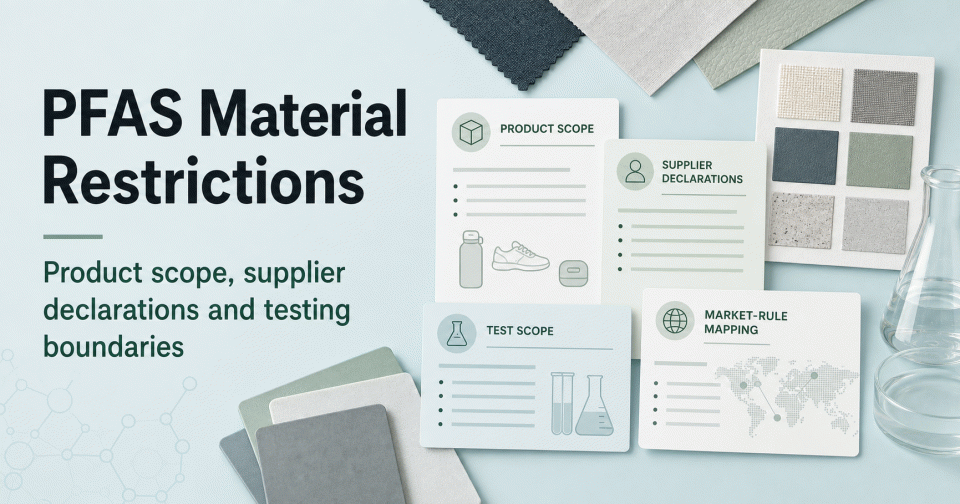
PFAS review is not a matter of applying one certificate across every product and market. Start with the product, material, and destination market, then map supplier information and test coverage to the relevant rule. This reference framework does not replace the applicable legal text, market-specific assessment, or professional advice.
1. Separate PFAS, the Product, and the Market
PFAS is a group of synthetic substances with defined fluorinated structures. Rules may be written around an individual substance, a substance group, a mixture, an article, a use, or a product category. “Not intentionally added,” “not detected for one substance,” and “meets a market rule” are different statements and should not be merged.
Create a SKU-level scope register covering the model, material or coating, formulation or component location, supplier, production batch, intended market, and rule version. Textiles, paper coatings, food-contact materials, electronics, and other categories may have different substance lists, methods, and boundaries.
2. Distinguish Current Restrictions from Proposals and Reporting
Annex I of the EU POPs Regulation contains entries and limits for certain PFOA-, PFHxS-, and related substances. These operative provisions should be recorded separately from ECHA’s broader PFAS restriction process. A restriction proposal, committee opinion, and final legal act are different stages; a proposal should not be presented as a universal restriction already applying to every product.
In the United States, TSCA Section 8(a)(7) addresses PFAS manufacturing and import reporting and recordkeeping. Its covered roles, lookback period, and data fields are not the same as a product-level substance restriction. For U.S. activity, assess the actual role and rule text before deciding whether reporting, supplier cooperation, or due-diligence records are relevant.
3. Make Supplier Declarations Traceable to the Material
A supplier declaration should identify the supplier and legal entity, material or component, product or batch scope, intended market, basis of the statement, signatory, and date. If it only says “PFAS-free” or “complies with all regulations,” request the definition, substance scope, evidence basis, and excluded uses or markets.
Link the BOM, material specification, formulation or surface-treatment information, supplier declaration, change record, and purchase batch to the SKU. A change in material, formulation, process, or production site requires a fresh applicability review rather than automatic reuse of an older declaration or report.
4. Check the Test Method and Coverage
Before testing, confirm the substance list, limit, sample part, preparation procedure, and analytical method required by the target rule. The report should identify the sample, model or batch, submitting entity, laboratory, method, result, unit, detection or quantification limit, and report date. A screen covering only part of the PFAS list does not automatically establish suitability for another list or use.
The report, material declaration, and actual product state should align. If the sample name, composition, test scope, or customer entity differs, record the gap and obtain supporting evidence instead of treating a generic report as SKU-specific proof.
5. Build a Claim-to-Evidence Index
Maintain an auditable index with the claim sentence, SKU, material component, target market, rule version, evidence file, evidence date, applicability boundary, owner, and open item. Every PFAS statement in a product page or sales document should trace back to a material record and a source text.
Use bounded language where the evidence is limited, such as: “Based on the supplier’s current declaration, no intentional addition is recorded for the listed material scope; the target-market rule, substance list, and test coverage still require review.” Do not turn a completed file set, a test, or a supplier statement into an authority approval, market-access conclusion, or outcome promise.
6. Manual Review Before Submission or Publication
Check that the product and material scope is clear; the target market and rule version are identified; current provisions are separated from proposals, guidance, and private requirements; supplier entity and SKU are linked; method and substance coverage are adequate; wording stays within the evidence; changes trigger reassessment; and the English and Chinese pages express the same boundaries. Do not publish absolute, generalized, or unsupported PFAS conclusions before this review is complete.


