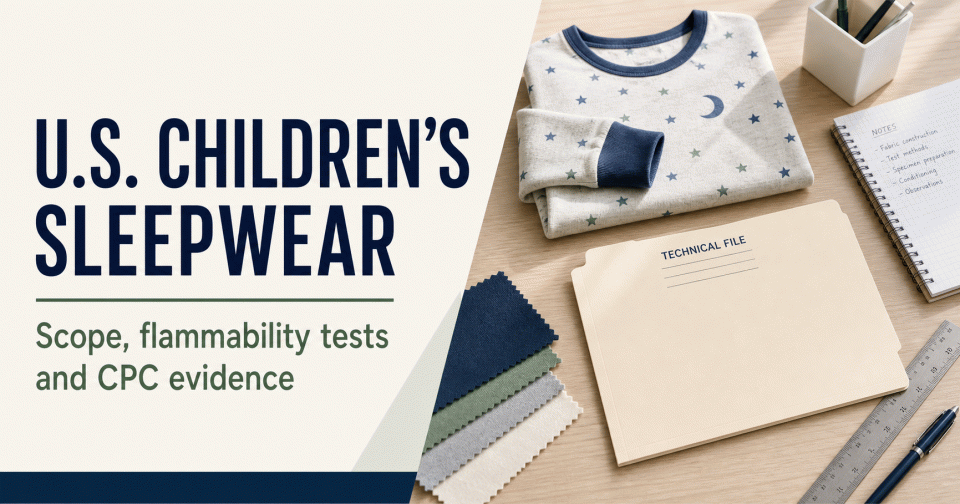
Before placing children’s sleepwear on the U.S. market, do not start by applying a generic report. First determine whether the product falls within the U.S. children’s sleepwear flammability standards. Based on public CPSC guidance on children’s sleepwear, flammability testing and Children’s Product Certificates (CPCs), this article provides a SKU-level evidence framework. It does not promise a test outcome, CPC issuance, platform display or sales result.
1. Separate children’s sleepwear from ordinary children’s apparel
CPSC’s children’s sleepwear flammability standards are codified in 16 CFR Part 1615 for the applicable 0 through 6X size range and Part 1616 for sizes 7 through 14. The product name alone is not enough; design, promotion and intended sleep use also matter. Infant garments and tight-fitting sleepwear have specific exceptions, but an exception does not remove every flammability review. CPSC materials state that some excepted products may still be subject to clothing-textile requirements such as 16 CFR Part 1610.
2. Put the product and SKU boundary in the evidence register
For each SKU, record the size range, garment design, fabric and trim, seams and decorations, page language about intended use, target market and production unit. Do not combine infant garments, tight-fitting sleepwear, loose-fitting sleepwear and ordinary loungewear into one conclusion. If the product positioning, pattern, fabric, trim, supplier or production unit changes, reassess whether the existing sample and report still represent the product.
3. What to check in flammability test records
For non-tight-fitting children’s sleepwear, reconcile the applicable standard with the required test objects and methods for fabrics, garments, prototype seams and trims. Check the sample description, model or style, fiber content, size, production unit or batch, test standard, result pages, laboratory identity and signatures. CPSC’s lab bulletin specifically warns that children’s sleepwear should not be tested under the ordinary clothing-textile standard instead of the children’s sleepwear standards; the current rule and the actual product scope determine the route.
4. A CPC is not the same as a test report
A CPC is a certificate issued by the responsible party based on the applicable rules and supporting evidence, including third-party testing where required. A supplier report on another entity’s letterhead does not automatically replace the responsible party’s certificate, and a CPC should not be marketed as a “pass certificate.” Build a mapping between the manufacturer or importer, product identity, applicable rule, testing laboratory, report number, sample and issue date. Check the current CPSC rules for the exact certificate and recordkeeping duties.
5. Keep the page, label and physical product aligned
The listing title, size, style, fiber content, sleepwear description and label information should trace to the same SKU. Do not use another product’s report merely because the page calls the item “pajamas,” and do not turn “flame resistant,” “safe” or similar wording into an unsupported outcome claim. Product artwork should not invent a CPSC mark, CPC document, laboratory seal or official endorsement.
6. Manual pre-listing review
□ Market and intended use are documented; □ size and design boundaries are recorded; □ the basis for using 16 CFR 1615/1616 or another clothing-textile requirement is documented; □ test samples, fabrics, trims and production units match the SKU; □ laboratory, standard, results and signatures are legible; □ CPC responsibility and product identity align; □ page, label, packaging and product contain no unsupported safety or outcome claims; □ a change in pattern, material, supplier or production unit triggers review.
GreenArk (Shenzhen) Certification Co., Ltd. may support product-to-test-to-CPC evidence mapping and gap identification, but it does not replace CPSC, a testing laboratory or the responsible party’s decision. Recheck current CPSC rules, official guidance and the specific product facts before use.
Sources: CPSC Flammable Fabrics Act guidance, Children’s Sleepwear Regulations, Children’s Sleepwear Lab Bulletin, CPSC Clothing FAQ, and 16 CFR Parts 1615, 1616 and 1610. This is an evidence reference, not a testing, certification or market-access conclusion.