
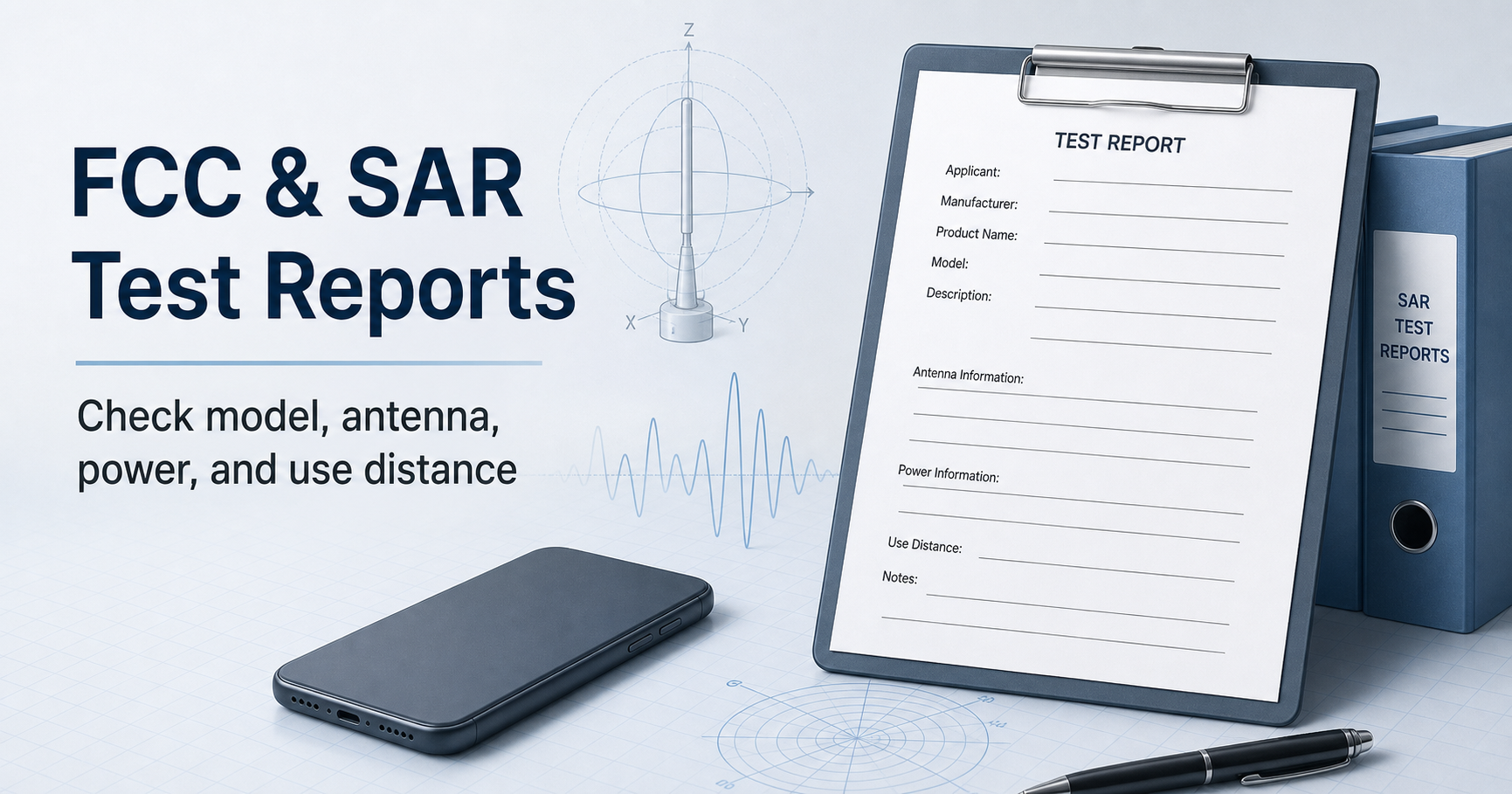
Summary: This reference helps manufacturers, brand owners, and engineering teams organize FCC equipment-authorization, RF-exposure, and SAR evidence for wireless products intended for the U.S. market. It is an evidence-review framework, not a substitute for FCC rules, applicable KDB guidance, laboratory judgment, or a device-specific engineering evaluation.
Scope note: Whether a product is treated as portable, mobile, or fixed depends on intended use, expected antenna-to-person distance, transmitter configuration, and the applicable rules. A product name or an old report is not enough to establish the classification.
1. Separate equipment authorization from SAR evidence
FCC equipment authorization addresses the applicable authorization path and technical exhibits for an RF device. SAR, or Specific Absorption Rate, is one type of RF-exposure evidence concerning localized absorption of radiofrequency energy by the body. FCC RF-exposure requirements include 47 CFR §§1.1307, 2.1091, and 2.1093; the device assessment also depends on transmitters, frequencies, power, use posture, and the authorization procedure. A SAR report does not replace the complete equipment-authorization record, and an FCC ID is not automatic proof that every model or configuration is covered.
For a device normally used within 20 cm of a person, start by documenting the basis for its portable or mobile classification. A device installed and used at a greater distance may require an MPE, or maximum permissible exposure, assessment. Changes to separation distance, installation, or accessories can change the relevance of an existing RF-exposure evaluation.
2. Map the model, antennas, and transmit configuration
Build a model-to-evidence map covering product model, FCC ID where applicable, applicant or responsible party, hardware revision, antenna model and location, antenna gain, frequency bands, bandwidth, modulation, maximum power, and simultaneous-transmission combinations. A family name, prototype name, or sales SKU should not be treated as engineering equivalence without supporting records.
For handsets, tablets, wearables, laptops, headsets, routers, and products with multiple transmitters, document the expected head, body-worn, handheld, hotspot, and simultaneous-transmission conditions. The test sample, software version, power control, and antenna state should be traceable to the configuration intended for sale.
3. Read the SAR report as an evidence record
Begin with the laboratory, report number, date, sample information, and cited standards. Then check:
- whether the test device matches the intended model, hardware revision, firmware, and transmit configuration;
- whether bands, channels, bandwidth, modulation, power settings, and power-control records are complete;
- whether head, body-worn, or other expected postures, separation distances, fixtures, and accessories match real use and the manual;
- whether tissue-equivalent materials, probe calibration, system validation, uncertainty, and scan locations are traceable;
- whether simultaneous transmission, worst-case selection, power reduction, and sample representativeness are explained;
- whether the cited rule, KDB publication, or measurement method is the version applicable to the project.
A reported value is meaningful only within its test conditions and measurement uncertainty. Do not generalize one posture, channel, or engineering sample to every product configuration, and do not replace the full report with a rewritten numerical summary.
4. Reconcile the FCC ID, exhibits, and product pages
Keep the FCC public authorization record, internal BOM, test report, user manual, label photographs, and sales-page copy in one evidence register. Check the FCC ID against applicant, model, photographs, manual, test exhibits, antenna information, and authorization status. Confirm that the product’s brand, model, and RF configuration stay within the documented authorization boundary.
Use distance, wearing instructions, antenna location, and accessory restrictions consistently across the manual and product page. A new antenna, enclosure, output-power setting, or simultaneous-transmission feature should trigger a documented change-impact review rather than automatic reuse of an older page.
5. Final record-review checklist
- Create one record for each specific model and hardware revision, with the model map and change history;
- Link each antenna, band, power, distance, posture, and simultaneous-transmission combination to its supporting evidence;
- Read the SAR report page by page and check samples, conditions, methods, accessories, and result wording for gaps or mismatches;
- Perform a final consistency check across FCC ID, label, manual, page, packaging, model, and responsible party;
- Define review triggers for hardware changes, supplier changes, firmware updates, and marketing-copy changes, and retain reviewer, date, and basis.
6. Sources and boundaries
This page uses FCC OET KDB Publication 447498 on RF exposure and equipment-authorization procedures for mobile and portable devices, 47 CFR §2.1093, and FCC public equipment-authorization and RF-exposure materials as its source basis. FCC guidance can change, so the current version and device-specific applicability should be checked before filing. 绿色方舟(深圳)认证有限公司 provides an evidence-organization and review framework; the responsible project party and appropriately qualified laboratory or authorization body must confirm testing, filing route, and technical conclusions from the complete record.


