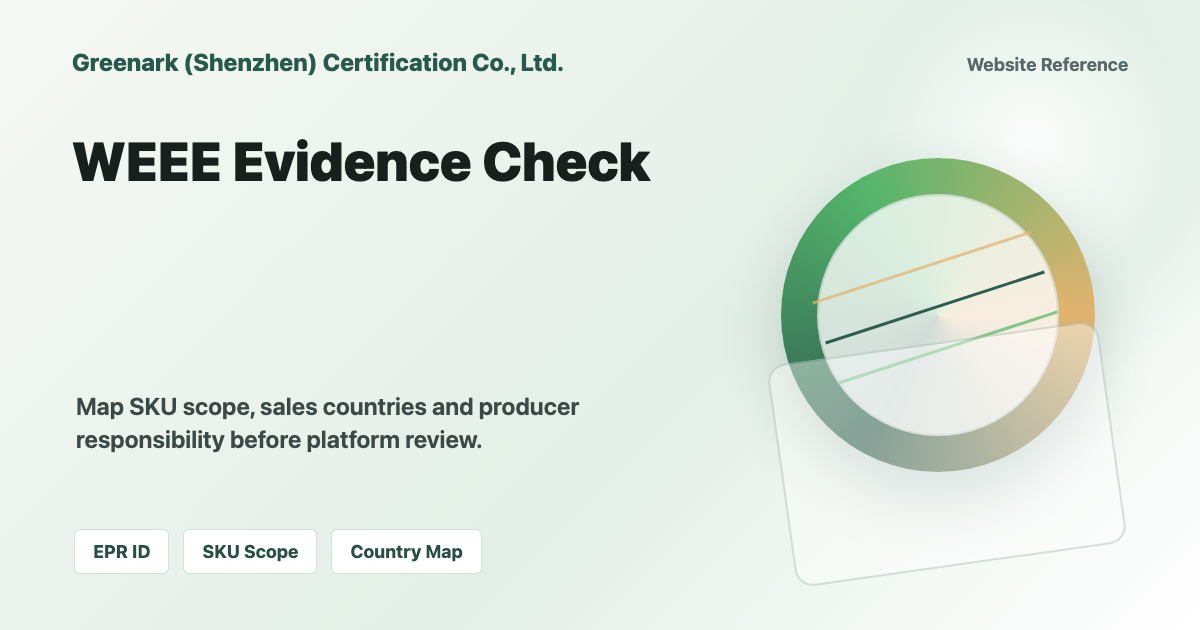
This reference is for brand owners, manufacturers, importers and distance sellers placing electrical and electronic equipment on EU markets. Start by defining whether the product is EEE, which Member States are involved, who is the producer for each route to market, and which records demonstrate fulfilment. The WEEE Directive provides an EU framework; registration, reporting, authorised-representative and take-back details must still be checked under the rules of each target Member State.
1. Separate WEEE, EEE and EPR
EEE generally relies on electric currents or electromagnetic fields, or is used to generate, transfer or measure them. WEEE is the waste arising when such equipment is discarded. EPR describes arrangements that assign responsibility for a product’s end-of-life impacts; for electrical equipment, WEEE duties are a major part of that framework, but national registration, reporting, financing and operational requirements are not identical.
Do not treat a WEEE registration, CE marking, RoHS technical documentation or battery responsibility as one universal certificate. The object, legal basis and responsible entity may differ, so keep the evidence streams separate.
2. Map scope by product, country and sales route
Create a matrix covering SKU, Member State, sales route and producer role. Record the model, brand, power dependence, power source, weight, equipment category, battery configuration and the entity that first places the product on the market in the target country. For distance sales, check the target country’s producer definition, registration route and authorised-representative requirements; a factory name or generic EU certificate is not a substitute for a country-level assessment.
Different models, power configurations or selling entities under one brand may need different classifications and evidence. Keep packaging, chemicals and batteries as separate EPR workstreams; a WEEE record does not by itself prove that those obligations are complete.
3. Organise registration, take-back and reporting evidence
Use the competent authority or producer register for each target Member State as the starting point. Keep the registered entity, registration number, equipment categories, current status, authorised representative where applicable, and the covered SKUs or brands. If a collective compliance scheme is used, retain the agreement, scheme name, fee or payment record, and the scheme’s stated responsibility for reporting and waste treatment.
The WEEE framework places financing responsibility for relevant collection, treatment, recovery and environmentally sound disposal on producers; for household WEEE, Member States also set arrangements for collection facilities, information and marking. Preserve reporting periods, placed-on-market quantities or weights, category methodology, treatment partners, filing receipts and the link back to the SKU list. Do not describe one Member State registration number as EU-wide coverage.
4. Reconcile product, page and internal records
Run at least four checks: the brand, model and selling entity on the product page match the registration or representative record; product category, weight and destination country have a source record; the crossed-out wheeled-bin mark, user information and language requirements are checked for the target market; and reported quantities, invoices, shipment records and the SKU register can be reconciled.
For each SKU, maintain an evidence index with file name, version, issuing entity, date, countries, covered models, intended use and reviewer. Reassess when the model, brand entity, power configuration, destination country or compliance scheme changes. Do not extend an old worksheet without checking the changed facts.
5. Set careful page wording and cite the basis
A page may state that a SKU has been registered under a named Member State’s requirements or included in a named compliance scheme only when the underlying record is current and the entity and scope match. Avoid wording that one EU WEEE certificate covers every country, or promises platform acceptance, customs release, no recall or a fixed completion time.
Reference basis: Directive 2012/19/EU on WEEE, especially its scope, producer responsibility, marking, registration and reporting provisions; and the European Commission’s WEEE topic page. Registration portals, fees, reporting frequency and authorised-representative requirements should be confirmed from the current authority and register for each destination country. 绿色方舟(深圳)认证有限公司 can help organise records and review the evidence chain, but the specific legal duty depends on the product, destination country and responsible entity.