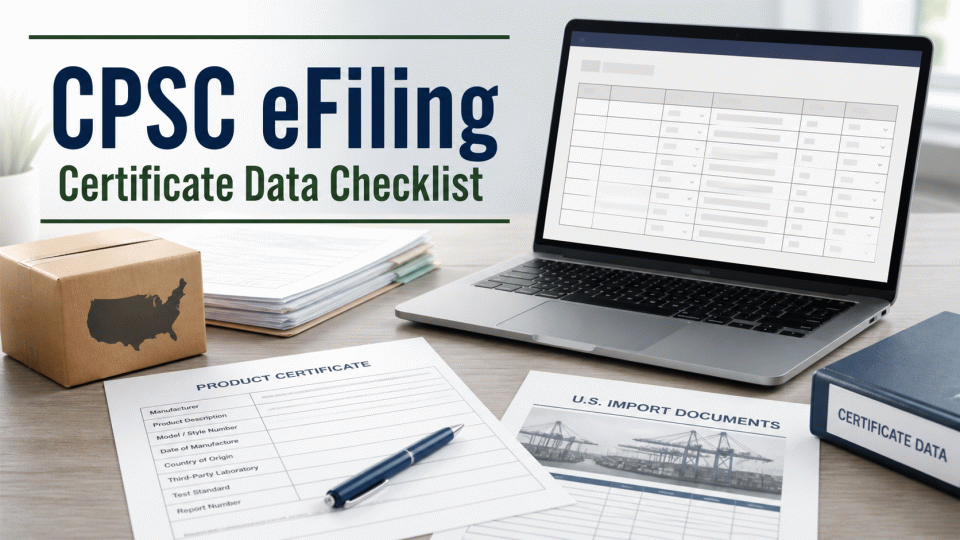
CPSC eFiling concerns the electronic handling and transmission of certificate data for regulated consumer products. It is not a substitute for the applicable product-safety rule, testing, certification, or certificate. Start by defining the product scope, the responsible importer or certifier, and the link between the certificate record and the entry data.
1. Separate eFiling, certificates, and testing
For imported consumer products, eFiling provides an electronic route for certificate data in the import process. CPSC describes the Product Registry as a standalone repository for managing product certificate data, with data that can support a Reference PGA Message Set transmitted to CBP’s ACE system. The registry record should not be described as an approval decision or as an automatic synchronization of every compliance document.
Children’s products commonly involve a Children’s Product Certificate (CPC). General-use products may require a General Certificate of Conformity (GCC) when a CPSC-enforced rule, ban, standard, or regulation applies. The product-specific rule controls; a product name alone does not determine the certificate type.
2. Build a product and responsibility register
For each product record, capture the product name, model or style number, SKU, product category, manufacturer, production location, brand or seller, importer of record (IOR), and the identifiers used in the entry or shipment process. If a customs broker assists with filing, record the broker’s role separately from the owner, purchaser, consignee, or other party responsible for the product information.
CPSC’s importer guidance explains that an IOR eligible to make entry may be an owner, purchaser, or authorized customs broker. If an authorized broker does not have sufficient knowledge of the product to be responsible for testing and certification, the workflow should identify the owner, purchaser, or consignee that is certifying the products. Do not assume that the factory, brand owner, seller account, and importing party are the same entity.
3. Map the CPC or GCC data
Create a field map for each certificate: certificate type, issuing or certifying party, product identifiers, applicable product-safety rules or citations, testing or reasonable-testing basis, laboratory and report details where relevant, certificate access location, version, and review record. Keep CPC and GCC requirements separate and follow the current CPSC guidance for each.
A supplier document may be an input to the file, but it still needs a scope check against the product, responsible party, model, materials or construction, applicable rule, and test coverage. The presence of a laboratory name does not by itself establish that a report covers the current SKU or certificate scope.
4. Prepare for Product Registry and broker handoff
The Product Registry is used to establish, manage, and collaborate on product certificate data. An internal register can map each product to its certificate identifier, product version, data owner, broker handoff status, and change reason. Use the CPSC eFiling documentation, the CBP implementation guidance, and the actual filing workflow to confirm the required message set, fields, and transmission method.
Do not present the Product Registry as a public approval database or interpret a system record as a product approval. The repository, the certificate, and the entry filing have different functions. The responsible party should confirm data accuracy and traceability before transmission.
5. Preserve version evidence after changes
When the model, formulation, material, construction, label, packaging, manufacturer, production site, or applicable rule changes, record the change date, affected certificates and reports, reassessment, and the relationship between old and new versions. “Same product” is not enough as a review conclusion, particularly when a children’s product’s age grade, component, or warning information changes.
Before each filing, perform a human check: product identifiers match; the responsible party is clear; the certificate type and rule scope align; and the report, certificate, and submitted data describe the same version. Keep the review record rather than replacing it with a fixed validity period or an outcome claim.
6. Sources and limits
This reference is based on CPSC’s eFiling page, CPSC Product Registry page, importer guidance, CPC/GCC business guidance, and the Commission’s certificate and eFiling updates. Official rules and implementation materials can change, so the current CPSC guidance, applicable regulation, testing record, and entry requirements should be checked for the specific product. This article is a documentation reference; it does not determine whether a product needs a particular certificate, satisfies a rule, or will receive a regulatory or commercial outcome.