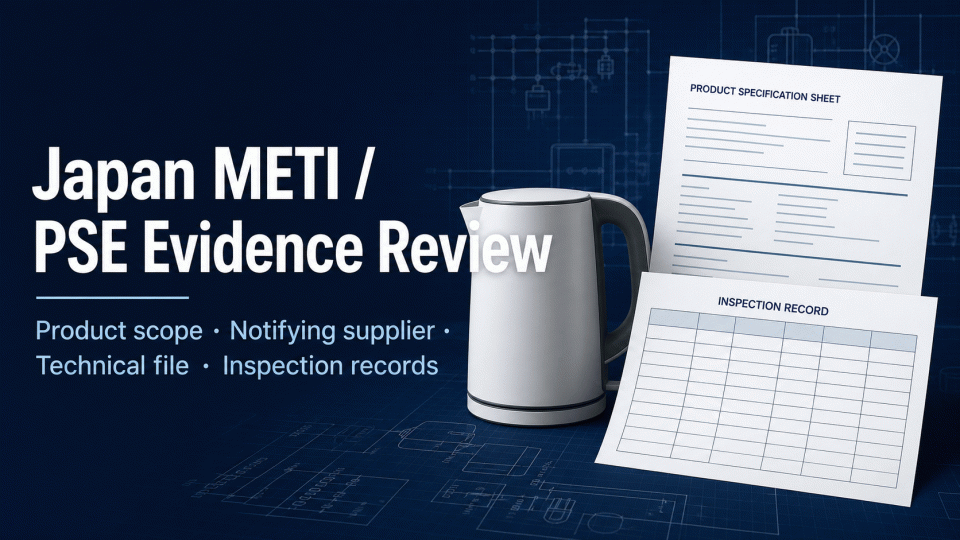
Japan’s Electrical Appliances and Materials Safety Act covers activities including manufacturing, importing and selling regulated electrical products. A useful evidence file starts with product classification, then maps the notifying supplier, technical requirements, inspection records and marking information. This page is a documentation reference, not a product-specific legal or conformity conclusion.
1. Confirm whether the product is in scope
Build a SKU-level product register covering intended use, construction, rated voltage and frequency, rated power, input and output, supplied adapters, and the planned route to market in Japan. Compare those facts with METI’s electrical-product classifications and applicable technical requirements. Do not determine scope from a product title, HS code or supplier statement alone.
Record separate review lines when a series differs in circuitry, rated values, critical components or intended use. If public information is insufficient, retain the specification, drawings and open questions for review by the responsible business operator or an appropriately qualified adviser.
2. Identify the notifying supplier and import route
For a manufacturing or import business involving regulated electrical products, record the notifying supplier, manufacturer or factory, importer, Japanese address or representative arrangement, product classification and relevant commencement or change records. METI’s guidance states that the importer has responsibility for imported electrical appliances and materials; the eligibility of an overseas business to file in Japan must be checked against the law and corporate-registration facts applicable to the case.
Keep the legal name, address, registration information, authorisations, factory list and supplier contacts together. If names differ across a report, label artwork, invoice or product page, log the difference and its explanation. Do not use a brand authorisation or another company’s document as a substitute for evidence from the responsible legal entity.
3. Link the technical file to the specific product
Organise the technical file by model or variant. Typical records include specifications and ratings, a BOM or critical-component list, circuit and construction drawings, instructions, labels and warnings, production or quality-control information, and test or assessment material mapped to the applicable technical requirements. Keep model, revision, date and scope consistent across the set.
METI’s materials distinguish conformity assessment for Specified Electrical Appliances and Materials from the self-inspection duties of the notifying supplier. Whether a registered conformity assessment body is required depends on the product classification and applicable rules. Preserve the inspection item, sample, test condition, result, basis, person and date; a generic certificate is not a product-level inspection record.
4. Review marking and page wording separately
Use a marking checklist to record the applicable mark, the notifying supplier’s name or permitted abbreviation, ratings and category-specific information. The marking rules for Specified and Non-Specified Electrical Appliances and Materials are different; a marking layout should not be copied from one category to another without checking the rule.
Reconcile the product, packaging, instructions, Japanese page and internal records. Customer-facing copy should describe the reviewed product scope, document status and open questions. It should not turn “a filing was made” or “a report exists” into a blanket certification or sales conclusion for every SKU.
5. Maintain one evidence register through changes
Useful fields include SKU, classification basis, notifying supplier, manufacturer and factory, technical-file revision, test or conformity-assessment material, inspection record, label artwork, instruction revision, source file, owner, review date and open question. Link each conclusion to the original specification, legal provision or laboratory document and keep a change history.
After changing a critical component, rating, factory, packaging or importer, reassess which records and inspections are affected. 绿色方舟(深圳)认证有限公司 can help structure the evidence register and clarify the review boundary; the responsible business operator must confirm the legal scope, filing duties and marking use against current official requirements.