
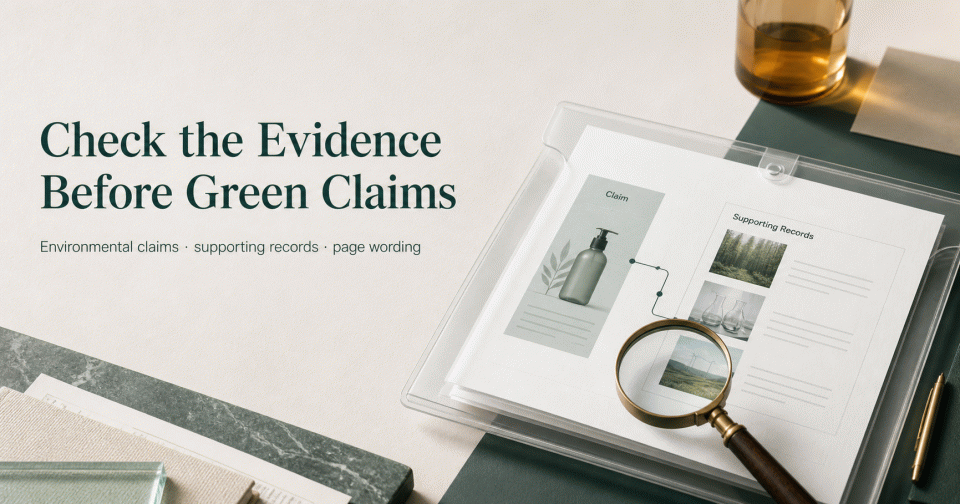
An environmental claim is not complete because words such as “green,” “eco-friendly,” or “sustainable” appear on a product page. The claim should identify its subject, boundary, comparison basis, and supporting evidence. This reference page maps product records, evidence files, and page wording so teams can find scope gaps and unsupported wording before publication.
1. Define the environmental attribute first
Break each marketing statement into a claim that can be checked. Does it concern material origin, recycled content, recyclability, durability, energy use, or one stage of the product life cycle? Broad terms may suggest an overall environmental advantage and should not replace a specific, limited description of the attribute being supported.
At minimum, record the claim text, language, target market, product or component, life-cycle stage, boundary, functional unit, comparison basis, conditions of use, responsible entity, version date, and evidence owner.
2. Link each claim to a specific record
Evidence should support the actual statement rather than a general impression that the product is environmentally preferable. Build a claim-to-record map covering the claim, indicator, method, source file, and version. For recycled-content wording, check the material definition, calculation basis, covered component, and production batch. For recyclability wording, check local collection or processing conditions, component separation, labeling, and limitations.
Potential records include product specifications, a BOM or material list, supplier declarations, purchasing and batch records, test or analytical reports, life-cycle or impact calculations, packaging and label artwork, and—where applicable—third-party certificates or transaction records. A supplier document is not automatically evidence for every SKU owned by another legal entity. Match the holder, product scope, standard version, sample or batch, and current status.
3. Check that the page stays within the evidence boundary
Page copy, images, icons, comparison tables, and search summaries all communicate to customers. State the specific environmental attribute and its limitations clearly; do not hide a material qualification where readers are unlikely to notice it. Comparative claims should identify the comparator, time period, and method. Words such as “reduced,” “lower,” and “zero” need support in the underlying records.
Before release, ask whether the visible scope matches the evidence scope; whether an improvement for one component or stage has been presented as an overall product benefit; whether a certificate, test, or supplier statement has been turned into a promise of regulatory recognition, market access, or an outcome; and whether an image or icon implies an official approval or verified result that the records do not establish.
4. Separate markets and evidence systems
The same product may face different consumer interpretations, advertising rules, labeling requirements, and substantiation methods in different markets. For the United States, the Federal Trade Commission’s Environmental Marketing Claims guidance is a relevant reference. In the European Union, consumer-facing environmental claims should also be reviewed against Directive (EU) 2024/825, which addresses misleading environmental information and non-transparent sustainability labels. These are distinct sources, not one universal certificate or conclusion.
Review translated pages independently. The Chinese and English pages should describe the same claim object and boundary, but they should not be produced by copying paragraph order mechanically. Market names, qualifiers, comparison conditions, and file names need a separate language review.
5. Keep a traceable pre-publication file
Give each claim a traceable reference that connects the approved page version to its evidence folder. Keep the product and version identity, claim-by-claim list, boundary and method notes, original sources, review comments, change history, approved wording, and the conditions that trigger a new review.
Reassess the wording when the product, materials, supplier, packaging, target market, or calculation method changes. Complete files do not mean that a platform or market must accept a claim, and they do not establish certification, regulatory approval, or a particular commercial result. The page should say only what the evidence supports.


