
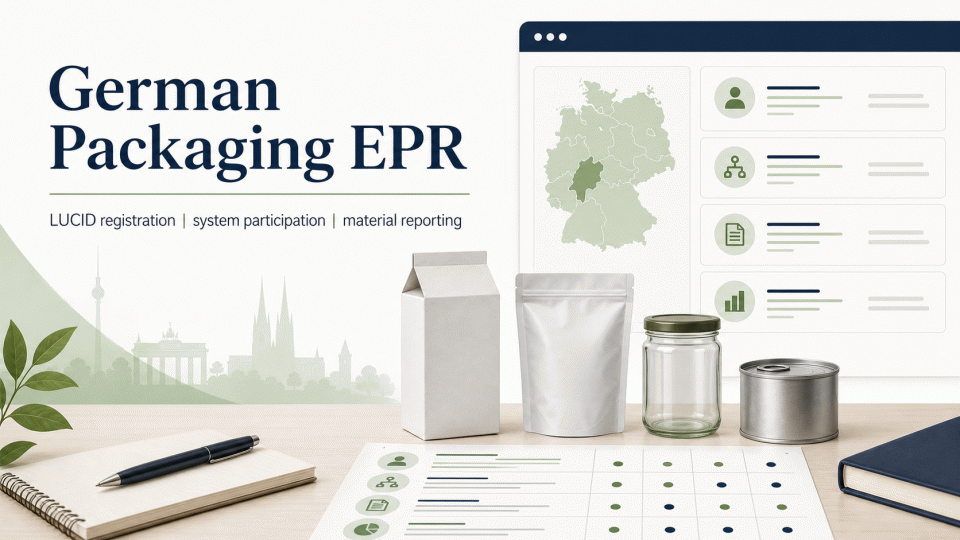
Preparing for German packaging EPR starts with identifying the party that first makes packaging available on the German market, the packaging categories in scope, and the relationship between LUCID registration, system participation and volume reporting.
Scope note: LUCID registration, a system participation agreement and volume reports to the system and to LUCID are separate steps. The responsible party and packaging scope depend on the actual supply chain. This reference page is not a substitute for case-specific legal advice.
1. Identify the responsible party and packaging scope
Start with a role table: who first places sales, grouped or shipment packaging on the German market; whether an overseas business sells packaged goods directly to German end users; and whether it has a German branch. An overseas business without a German branch should also check whether an authorised representative is required for its situation.
Record packaging by component rather than only by brand or finished product. Each row should link the SKU, market, packaging level, component, principal material, mass, first-placement scenario, responsible party and source file. Material categories such as paper/cardboard, plastics, glass and ferrous metals should be traceable to weighing records, bills of materials, supplier specifications or a documented calculation.
2. Keep LUCID registration data aligned
Before registering, check the legal company name, address, tax or other identification data, brand names and the role of the responsible producer. LUCID registration itself is free, but it does not complete system participation. Registration information must also be maintained when the underlying business or responsibility changes.
Do not treat a supplier, marketplace account or brand licensor as the registration party without checking the actual role. Keep a short mapping note that links the registration party to the packaging activity, supported by contracts, authorisations or supply-chain records where relevant.
3. Keep system participation and LUCID reporting as separate records
For packaging subject to system participation, the producer generally needs to conclude a system participation agreement before making the packaging available in Germany and report the packaging volumes to the system operator. The same material categories, masses, reporting period and system information must then be reported to LUCID. Sending a volume confirmation alone is not the same as completing the LUCID data report.
The reporting frequency depends on the system participation agreement. Separate planned volumes, current-year volumes and prior-year actual volumes in the ledger, and retain submission receipts, corrections, reasons and versions. If a simplified reporting rule for small volumes may apply, verify the current official conditions; do not treat it as a general exemption from registration or system participation.
4. Build a material-and-mass evidence chain
For each reporting period, retain a review set: the packaging-component register, material classification basis, weighing or mass calculation, system agreement or volume confirmation, LUCID report receipt, shipment or invoice data, and the SKU and channel mapping. File names should identify the period, entity, material and version so that a record is not reused for the wrong period.
If an estimate is used, record the method, sample, assumptions and reviewer. If the actual volume changes, retain both the original and correction record. The purpose of the evidence ledger is to trace each reported mass back to a packaging component and reporting period, not to imply approval, certification or a guaranteed market outcome.
5. Human pre-publication review
Before publishing a page or sending a file to a customer, check the responsible party, packaging level, material classification, mass, reporting period, system name, brand names and current LUCID information. Also check whether an overseas sales model requires an authorised representative, and whether the page has mixed German packaging EPR with PPWR, another country’s EPR, marketplace policy or product-safety law.
Have business, supply-chain and compliance readers review the file independently, using current ZSVR/LUCID guidance and the applicable legal text as the final reference. 绿色方舟(深圳)认证有限公司 can help structure the evidence file, while the responsibility assessment remains dependent on the company’s actual supply chain and applicable law.


