
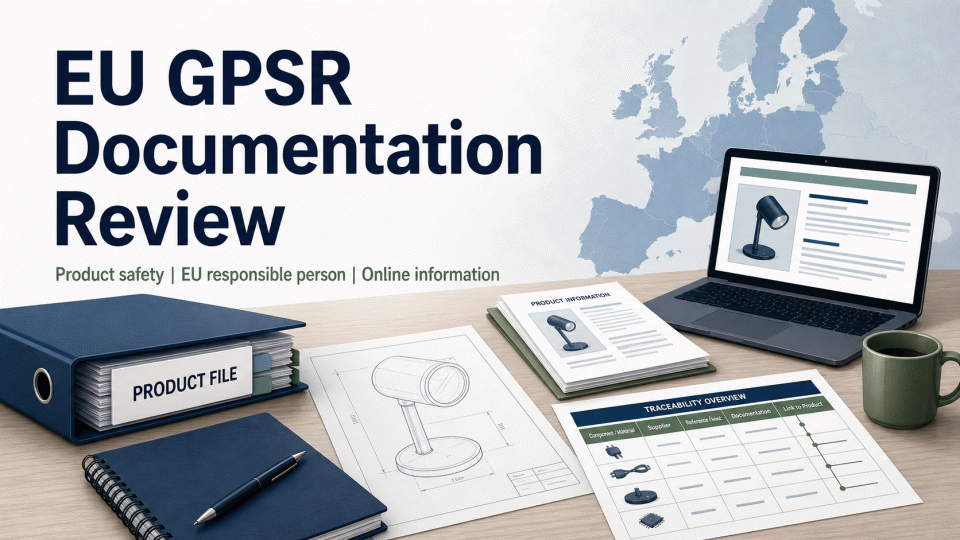
The EU General Product Safety Regulation (GPSR, Regulation (EU) 2023/988) applies to relevant non-food products offered to consumers in the Union. A useful file is not a generic certificate pack: it connects the specific product, safety assessment, economic operator, traceability information and online offer. This page is a practical review framework, not a product-specific legal opinion.
1. Define the product and sales scenario
Start with a SKU register covering model, version, key characteristics, intended use, user group, packaging and sales route. Article 4 treats an online or other distance-sale offer as made available on the market when it targets consumers in the Union. The review therefore needs to consider the market addressed by the offer, not only the place of manufacture.
- Check whether another Union harmonisation instrument also applies; the GPSR general safety requirement does not replace product-specific legislation.
- Record variants, software or firmware versions, accessories and packaging versions so that evidence is not silently reused across different products.
- Keep the reasoning and open questions in the register instead of treating a test report as proof of every applicable obligation.
2. Turn the general safety requirement into a risk record
Article 5 requires economic operators to place or make available only safe products. Article 6 identifies factors relevant to a safety assessment, including design and technical features, composition, packaging, installation and use instructions, foreseeable combinations with other products, applicable rules or standards, the state of the art and the safety reasonably expected by consumers.
For each SKU, record hazards, use scenarios, potentially affected users, design or information measures, supporting evidence, residual risks and review triggers. Products likely to be used by children, older people or other vulnerable users should not be assessed using an unexamined adult-user assumption.
3. Check the manufacturer’s technical documentation
Article 9 requires manufacturers to perform an internal risk analysis before placing a product on the market and to prepare technical documentation. At minimum, it must describe the product and the essential characteristics relevant to its safety assessment. Depending on the risks, it should also preserve the risk analysis, mitigation measures, test reports and the standards or other safety evidence relied upon.
- Specifications, critical materials or components, drawings, software versions and instructions should point to the same model.
- Reports should identify the sample, model, version, method, date and limits of the conclusion; quoting only a favourable sentence is not a complete evidence record.
- Labels, warnings and instructions should match the product’s actual risks, target-market language and online information.
4. Identify the EU responsible economic operator
For products covered by the GPSR, Article 16 requires an economic operator established in the Union to be responsible for the relevant product-safety tasks before the product is placed on the Union market. Record the legal name, address, electronic contact, role, covered products or models and the basis for the appointment or change. Do not automatically treat a marketplace name, customer name or logistics provider as the responsible operator.
Importers and distributors should also check product, packaging or accompanying-document identification, manufacturer and responsible-person information, and any required instructions or warnings. Handover records should show who supplied which product version and when.
5. Align the online offer with the product file
The online offer should present the product identification, manufacturer and EU responsible-person information relevant to the product, together with required warnings or safety information. Keep page captures, versions, SKU references, language and timestamps in the evidence register, and reconcile them with packaging, instructions and technical documentation.
- The title, images, specifications, warnings and limitations must describe the same product.
- Avoid statements such as “approved”, “officially certified” or “zero risk”, and avoid universal wording for all SKUs unless the scope is explicit and verifiable.
- Marketplace policies, buyer requirements and other legislation should be labelled with their own source and scope rather than presented as GPSR provisions.
6. Keep change, incident and review records
Changes to the model, materials, suppliers, software, packaging, warnings, responsible operator or online offer should trigger a documented review. Keep factual records for incidents or safety concerns, including product identification, timing, communications and measures taken. Article 19 sets requirements for manufacturers to report accidents caused by products through the Safety Business Gateway; whether a report is required depends on the facts of the event.
A practical pre-publication sequence is: product and version register → risk analysis → technical file and test scope → EU responsible operator → labels and instructions → online offer → change and incident records. Each item should identify its evidence location, owner and review trigger.
Sources and limits
This reference is based on the current EUR-Lex text of Regulation (EU) 2023/988, with emphasis on Articles 4, 5, 6, 9, 16, 19 and 20, and on European Commission GPSR explanatory materials. Application may also depend on product-specific legislation, sales facts, Member State requirements and the evidence for the specific product. Completing a checklist does not constitute certification, approval or an enforcement conclusion.


