
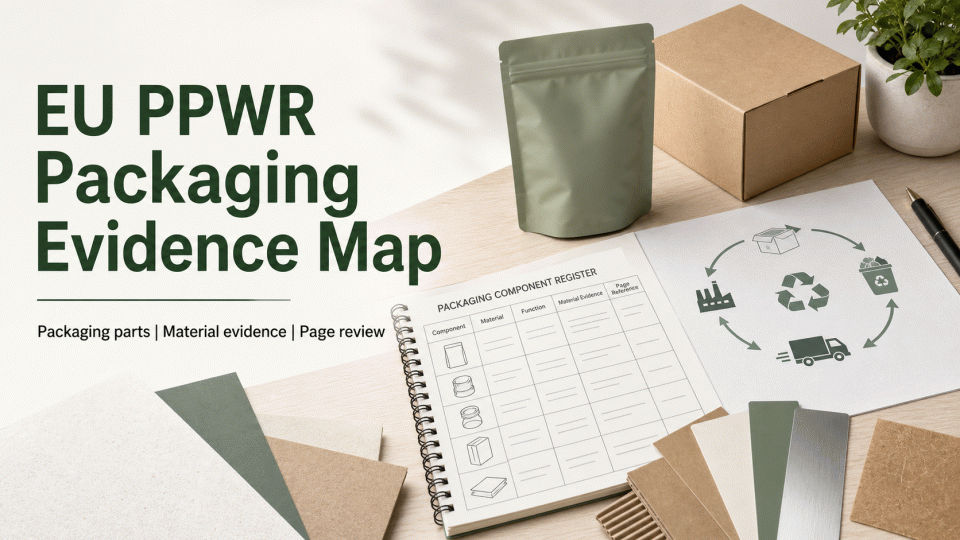
Regulation (EU) 2025/40, the Packaging and Packaging Waste Regulation (PPWR), covers packaging and packaging waste placed on the EU market. A useful preparation file should not merge unrelated laws or platform requirements into one generic “compliance” sheet. It should map each packaging component to its responsible parties, material information and page wording.
This is a documentation reference, not legal advice for a specific product. Scope, exceptions and implementation details should be checked against the official EU text and the current requirements applicable to the target market.
1. Confirm the Packaging Objects and Responsibility Boundary
Start with a component register rather than only recording the finished product. Separate sales packaging, grouped packaging and transport packaging, and list inner bags, boxes, caps, labels, tape and protective materials by function, material, mass and relationship to the product. E-commerce outer packaging should be assessed separately; outsourcing packaging preparation does not remove the need for records.
Record who supplies and confirms each field. The brand owner, importer, packaging designer, manufacturer, supplier and fulfilment provider may hold different evidence. The responsible party must be determined from the actual transaction chain, market placement route and applicable provisions, not inferred from a supplier statement or an existing marketplace listing.
2. Build Material Evidence by Component
For each packaging part, retain its name and photo, material category, composition or structure, mass, supplier and version, use case, and the specification, BOM, supplier declaration or test material supporting those fields. Do not describe a multilayer pack, coating, adhesive or closure simply as “paper box” or “plastic bag” when the actual structure requires a more precise record.
For statements about recyclability, recycled content, reuse, reduction or food contact, keep a claim register with the claim object, method, data period, packaging format, market and source file. Evidence that does not cover the current packaging version should not be expanded into a conclusion for an entire product range.
3. Reconcile Labels and Page Wording to One Version
Keep packaging artwork, label language versions and page screenshots or version records, and identify the SKU, packaging version and effective date they belong to. Statements about material, waste handling, reuse, reduction or environmental attributes should trace back to the component register and source files. If a statement applies only to one format or market, state that limitation.
Do not treat an internal completion flag, supplier marketing phrase or marketplace field as a regulatory conclusion. Before external release, review the name, material, mass, artwork, language, market, source and evidence version item by item. Reconcile again after a packaging, supplier or page change.
4. Suggested File Set and Review Order
- Packaging component register: SKU, packaging layer, part, function, material, mass, supplier and version.
- Material evidence pack: specifications, BOMs, material or composition declarations, and applicable tests or assessments with scope.
- Label and page pack: artwork, language versions, page wording, environmental claim register and change log.
- Responsibility and source pack: participating parties, transaction-chain data, data owners, source links or file numbers and review dates.
Review in the order “packaging object—responsible party—material data—page wording”, then separately confirm applicable provisions, exceptions and implementation documents. Materials prepared by Greenark (Shenzhen) Certification Co., Ltd. should likewise be based on the client’s actual packaging, target market and traceable files; a template is not a substitute for item-by-item judgment.
5. Official Sources and Use Boundary
Primary sources: the European Commission Packaging and Packaging Waste Regulation topic page; the European Commission Packaging waste overview; and EUR-Lex, Regulation (EU) 2025/40. Implementation information may change, so re-check the official text and applicable provisions before publication.


