
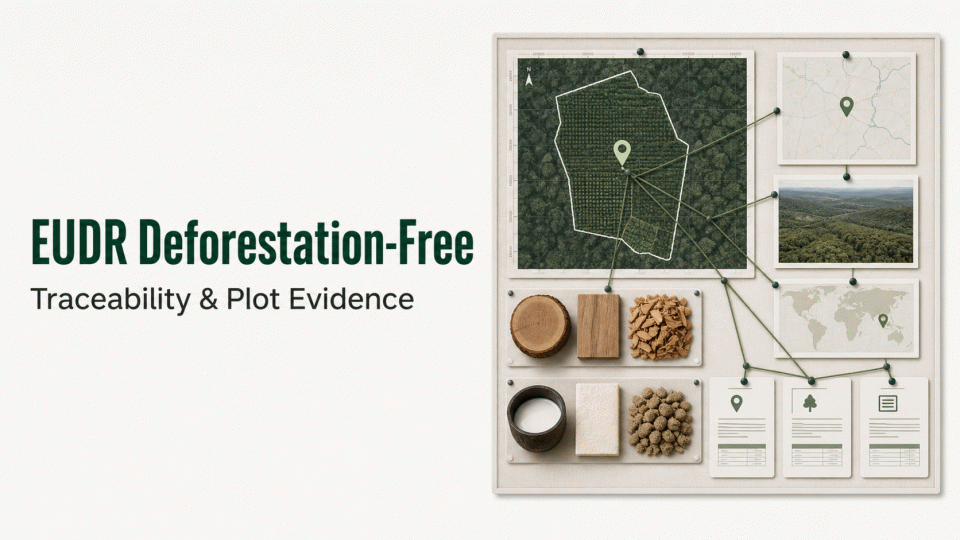
The EU Deforestation Regulation (EUDR) concerns whether relevant commodities and derived products are deforestation-free, produced in accordance with relevant legislation in the country of production, and covered by the required due diligence statement. It is not a standalone certificate that can be detached from the product, production location and supply chain. This reference page turns the legal information into a working map between SKUs, commodities, plots and records. The exact scope still depends on the product code, transaction role and current legal text.
1. Start with scope and transaction role
The EUDR covers seven relevant commodities: cattle, cocoa, coffee, oil palm, rubber, soya and wood, together with the relevant products listed in Annex I. Product names alone are not enough. Compare the HS code, materials, country of production and intended Union-market or export transaction against Annex I.
- Product unit: record the SKU, product description, HS code, material composition, quantity and unit of measure. For composite products, check the applicable derived-product entry.
- Production unit: record the country of production, supplier, plot or production location, production date or time range, and the batch relationship between the commodity and the finished product.
- Transaction unit: identify the operator placing the product on the Union market, the exporter, any authorised representative, and the downstream party that must retain a due diligence statement reference number.
The European Commission currently lists these application dates: 30 December 2026 for large and medium operators; 30 June 2027 for most micro and small operators; and 30 December 2026 for micro and small operators already covered by the EU Timber Regulation. Dates and category tests may change with later amendments, so check the Commission and EUR-Lex before publication or filing.
2. Separate the three legal conditions
Under Article 3 of Regulation (EU) 2023/1115, relevant commodities and products may be placed or made available on the Union market, or exported, only when all three conditions are met: they are deforestation-free; they were produced in accordance with relevant legislation in the country of production; and they are covered by a due diligence statement. An FSC, RSPO or other third-party certificate should not be presented as the EUDR conclusion. The Commission explains that certification and third-party verification may provide complementary information for risk assessment, but they are not a mandatory substitute for the required product, plot and legal information.
- Deforestation and forest-degradation evidence: connect the production plot, production period, geospatial information, supply-chain batch and other risk-relevant records.
- Country-of-production legality evidence: collect land-use, forestry, environmental, labour, tax, anti-corruption and trade records as relevant to the actual commodity and location. Do not apply one generic country checklist everywhere.
- Due-diligence process evidence: retain information collection, risk assessment, risk mitigation, conclusion, statement submission and subsequent-update records.
3. Documentation checklist: from SKU to plot
Product and classification
- SKU, product name, specification, material or recipe, quantity and unit;
- HS code and the basis for the classification, including a customs opinion where relevant;
- conversion, mixing, processing and batch relationships between commodities and finished goods;
- purchase orders, invoices, packing lists, transport records and batch identifiers.
Country and plot
- country of production and production date or time range;
- geolocation information for each relevant production plot. The exact data format depends on the product, plot characteristics and system requirements; follow Annex II and the current system guidance;
- plot boundaries or coordinate files, source, measurement or conversion method, version and owner;
- a mapping between plots, suppliers, harvest batches, processing batches and finished-product SKUs;
- where one product contains material from multiple plots, confirm whether all relevant plots must be recorded rather than using only the supplier address.
Legality and risk assessment
- land-use or harvesting rights, permits, production or harvest records, and other laws applicable to the commodity and location;
- a written assessment of supply-chain complexity, production country and region, mixing or trans-shipment, corruption risk, data reliability and deforestation risk;
- risk-mitigation actions for missing or contradictory information, such as obtaining primary records, narrowing a batch, reconciling plot data or holding a batch that cannot be explained;
- the basis, date, version, reviewer and open questions for each material conclusion. “No issue found” should not be rewritten as “compliance proven” when the evidence is incomplete.
Due diligence statement and retention
Where an operator concludes after due diligence that the product meets the conditions, the operator must submit the due diligence statement through the EUDR Information System before placing the product on the Union market or exporting it. The submission role, fields, references and system workflow must follow the current Regulation, implementing rules and system guidance. An internal register should link the statement reference number back to the SKU, batch, supplier, country of production and plot evidence, with the submitted version and reasons for any change retained.
4. Roles and downstream handover
An overseas supplier’s statement that “the documents are ready” does not by itself establish the buyer’s legal position. First identify the operator, trader, exporter, importer or first Union-market placer, and any authorised representative. The Regulation contains specific rules for products placed on the Union market by a natural or legal person established outside the Union; ordinary procurement labels should not replace this role analysis.
Downstream businesses should retain the due diligence statement reference numbers they receive and maintain the link to the relevant product and transaction. For supplier-provided coordinates or statements, retain more than a PDF: check the version, product scope, quantity, batch, plot and commercial documents for consistency.
5. Common errors
- Treating a general certificate as an EUDR conclusion: a certificate may provide supporting information but does not automatically cover every SKU, batch and plot.
- Keeping only a supplier address: an address is not normally a substitute for the geolocation of the relevant production plot.
- Building a one-time file pack: changes to a supplier, commodity source, plot, processor, recipe or product code should trigger an impact review and a recorded change.
- Mixing official and private requirements: a platform or buyer may request additional records, but those requests should not be described as the text of the EUDR. Website language should not imply that an official check has already been completed.
- Using fixed fines, fixed review periods or guaranteed-outcome language: enforcement and penalties depend on the applicable law, competent authority and facts. Use bounded, verifiable wording.
6. Internal pre-publication check
- Is the product within Annex I, and is the HS-code and material analysis documented?
- Are the operator, trader, exporter, importer and authorised-representative roles clear?
- Can each relevant commodity be traced to a country of production, production period and relevant plot?
- Can plot information, purchase and transport records, batches and finished SKUs be mapped?
- Are country-of-production records specific to the actual commodity and location rather than copied from a generic checklist?
- Are risk assessment, mitigation, due diligence statement references and changes available for review?
- Does customer-facing wording distinguish legal facts, preparation actions and private customer requirements?
7. Sources and limits
This page is based on the European Commission’s Regulation on Deforestation-free Products page, the Commission’s July 2026 update on product scope and tools, and the current consolidated EUR-Lex text of Regulation (EU) 2023/1115. The Regulation, implementing rules, product scope, system fields and application dates may change. Before filing, use the latest official text, guidance and competent-authority requirements. Greenark Certification (Shenzhen) Co., Ltd. provides document-structuring and preparation guidance; it does not replace the company’s independent determination of scope, legal role or filing conclusion.
European Commission: Regulation on Deforestation-free Products


