
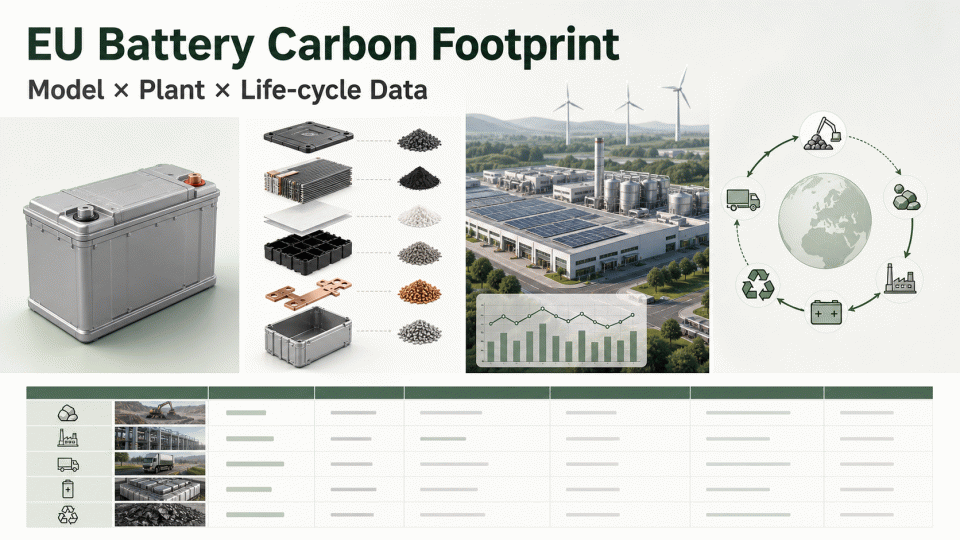
This reference framework helps teams organize evidence for carbon-footprint requirements under the EU Batteries Regulation. The aim is not to reuse a generic report, but to connect the battery model, manufacturing plant, life-cycle data, calculation method and declaration version.
1. Confirm the declaration object and scope
Article 7 of the Regulation addresses electric-vehicle batteries, rechargeable industrial batteries above 2 kWh and light means of transport batteries. It requires a carbon-footprint declaration for each battery model per manufacturing plant. The final scope assessment still depends on the product category, capacity, market placement and the applicable text; “lithium battery” alone is not a sufficient conclusion.
Record the model or version, manufacturing plant, rated energy, chemistry, production-batch scope, market-placement entity, target market and language. If the model, plant or a material input changes, reassess whether the existing declaration still covers the product.
2. Define the functional unit and life-cycle boundary
Annex II states that the calculation is based on the bill of materials, energy and auxiliary materials used at a specific plant to produce a specific battery model. It also calls for accurate identification of electronic components and cathode materials, which can be material contributors. Fix the functional unit, system boundary, life-cycle stages, allocation rules and data period before discussing the result.
Keep a boundary note that identifies included and excluded raw materials, components, manufacturing processes, transport, use and end-of-life stages. State the reason and source for each exclusion. Do not combine different plants, chemistries or capacity versions into an unexplained average.
3. Build a traceable input-data register
Use a register with the fields “data item, source, owner, period, unit, conversion, version and gap.” Useful evidence may include the BOM, cathode and anode information, cell and pack components, plant energy records, auxiliary materials, production output, supplier data-quality notes, and transport or end-of-life boundary records.
Each material input should lead back to an original file and a specific model. A generic supplier environmental document does not automatically replace model- and plant-specific evidence. Mark estimates with their method, assumptions and uncertainty; do not present an estimate as measured data.
4. Separate calculation, verification and page wording
The Regulation’s calculation and verification framework is based on Article 7 and the essential elements in Annex II, aligned with the latest Product Environmental Footprint method and relevant category rules. Keep the calculation model, factors and versions, input files, result table, change log, verification material and applicable declaration format as separate but linked records.
Use only wording supported by the register. “Internal calculation completed” is not the same as “approved by the EU.” Do not replace the declaration with an unverified class, ranking, reduction percentage or universal conclusion. If a threshold, class or number is quoted, identify the applicable legal text, version and evidence location.
5. Model-level pre-publication review
- Model, plant, capacity and chemistry match the BOM, production records and declaration;
- Functional unit, life-cycle boundary, allocation rules, data period and estimates are documented;
- Sources, units, conversions and versions for key materials, energy and auxiliaries are traceable;
- Calculation files, verification material, declaration format and page copy use the same version;
- Legal references use Regulation (EU) 2023/1542 and later applicable texts, with a recorded review date.
This checklist supports evidence preparation and page review; it does not replace an independent assessment of product scope, data quality or filing responsibility.


