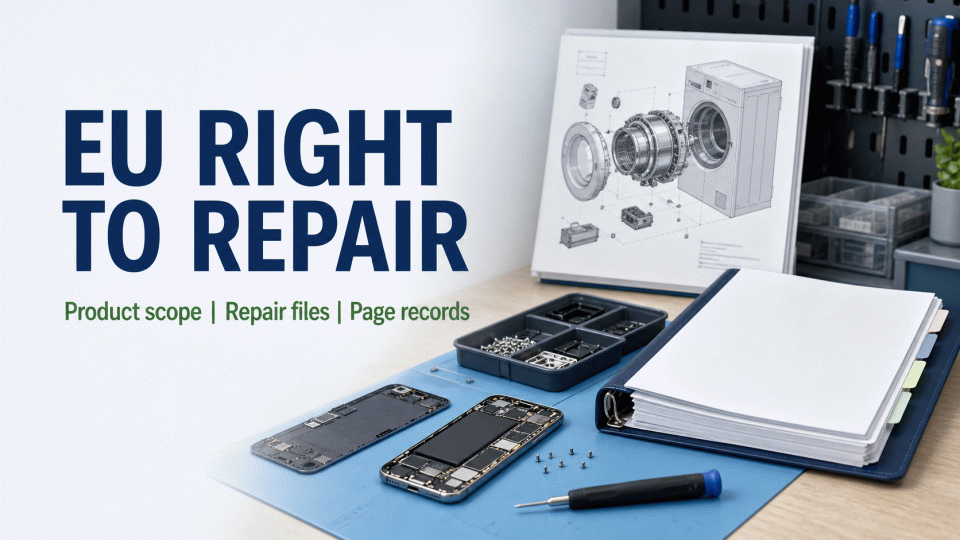
Directive (EU) 2024/1799 creates common rules to promote the repair of goods. It does not make every product subject to one identical repair duty. The practical starting point is to map the specific product to the Union legal act listed in Annex II and confirm which repairability requirements actually apply.
1. Confirm the product scope
Article 1(3) limits Articles 5 and 6 to goods for which, and to the extent that, repairability requirements are provided by the Union legal acts listed in Annex II. The current list covers categories including certain household washing machines, dishwashers, refrigerating appliances, electronic displays, welding equipment, vacuum cleaners, servers and data storage products, mobile phones, cordless phones, slate tablets, tumble dryers, and goods incorporating light means of transport batteries. The precise SKU still needs to be checked against the relevant product legislation; “EU right to repair” should not be used as a universal product claim.
Create a mapping record with the SKU, product category, applicable Union legal act, repairability requirement, responsible role, model/version, market, instruction-manual reference, spare-parts source, and review date. If the product is outside Annex II or outside the relevant repairability requirement, avoid stating that the manufacturer has a uniform mandatory repair obligation.
2. Organise the repair file
For products confirmed within scope, keep an evidence register covering:
- Product identity: brand, model, variants, batch or serial-number logic, and the link to the relevant product-law entry.
- Repair capability: repairable faults, technical information, tools, disassembly constraints, software or hardware conditions, and safety instructions.
- Parts and tools: required parts or tools, compatible models, availability, price records, and supply route; a supplier catalogue alone does not prove a manufacturer obligation.
- Repair service: service provider, request channel, expected arrangements, price components, delivery method, and the documented reason where repair is impossible.
- Version control: versions and dates for manuals, labels, repair pages, parts lists and customer-facing wording, with approval and retention locations.
Within scope, Article 5 requires Member States to ensure that manufacturers repair goods at the consumer’s request, unless repair is impossible. Repair may be subcontracted, and the repair must be free or offered at a reasonable price and completed within a reasonable time. Manufacturers must also provide free website access to indicative prices for typical repairs and must not impede repair through contractual, hardware or software techniques, subject to the directive and other applicable law.
3. Page and consumer information records
Article 6 requires manufacturers, or where applicable authorised representatives, importers or distributors, to make repair-service information available free of charge in a clear and comprehensible way. A product page can be organised as product scope, service role, request route, parts and tools, indicative price, repair arrangements, and limitations. Keep the source document and version for each statement.
A repairer may provide the European Repair Information Form in Annex I on a durable medium after a request and before the consumer is bound by a repair contract. The conditions in the form generally remain unchanged for 30 calendar days from the date it was provided, unless the parties agree a longer period. This is not a universal validity period for certificates, test reports, or product repair obligations.
4. Pre-publication checks
- Confirm whether the SKU falls within Annex II and the relevant product legislation; record the legal source and version.
- Keep manufacturer, authorised representative, importer, distributor and repairer roles distinct.
- Trace each parts, tools, repair, price and service statement to an actual source.
- Do not turn available information into a claim that a product has been repaired, is compliant, or has received a regulator’s conclusion.
- Retain page versions, source links, screenshots and change records; verify national transposition and implementation details separately.
绿色方舟(深圳)认证有限公司 provides a reference framework for organising records and checking page wording. This article does not replace national transposition measures, product-specific legislation, contract review, or an authority’s interpretation. Scope, responsible roles and repair conditions must be confirmed against the relevant Union legal act and the actual transaction chain.
Sources
Primary references: EUR-Lex, Directive (EU) 2024/1799 (Articles 1, 4, 5, 6, 7 and Annexes I–II); European Commission, Directive on repair of goods. Recheck the current text and national implementation before publication.