
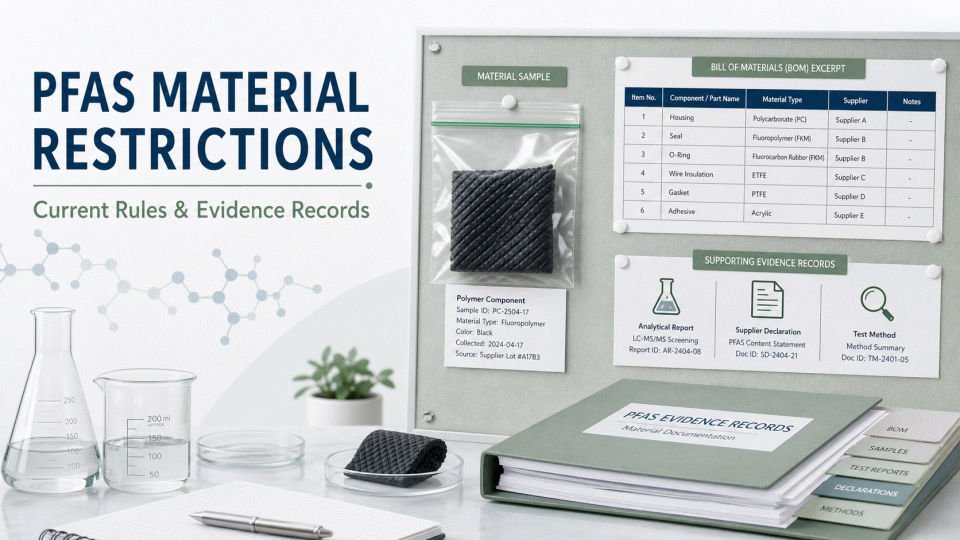
PFAS (per- and polyfluoroalkyl substances) is not one universal product ban or one global threshold table. A defensible record starts with the product, material, use, market, and applicable legal text, then links each supplier statement or test record to that scope. This page is a documentation reference; it does not decide whether a particular product satisfies a legal requirement or will receive a regulatory or commercial outcome.
1. Separate current restrictions, reporting duties, and proposals under review
EU REACH already contains substance-specific PFAS restrictions. For example, Commission Regulation (EU) 2024/2462 adds PFHxA, its salts, and PFHxA-related substances to a specific REACH Annex XVII entry, with the scope, exemptions, and transitional arrangements set by the legal text. It should not be rewritten as an already effective ban on approximately ten thousand PFAS substances.
The broader EU PFAS restriction work must be described as an assessment and possible future proposal until a final legal text is adopted. ECHA is conducting the scientific assessment and the European Commission will decide its next legislative step. Assessment-stage scopes, thresholds, and dates must not be presented as a single current requirement for every product.
In the United States, EPA's TSCA section 8(a)(7) rule is principally a one-time information-reporting and recordkeeping requirement. It concerns PFAS manufactured, including imported, since 2011 and asks for information such as identity, uses, volumes, disposal, exposure, and hazard information. That reporting rule is not the same question as whether a finished product may be sold or what a marketplace may request. Check EPA's current page, rule text, and applicable amendments for the live reporting scope and dates.
China and other markets may apply substance-, product-, food-contact-, emissions-, or sector-specific controls. Do not replace product-specific legal research with a global PFAS threshold table. A conclusion should retain the instrument name, clause, version date, and conditions of application.
2. Build the evidence chain at BOM level
1. Define the product scope: model, SKU, market, intended use, contact medium, target instrument, and instrument version.
2. Break the product into parts and homogeneous materials. Record the material name, part number, supplier, manufacturing location, formulation or grade, and change history. Track coatings, seals, surface treatments, processing aids, and packaging separately rather than relying on the finished-product name.
3. Scope-check every supplier statement. Record the substance definition, material or batch covered, intended use, market, and exclusions. “No intentional addition” does not automatically mean “no residue,” and it does not automatically replace a test or technical file required by the applicable rule.
4. When testing is needed, ask the laboratory to design the work against the target instrument, sample matrix, method suitability, analyte list, detection and quantification limits, and uncertainty. Do not turn “full-spectrum PFAS” or one universal ppb value into a rule for every market; the report should state its actual coverage and limitations.
3. Fields for a supplier-declaration register
Product and responsibility: model, SKU, part number, market, use, manufacturer, importer or sales responsibility, and the internal record owner.
Material and supplier: homogeneous material, grade or formulation version, supplier statement, change date, batch or sample identifier, and traceability link.
Legal mapping: instrument title, clause or annex, conditions, exemptions or transition arrangements, review date, and original source. Keep a specific REACH restriction, a TSCA reporting duty, and a broader restriction under assessment in separate fields.
Verification record: report number, sample handling, method, analyte scope, LOD/LOQ, interpretation, technical reviewer, and open evidence gaps. Archive declarations, testing, and legal conclusions as distinct records; a supplier sentence cannot replace the full evidence chain.
4. Page wording and human-review boundaries
Customer-facing wording should identify the products, markets, and instrument versions covered by the records. Avoid unsupported claims such as “globally banned,” “approved by every marketplace,” “zero risk,” or “one threshold applies everywhere.” Recheck the mapping when a formulation, material, supplier, use, or legal version changes. 绿色方舟(深圳)认证有限公司 provides documentation and review references; it does not replace a regulator's, customer's, or marketplace's decision for a specific product.
Sources and limits
This reference was checked against Commission Regulation (EU) 2024/2462 on EUR-Lex, the European Commission PFAS pollution topic page, ECHA information on the broader PFAS restriction assessment, and EPA's TSCA section 8(a)(7) PFAS reporting and recordkeeping page. Rules, guidance, and dates can change; return to the applicable official text before relying on a record.


