
For: Manufacturers, importers, brand owners and evidence managers supplying toys to the EU market.
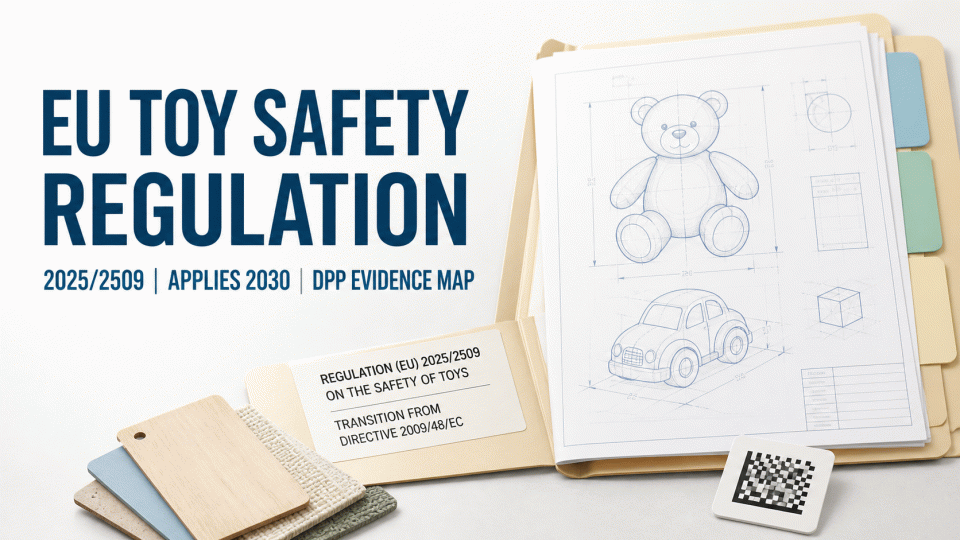
Summary: Regulation (EU) 2025/2509 entered into force on 1 January 2026 and applies in principle from 1 August 2030. This reference page maps product scope, technical documentation, safety assessment, warnings, CE marking and digital product passport (DPP) records. It does not turn the application date into a current marketplace review date and does not replace a product-specific legal assessment.
1. Separate entry into force from application
The new instrument is Regulation (EU) 2025/2509, not a “2024/470/EU directive”. It entered into force on 1 January 2026, applies in principle from 1 August 2030, and repeals Directive 2009/48/EC. Before 1 August 2030, toys placed on the market in conformity with Directive 2009/48/EC remain subject to the Regulation’s transitional provisions; EC type-examination certificates also have the continuation boundaries stated in the Regulation. Check the actual placing-on-the-market date, certificate status and applicable provision for each product. An FBA inbound date or marketplace page alone is not a legal test.
The Regulation covers products designed or intended, whether or not exclusively, for play by children under 14. It applies to forms of supply including distance sales. Whether a product is a toy, or falls within an exclusion in Annex I, requires a fact-specific review of its functions, dimensions and characteristics.
2. Manufacturer evidence pack
Before placing a toy on the market, build a traceable record for the same toy model:
- Product identity: model, batch or serial information, product photographs, design version, manufacturing and storage locations.
- Materials and components: component and material lists, substances and mixtures used, safety data sheets and supplier evidence.
- Safety assessment: identify hazards presented by the toy and assess potential exposure of children or other users; record assumptions, sample scope and the basis for conclusions.
- Testing and conformity basis: test reports, harmonised standards or common specifications used, production-conformity records and, where relevant, notified-body documents or an EU type-examination certificate.
- Technical documentation: organise the design and manufacturing description, safety assessment, conformity-assessment procedure, test reports and certificates in line with Annex V. Keep the documentation available to market-surveillance authorities for 10 years after the toy is placed on the market.
3. Marking, warnings and online offers
Affix the CE marking as required by the Regulation. Where the toy cannot carry it clearly, use the label, packaging or accompanying documentation as provided by the rules. Where risks cannot be eliminated by design or manufacture, provide warnings and safety instructions that are legible, visible, intelligible and consistent with the intended or reasonably foreseeable use. Applicable warnings must also be clear in online offers; they should not exist only in an internal file.
Compare the toy, packaging, instructions, online offer and technical file as one model chain. If the name, model, manufacturer information, warning or language version differs, document the factual reason and supporting record. A generic statement should not be used to cover every SKU.
4. Preparing DPP records
The new Regulation introduces a digital product passport for toys. Before placing a toy on the market, the manufacturer creates a DPP for a specific toy model and connects it through a data carrier to a persistent unique product identifier. At a minimum, the DPP must be accurate, complete and up to date; available in the language or languages required by the Member State; accessible according to the Regulation’s access rights to consumers, market-surveillance authorities, customs authorities, notified bodies, the Commission and other economic operators; retained for 10 years; and aligned with Articles 19–22 and Annexes VI–VII.
Use a field map covering the toy model and unique identifiers, manufacturer and relevant economic operators, applicable legislation and conformity information, technical-file index, warning and instruction languages, data-carrier location, version history, access rights, backup location and supplier evidence. The responsible economic operator must stand behind the DPP data. A QR code, URL or internal folder is not itself an approval or certification result.
5. Manual SKU review
- Determine whether the product is a toy under the Regulation or an Annex I exclusion.
- Lock the model, batch, materials and version; check that test samples represent the product offered for sale.
- Review the safety assessment, technical documentation, test basis, warnings and instructions item by item.
- Reconcile CE marking and economic-operator details across the product, packaging and records.
- Build the DPP field and version record for the 1 August 2030 application point without presenting preparation as a current application conclusion.
- Keep each conclusion within its evidence boundary and obtain support for any unverified standard edition, chemical, language or stock-status statement.
Sources and boundary
Primary references: Regulation (EU) 2025/2509, especially Articles 2, 18–22, 25 and 27 and Annexes V–VII; the European Commission Toy Safety page; and the EUR-Lex summary. This is a records-preparation reference, not legal advice or a certification, marketplace or customs decision. For a client project, the evidence owner and appropriate professionals should review the actual product, market and legal version.
Prepared by 绿色方舟(深圳)认证有限公司.


