
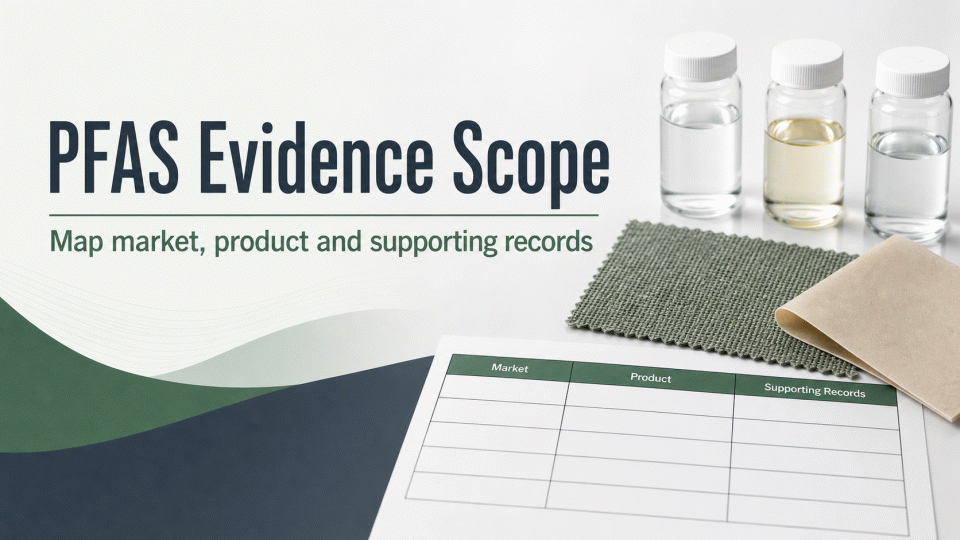
PFAS, or per- and polyfluoroalkyl substances, is not a single “global ban” that can be applied without context. Definitions, regulated uses, responsible parties, evidence and timing can differ by market and product. This reference turns the work into reviewable records. It does not replace an applicable rule, authority decision or customer requirement, and it does not promise test, filing, platform or market-access outcomes.
1. Separate three questions
First define the PFAS scope: a structural definition, substance list or product-use boundary. Next identify the rule: an EU, US federal, US state or other market requirement. Finally map the evidence: supplier information, BOM, test data, labels, or an authority filing. Combining these into “PFAS Free” or “globally compliant” hides material differences.
2. Record the current public rule position
European Union: ECHA currently describes the broad PFAS restriction as a REACH restriction proposal under evaluation. It should not be presented as an already-effective universal REACH PFAS ban. Existing restrictions for particular PFAS, the Candidate List, POPs rules and product-specific requirements must be checked separately for substance, use, derogation, limit and date. Keep the legal source, version, product scope and review date for each entry.
United States federal: EPA’s TSCA Section 8(a)(7) rule concerns relevant persons that manufactured, including imported, PFAS during the defined lookback period. The PFAS definition, reporting scope, streamlined forms and submission dates must be checked against 40 CFR Part 705 and current EPA guidance. This is a reporting and recordkeeping rule; it is not a universal product certificate or a laboratory detection threshold.
States and other markets: Textiles, food-contact materials, cosmetics, firefighting foams and electronics may face different state, product or customer requirements. Do not extend one state’s scope or timing to the whole US. Record the destination state, product category, responsible party, rule source and applicable version first.
3. Build a product-level evidence record
For each SKU, record the model and batch; BOM for materials, coatings, auxiliaries and packaging; any intentional-use risk; suppliers, sites and lots; destination market and use; applicable rule or customer specification; the PFAS definition used in the claim; test matrix, method, reporting limit, date and laboratory scope; and the wording used on labels, pages and questionnaires. A supplier declaration describes the declarant’s stated scope; it does not automatically replace product testing or a legal filing.
4. Read test reports without overclaiming
Have the applicable rule or customer define the analytes, method, matrix and reporting limit before comparing reports. A non-detect result for a limited target list cannot prove that every PFAS is absent. “ND” must be read together with the method’s LOQ or reporting limit. Keep the laboratory scope, sampling plan, blanks, storage records and report version. ISO/IEC 17025, CNAS or another accreditation must be checked for its relevant scope; a logo or laboratory name alone does not establish coverage.
5. Keep listing and customer wording within the evidence
State whether the claim concerns a material, SKU, batch or supplier record, and identify the market, definition/method and evidence date. Avoid “PFAS-free,” “globally banned,” “guaranteed pass,” “zero risk” or “valid for every market” when the files do not support those statements. If the evidence only shows that named analytes were not detected by a stated method, describe exactly that scope. GreenArk Certification (Shenzhen) Co., Ltd. organizes source records, while the responsible business and applicable authority determine the project conclusion.
6. Five checks before publication
- Product, material, lot and destination market are uniquely matched.
- The PFAS definition, legal basis and customer scope are stated without mixing them.
- Matrix, method, analytes, LOQ and date cover the proposed claim.
- Supplier records, BOM, purchase/production records and test samples connect to the same evidence trail.
- Chinese, English, label and web wording express only what the files support.
Sources: ECHA’s PFAS topic and restriction-proposal pages; the US EPA TSCA Section 8(a)(7) page and 40 CFR Part 705 guidance; and current official rules for the relevant product and destination. Proposals, regulations and customer requirements may change, so verify the current version and scope before use.


