
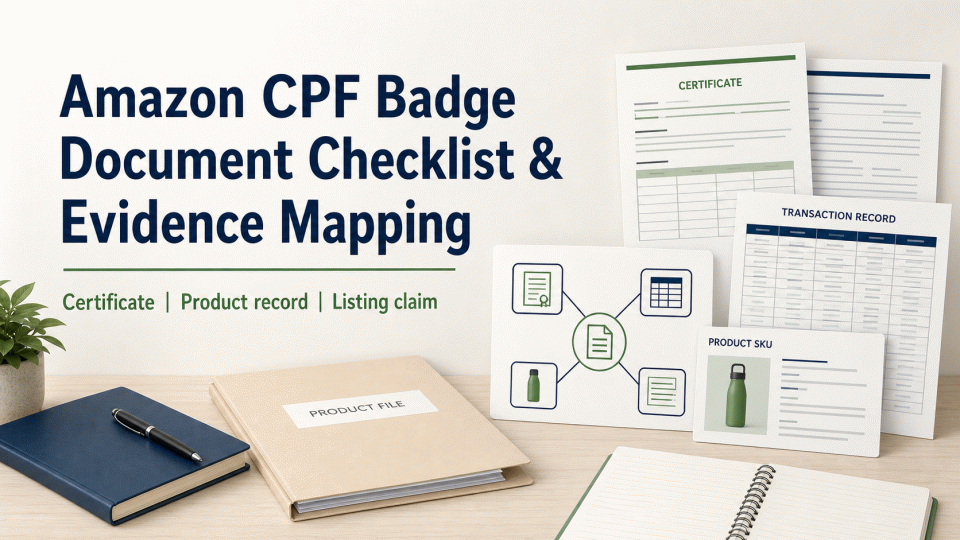
Climate Pledge Friendly (CPF) is an Amazon program entry point used to identify some products with sustainability attributes. Amazon states that CPF works with third-party certifications and Amazon-owned programs. The eligible schemes, product scope and submission route must be confirmed in Seller Central's Sustainability Solutions Hub and the current requirements for the relevant scheme. This article provides a document-mapping framework; it does not promise a badge, approval, listing display or other Amazon outcome.
1. Confirm the program route and certification scope
Start in Seller Central by confirming whether the product is eligible for a CPF-related route, which certifications or programs are accepted for that route, and what product information must be supplied. Do not treat FSC, GRS, RCS, OCS, ISCC PLUS, Fairtrade and other schemes as one generic “green badge certificate.” Each scheme can define its own certified object, scope, claim language and evidence. Record the program name, certification standard or scheme, certificate number, certificate holder, scope, product category, claim type and document version.
If the route, marketplace or product category is not confirmed, mark it “to be confirmed.” Do not infer current eligibility from an old page, a supplier's verbal statement or the outcome associated with another ASIN.
2. Link the certificate, product and supply-chain records
Build a three-column product–document–claim map. The product column should retain the ASIN, SKU, model, product description, material composition, packaging and label version. The document column should retain the certificate or scope document, transaction records where the scheme requires them, supplier records, invoices and testing support. The claim column should record each certification name, material percentage or other environmental attribute used on the listing. For every entry, record the source file, version or reference number, responsible party and human review conclusion.
For chain-of-custody schemes, a certificate scope identifies the certified organization and product categories; whether transaction records, invoices or supplier records are needed, who issues them and how they must match should be checked against the applicable standard and certification-body instructions. Do not turn a practice used by one scheme into a universal “last 12 months” rule or a fixed document count for every scheme.
3. Check the claim boundary for each ASIN
Listing claims must correspond separately to the certification scope and to the actual product composition. If a certificate covers one material, product category or supply-chain step, do not expand it into a claim about the entire product, all materials or the whole production process. “Contains recycled material” does not automatically mean “100% recycled.” Percentages, material names, certification wording and product images should all point to the same model and document version.
Keep the pre-submission listing text or screenshot together with the certificate scope and product BOM mapping. If the wording exceeds the documents, revise it to a neutral claim supported by the records or mark it for confirmation. Do not replace evidence with assumptions about automatic checks, mandatory resubmission or guaranteed approval.
4. Focus points by certification type
FSC and other forest-product chain schemes: Check the certificate holder, certificate scope, product classification, sales-document claim and physical chain. FSC public material explains that chain of custody identifies, separates and traces eligible material; transaction-data and claim requirements must be checked against the current standard and certification-body documents.
GRS, RCS, OCS and material-claim schemes: Check the standard name, certificate and scope, material composition, transaction or supply-chain records where applicable, and the wording used for material content. Do not copy a threshold, validity period or document name from one scheme into another.
ISCC PLUS, Fairtrade and other schemes: Read the scheme's own rules for products, feedstock, mass balance, chain of custody and claims before deciding which records are needed. Where the applicable version is missing, write “to be confirmed” instead of inventing a fixed requirement from industry practice.
5. Human review before submission
① The CPF route, marketplace, scheme and product category are confirmed; ② the relationship between certificate holder, product owner, supplier and authorized party is documented; ③ the certificate scope covers the product category and claim object; ④ ASIN, SKU, model, material and packaging versions match; ⑤ transaction records, invoices, supplier files and testing support are included only when applicable and point to the same product; ⑥ the listing contains no percentage, whole-product or outcome claim beyond the certification scope; ⑦ missing fields are marked for confirmation; ⑧ the submitted document versions and human review record are retained.
Source boundary: This reference is based on Amazon's public Sustainability Solutions Hub / Climate Pledge Friendly description, public FSC chain-of-custody materials and the general evidence structure used by certification schemes. Marketplace, scheme, product category and timing can change the requirements. 绿色方舟(深圳)认证有限公司 provides a document-review framework only; it does not replace Amazon, a certification body or the applicable legal rule. Check the current official route, scheme standard and source documents before use.


