
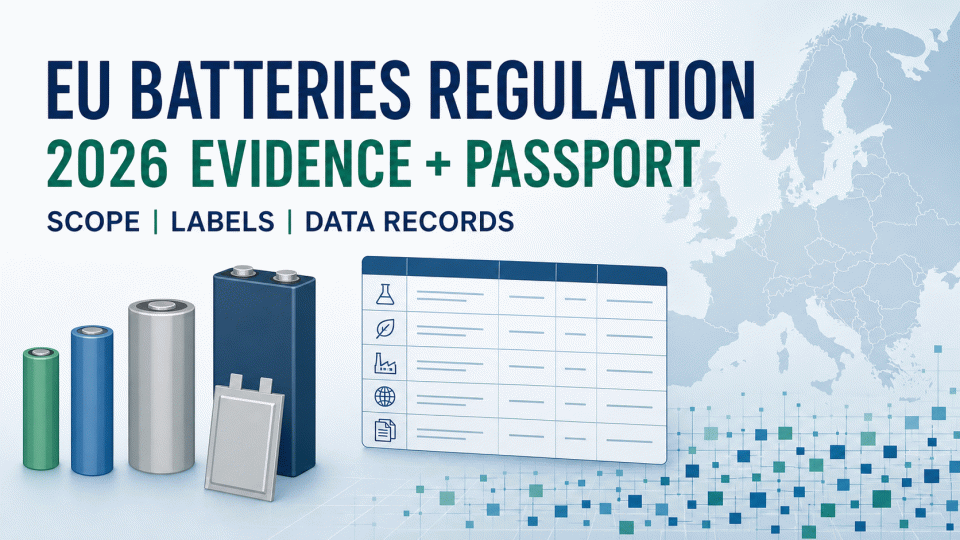
This reference page helps companies placing portable, light means of transport, industrial, starter, or electric-vehicle batteries on the EU market organise product scope, labelling, and data records. It is a preparation guide, not a product-specific legal assessment.
Separate scope from the evidence object
Regulation (EU) 2023/1542 applies different requirements according to battery category, capacity, use, and the economic operator's role. Common categories include portable, SLI starter, light means of transport (LMT), electric-vehicle, and industrial batteries. Primary batteries, button cells, and different chemistries can trigger additional rules. A lithium-ion description or an existing CE report does not establish every obligation.
For each model, keep one record covering the model and revision, capacity and chemistry, installation, removability, manufacturer/importer role, placing-on-the-market date, target Member States, technical documentation, test records, label artwork, and supplier evidence.
What to check in 2026
- Labels and capacity: Article 13 sets labelling, capacity, legibility, and related information requirements. The applicable start date must be checked against the relevant implementing act and battery category; it should not be reduced to a universal “four-piece mandatory set”.
- Recycled-content records: Industrial batteries over 2 kWh, electric-vehicle batteries, and certain SLI/LMT categories have phased documentation and calculation requirements. Check Article 8 and later delegated or implementing acts for the applicable material, date, category, and method. Do not turn a category-specific rule into one percentage for every battery.
- Carbon footprint: Article 7 introduces staged carbon-footprint information, declarations, or performance-class requirements for specified categories. Preserve the boundary, functional unit, data sources, production sites, method, assumptions, and version; do not present an estimate as an achieved outcome.
- Battery passport: Article 77 requires, from 18 February 2027, an electronic passport for each LMT battery, each industrial battery over 2 kWh, and each electric-vehicle battery placed on the market or put into service. The passport connects model and individual-battery data through a QR code and unique identifier and must be accurate, complete, current, machine-readable, and interoperable.
Evidence register to build
- Scope sheet: model, use, capacity, chemistry, category decision, and applicable provisions.
- Product identity: cell, module, pack, BMS, software revision, and change history.
- Technical file: risk assessment, drawings, test reports, instructions, label/packaging artwork, and draft declaration of conformity.
- Supply-chain evidence: raw materials, critical-mineral sources, recycled-content sources, supplier declarations, batches, and manufacturing sites.
- Carbon-footprint and recycled-content calculations: boundary, inputs, assumptions, version, reviewer, and covered models.
- Digital fields: model, manufacturing data, capacity, chemistry, performance and durability, material and recycled content, carbon footprint, responsible sourcing, and individual-battery records; map each field to Annex XIII and mark it public, restricted, or not applicable.
- Label review: wording, capacity, symbols, QR/unique-identifier location, durability, language, and final packaging photographs.
Keep EU, Chinese, and customer requirements distinct
GB 38031, GB 31241, UN 38.3, IEC/EN tests, customer templates, and the EU Batteries Regulation address different questions. A safety or transport report may support the file, but it does not by itself establish the EU classification, labelling, carbon-footprint, recycled-content, or passport position. Bind every document to the same model, revision, batch, or plant and record its scope and source version.
Wording boundaries for the page
The page may explain provisions, data fields, review steps, and open questions. It should not claim that a product has passed an EU review, will clear customs, will obtain a result, or will be completed within a fixed period. Any “compliant” or “ready for market” statement must identify the product, model, role, market, and verified evidence. 绿色方舟(深圳)认证有限公司 can help organise a review after receiving complete records; this page makes no product-specific outcome promise.
Sources and review date
Primary source: Regulation (EU) 2023/1542, especially Articles 7, 8, 13, 29, 30, 52, and 77 and Annexes VI, VIII, and XIII. Use the current EUR-Lex text, relevant delegated or implementing acts, and Member State information at publication time. Save the retrieval date and version because the regulation, acts, and standards can change.


