
When a customer asks only for “recycled content,” do not move a percentage or a supplier certificate straight onto the product page. The Global Recycled Standard (GRS) and Recycled Claim Standard (RCS) are voluntary Textile Exchange standards focused on third-party certification of recycled material and chain of custody. Any product-page claim still needs to be checked against the applicable standard, certificate scope, shipment records, and claims requirements.
1. What GRS and RCS are intended to verify
RCS: verifies recycled material content and tracks it from the recycling source through the chain of custody to the final product. GRS: also verifies recycled material and chain of custody, while adding social, environmental, and chemical requirements for processing; its minimum-content and product-claim conditions must be checked against the current standard and claims policy. Neither standard is a government licence, and neither by itself proves that product-safety, import, or platform requirements in a particular market have been met.
Current standard versions, content thresholds, labels, and claim conditions can change. Do not treat figures or label rules from an older training deck—or marketing language that presents GRS as automatically superior to RCS—as a current conclusion. Use the current Textile Exchange standard documents, Claims Policy, and certification-body procedure.
2. A Scope Certificate is not a Transaction Certificate
Scope Certificate (SC): answers what product categories, activities, and facilities an entity is certified for. It helps you check the supplier, site, product category, and standard, but it does not automatically prove that every SKU or shipment qualifies for a claim.
Transaction Certificate (TC): records a specific certified good or transaction. It commonly connects product descriptions, trading parties, quantities or weights, invoices, and shipment information to a batch. Check the current standard and certification-body procedure for required fields, responsibility, and applicability. A TC also does not automatically prove every later link in the chain, brand authorisation, or platform approval of page wording.
3. Build an SKU-level evidence map
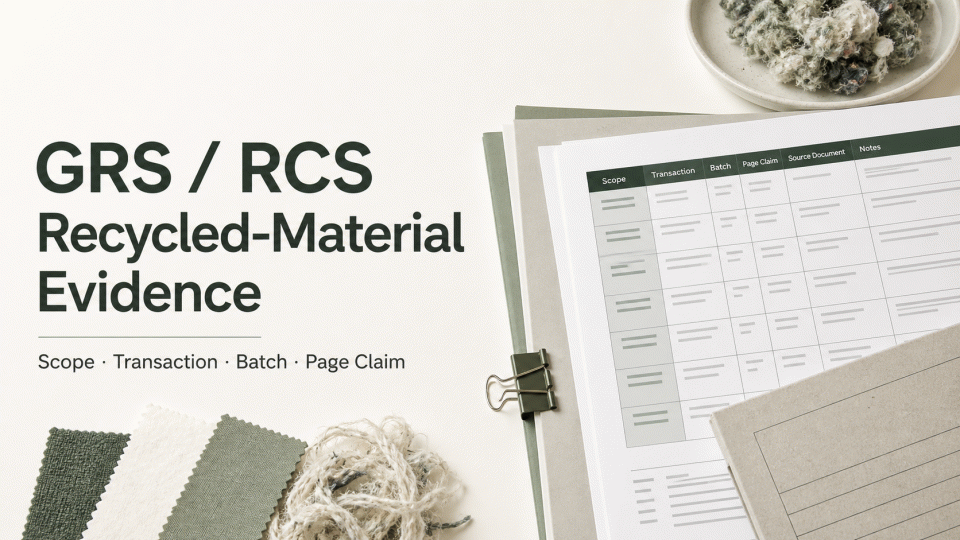
For each live SKU, retain at least: SKU or model, product version, material composition, recycled-material source and category, supplier and facility, applicable standard, SC reference and status, TC or batch record, purchase order, invoice, shipping record, and the exact recycled-content wording used on the page.
Check four links: model identity; material and content wording; supplier and facility within the certified scope; and batch, quantity, date, invoice, and shipment records that reconcile. Recheck when the product version, material, supplier, or shipment changes. Do not silently carry an old record into a new product.
4. Keep page claims inside the evidence
“Contains recycled material” should not be expanded into “the whole product is certified,” “environmentally risk-free,” or “compliant in every market.” Identify the claim object and evidence scope. Keep separate the supplier’s material record, a certification body’s certificate, a brand’s product claim, and any platform-program eligibility. For Textile Exchange marks or product-specific claims, follow the current Claims and Labeling Policy and certification-body approval process.
If the file supports only one material, batch, or supplier, limit the wording to that scope. If the SC, TC, product specification, and live page sentence cannot be reconciled, record the issue for confirmation instead of using “should pass” or “guaranteed.”
5. A manual check before submission
First read the current Textile Exchange RCS, GRS, and claims documents. Then confirm the standard version, certification body, certificate holder, facilities, product categories, and status. Map the SC, TC, purchase order, invoice, shipping record, and product specification to the same SKU or batch. Review the page claim word by word, including its object, scope, and language. Escalate unsupported points to the certification body, customer, or platform and record the date of the check.
Source basis: Textile Exchange: RCS and GRS, Textile Exchange: Standards, Standards Claims Policy, and the current standard documents. Standards, certification procedures, and platform requirements can change, so confirm the current version before submission. This is an evidence-review framework, not legal advice, a certification-body decision, or a platform review.


