
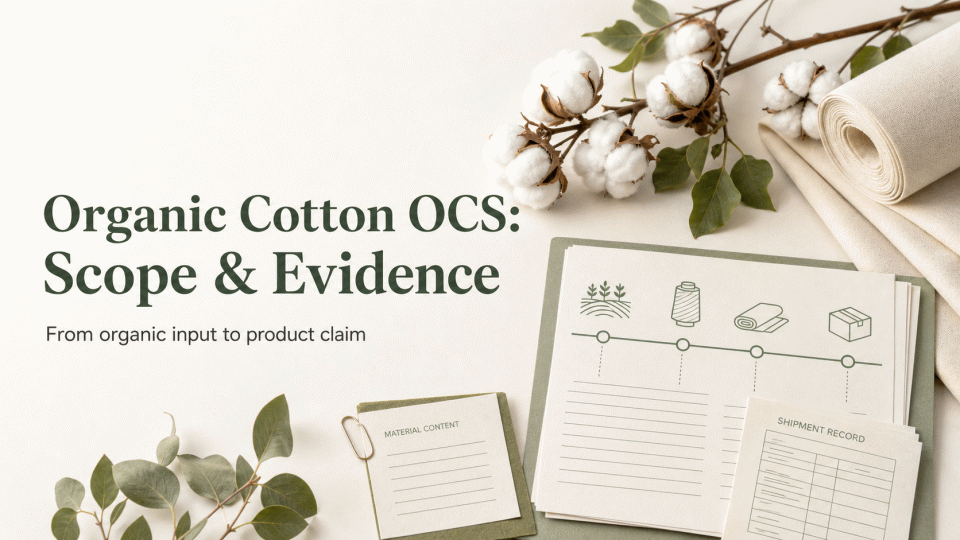
When a buyer asks for OCS evidence, the useful question is not whether a supplier has a generic “green certificate”. It is whether the organic input, chain of custody, product composition, transaction records, and product wording refer to the same certified scope. This reference separates OCS evidence from customs, marketplace, and other regulatory requirements.
1. Confirm that OCS fits the product and supply chain
OCS 3.0 covers eligible organically grown inputs from an accepted organic agriculture system and manages chain of custody from the first processor through the final business-to-business seller. It applies to products not intended for human or animal consumption. The applicable material percentage, product category, and labeling conditions must be checked against the current OCS standard and claims policy rather than assumed from a supplier presentation.
Start with a scope map: organic input source, first processor, spinning, weaving, dyeing, garment production, packaging, storage, trading, and the final business-to-business seller. Record the legal entity and site for each relevant step. A supplier certificate does not automatically cover an unlisted factory, product, or trading entity.
2. Understand Scope Certificates and Transaction Certificates
Scope Certificate (SC): identifies an organization, its certified sites, product or material categories, and the approved scope. Check the certificate holder, site address, certification body, certificate number, and listed products against the actual supplier and production records.
Transaction Certificate (TC): supports traceability for a particular certified transaction or shipment. Keep the relevant purchase or sales documents, transport records, batch or order identifiers, and the upstream and downstream certificate references. An SC is not a substitute for transaction-specific evidence, and a TC cannot extend certification to products outside the certified scope.
Certification review may also examine material flow, volume reconciliation, and controls against double claiming. For each SKU, link the input lot, receipt record, production lot, finished-product specification, sales document, and related TC. Note blends, trims, losses, transfers, and any resale step that affects the evidence trail.
3. Build an SKU-level evidence file
A practical file can be organized into four groups, while keeping unrelated legal or marketplace documents separate:
- Entity and scope: legal name, site address, role in the chain, current SC, certification body, and certificate number.
- Organic input: supplier SC, relevant TCs, purchase and transport records, batch references, and traceability into the first processing stage.
- Product and production: SKU, fiber composition or material specification, production lot, input/output records, and segregation or blending controls.
- Sales and claims: orders, invoices, shipping records, related TC, label artwork, and ecommerce wording. For product-specific OCS claims or marks, also check the current Textile Exchange claims policy, logo-use guidance, and certification-body release requirements.
4. Keep product wording within the evidence
“Contains OCS-certified organic material” is not the same as saying that the whole product is organic. Product wording should identify the actual product and certified content supported by the applicable records. Do not turn an organic-material claim into an unsupported claim about environmental performance, health, social conditions, or regulatory compliance.
If a product-specific OCS claim or mark is used, confirm that the product is covered through the relevant business-to-business seller, that the wording and artwork meet the current policy, and that the required certification-body approval has been obtained. Do not redraw, recolor, or use official OCS artwork without authorization. OCS should not be presented as a universal customs-clearance, marketplace-listing, or market-access document.
5. Run a final cross-check before submission
Ask five questions: Does the certificate holder match the transaction entity? Are the relevant sites within scope? Can every organic input be traced to an SC or TC? Does the SKU composition match the certificate and sales documents? Does the page wording say only what the evidence supports? If a buyer also requests PPWR, EUDR, product-safety, or marketplace evidence, create a separate evidence matrix for that requirement instead of using OCS documents as a substitute.
Sources: Textile Exchange Organic Content Standard, OCS-101 V3.0, OCS-102 Certification Procedures, and Textile Exchange Labeling & Standards Claims. Apply the version and certification-body requirements relevant to the actual project and evidence.


