
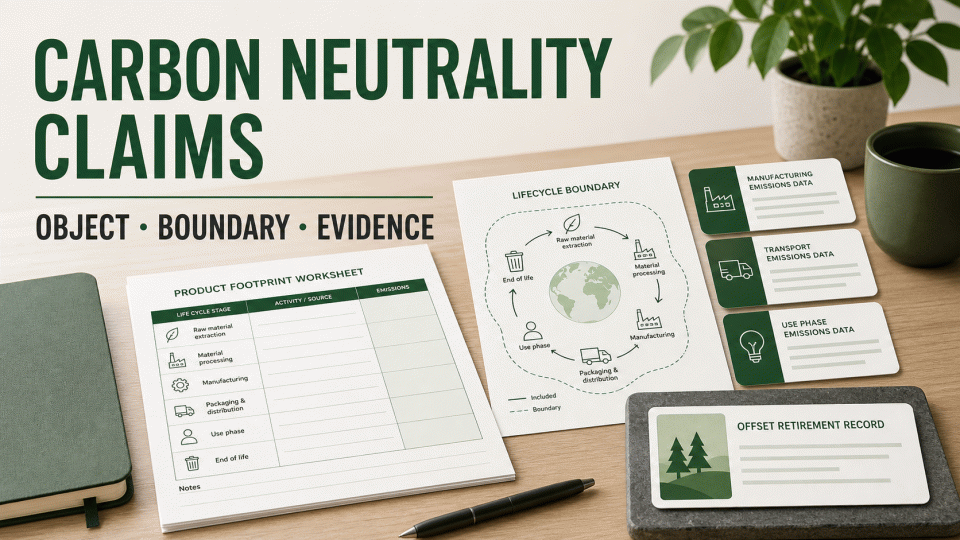
Carbon neutrality, net zero, low-carbon and offsetting are not interchangeable labels. Before preparing a product page or customer file, define who or what the claim covers, which life-cycle stages are included, where the data comes from, and what reduction and offset records each support.
1. Define the claim object
Separate the object into a product, package, corporate operation or specific project. For a product claim, record the model or SKU, market, functional unit, accounting period and life-cycle boundary. For an organisational claim, document the entities, facilities and operations included. A wider object requires evidence that covers more than one product or transaction.
When a page uses “carbon neutral”, “net zero” or “reduced carbon footprint”, review the words, graphics, label names and overall impression together. The FTC Green Guides call for competent and reliable scientific evidence for environmental and offset claims; a broad “green” statement is not a substitute for claim-specific support.
2. Put the accounting boundary in the file
List included and excluded stages such as raw materials, manufacturing, transport, use and end of life. Record activity data, sources, emission factors, units, data vintage and estimation methods. The GHG Protocol Product Standard can provide a reference for product life-cycle accounting; whichever method is selected, preserve its version, assumptions and change log.
Do not turn renewable electricity, a purchased offset or a supplier’s single carbon figure into a product-neutrality statement without checking the boundary. Tie each figure to the relevant activity data and state whether independent verification was performed, what it covered and the date of the opinion.
3. Keep reductions, removals and offsets separate
A reduction is a change in emissions within the defined boundary. A removal concerns taking greenhouse gases from the atmosphere and storing them for the relevant period. An offset generally refers to a unit from a project outside that boundary. Keep project, quantity, vintage, ownership and claim-use records separate; an offset certificate does not replace a product life-cycle inventory.
For an offset file, check the programme and project ID, project activity, quantification method, issuance and retirement records, quantity, beneficiary, vintage and double-counting controls. The FTC Green Guides also call for appropriate accounting methods, prohibit selling the same reduction more than once and caution against advertising reductions from activities already required by law.
4. Set market-specific page boundaries
EU Directive 2024/825 places strict limits on claims that, based on greenhouse-gas offsetting outside a product’s value chain, a product has a neutral, reduced or positive impact on emissions. Check the applicable implementation rules and timing for the target market. The FTC Green Guides are US advertising guidance, not a universal certification scheme.
Use wording that identifies the object and evidence, such as “a product footprint was calculated for the stated boundary” or “the company participated in the named project and retains retirement records.” Do not use “carbon-neutral product”, “zero-carbon brand” or “purchase offsets it” when the supporting record does not establish that exact claim. Certification names, verification marks and third-party statements must match their authorised scope and public rules.
5. Build a pre-publication evidence index
Create one index row for each claim: exact wording, object or SKU, market, life-cycle boundary, data year, accounting method, supporting files, verification scope, offset retirement details, owner and review date. Every environmental sentence on the page should point back to an index row, and the review should be repeated when a supplier, product, method or certificate changes.
绿色方舟(深圳)认证有限公司 provides a reference for organising evidence and claim boundaries. The claim owner must decide whether a statement is appropriate based on the target market, product data and available verification evidence.
Sources
FTC Green Guides summary; Directive (EU) 2024/825; GHG Protocol Product Standard. These sources inform the evidence, offset-accounting and life-cycle preparation framework; they are not a determination of any particular product outcome.


