
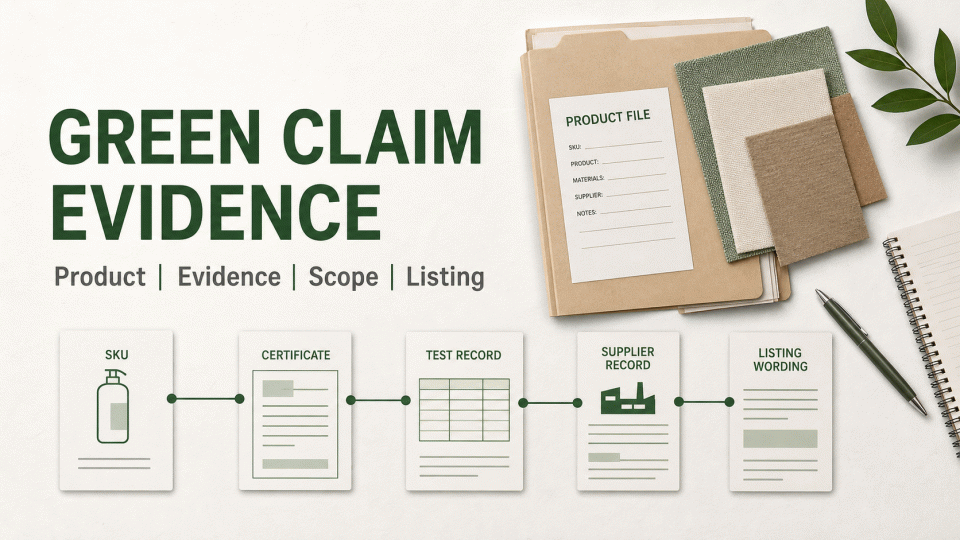
Words such as “green,” “eco-friendly,” “low carbon,” “recyclable,” and “made with recycled content” cannot be supported by a certificate or supplier note alone. The review must identify what the statement describes, which product and scope it covers, which records support it, who is responsible, and whether the listing says more than the evidence. This article is a SKU-level review framework. It is not a legal opinion, test conclusion, certification decision, or platform approval.
1. Deconstruct the claim before collecting documents
Copy each environmental statement from the listing into a register, then record five fields: claim object (product, packaging, ingredient, factory, or company), environmental attribute, scope (model, variant, batch, market, and life-cycle stage), supporting basis, and responsible party. This makes it possible to tell whether a certificate, test report, formulation, BOM, supply-chain record, or calculation file actually supports the wording.
A broad statement such as “environmentally friendly product” carries more implied meaning than a qualified statement about a verified recycled component in the packaging. The U.S. FTC Green Guides caution against broad, unqualified general environmental benefit claims; the European Commission’s Green Claims materials likewise describe the need for robust, science-based and verifiable substantiation. A safer editorial approach is to name the specific attribute and show its scope and basis near the claim.
2. Build a claim–product–evidence mapping
For each statement, map: listing wording → model or variant → material or formulation version → batch or production unit → evidence ID → document date and scope → reviewer. A certificate supports only the entity, scope, standard, and status it actually identifies. It does not automatically cover another SKU, a different material, a replacement supplier, or a revised package.
For “made with recycled content,” check the material layer, content basis, calculation method, and batch records. For “recyclable,” check composition, separability, and the actual collection or recycling context in the target market. For “low carbon” or a carbon footprint, check the functional unit, system boundary, data sources, allocation method, time period, and review record. For a certification or label, check the holder, scope annex, covered products, and mark-use rules. If a field is missing, do not turn a general concept into a conclusion.
3. Understand what each document can establish
Product identity records: specifications, model lists, BOMs, formulations, labels, and packaging artwork identify the thing being described.
Attribute or test records: test reports, material declarations, calculations, or life-cycle studies explain what was tested or calculated and how; the sample and method must match the product.
Certification or label records: certificates, scope annexes, transaction certificates, licences, or mark rules establish the scheme and authorization boundary, not a universal endorsement of every environmental attribute.
Supply-chain records: purchase orders, invoices, batch ledgers, transport records, and supplier statements connect inputs, production, and sales batches.
Listing and version records: final wording, images, publication date, market version, and change history show what customers actually saw.
4. Reconcile entity, scope, and dates
Compare the certificate holder, manufacturer, brand owner, importer, listing operator, and claim publisher. Where they differ, document the authorization, transaction, or responsibility link. A supplier saying that it “has a certificate” is not enough to transfer the certificate to another listing. The scope must also match the product category, model, material, factory, site, and market; “same series” is not automatic coverage.
Record issue, validity, and review dates, but do not convert an unexpired document into a claim that a product is permanently compliant. A material, formulation, pattern, factory, package, or claim context change should trigger a reassessment of whether the existing evidence remains representative. Use records that can be checked with the issuer, laboratory, standards body, or responsible party.
5. Keep listing language inside the evidence boundary
Titles, bullets, detail copy, image text, and FAQs all contribute to the claim. Do not use leaves, checkmarks, seals, or “officially certified” visual cues to enlarge the meaning of a document. Do not turn one material attribute into a product-wide, company-wide, or full-life-cycle environmental conclusion. If the evidence covers only part of the packaging, say so. If it covers one model or market, place that qualifier where customers can see it.
Run a reverse comprehension test before publication: ask someone outside the production process what object has what attribute, what supports it, and how far it applies. If the answer depends on an internal explanation, the page is still ambiguous. Delete or rewrite claims that cannot be verified or that create an unsupported overall environmental impression; common industry wording is not evidence.
6. Pre-publication checklist
□ Each environmental statement and its object are registered; □ product, material, packaging, batch, and market boundaries are clear; □ evidence traces to the SKU and matches entity, date, version, and scope; □ the test, calculation, or certification method fits the claim; □ supply-chain records connect key inputs to production batches; □ copy, imagery, and labels do not broaden the conclusion; □ changes trigger reassessment; □ the final page version and review record are retained.
GreenArk (Shenzhen) Certification Co., Ltd. may support claim–product–evidence mapping, gap identification, and listing-language review, but it does not replace a regulator, certification body, laboratory, or responsible party’s decision. Recheck the current rules, official guidance, and product facts for the target market before use.
Reference sources: the U.S. Federal Trade Commission’s Guides for the Use of Environmental Marketing Claims (16 CFR Part 260) and Environmental Claims Summary; the European Commission Green Claims topic page; and ISO 14021 public information on self-declared environmental claims. This is an evidence reference, not a certification, testing, market-access, or legal conclusion.


