
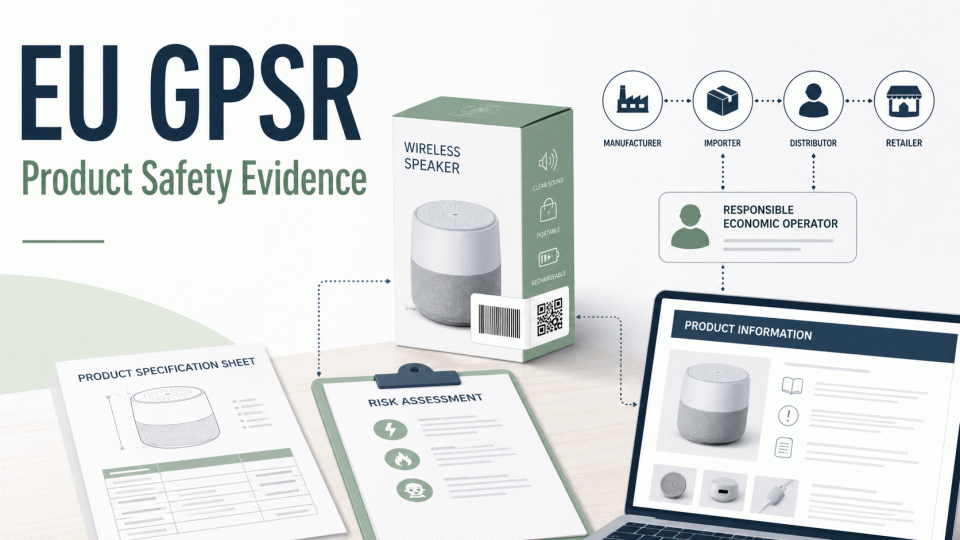
The General Product Safety Regulation (Regulation (EU) 2023/988, or GPSR) sets general safety rules for consumer products placed or made available on the EU market. It is not a universal certificate, and a supplier report cannot by itself replace a product-specific review of safety evidence, responsible parties and online information.
This page is a documentation framework, not a product-wide legal conclusion. First check whether a product is governed by more specific EU product legislation. Use the current consolidated text on EUR-Lex for the applicable scope, exclusions and interaction with other rules.
1. Define the product and regulatory scope first
Start with a SKU, model, intended use, sales method and destination-market register. Then identify whether a specific EU safety regime also applies. GPSR does not replace the rules that may apply to machinery, electrical equipment, toys, cosmetics, medical devices or other product categories. Where several regimes are relevant, record their separate legal bases and evidence owners.
For a non-EU manufacturer, map the manufacturer, importer, authorised representative or other relevant economic operator to the exact product and sales route. Do not assume that a brand, factory, marketplace account and supplier are the same legal entity.
2. Build evidence that explains the safety assessment
For each SKU, assemble a traceable file containing the product name, model or batch, images and identifiers; design specifications, BOM, critical components and materials; intended use, foreseeable misuse and risk assessment; applicable standards or test methods and their versions; test reports, corrective actions and the relationship to the final sample.
A report should identify the sample, model, test items, results and limitations. A laboratory credential, report date or file format does not prove coverage of a different configuration. Maintain a product–document–risk–conclusion map and preserve the relevant version history.
3. Review the information shown in online sales
An online product listing should not be treated as marketing copy only. Depending on the product and sales route, review the manufacturer’s name, registered trade name or mark, contactable postal and electronic address, product identifiers, safety warnings or instructions, and—where applicable—the relevant EU responsible economic operator information. The exact presentation and language requirements depend on the product and the applicable provisions.
Keep listing captures, product-detail versions, packaging artwork and instruction-manual versions in one record. If a safety or performance statement goes beyond the risk assessment, technical file or test evidence, narrow the wording before publication. Avoid replacing evidence with broad claims such as “safe,” “risk-free” or “EU compliant.”
4. Treat supplier documents as inputs, not automatic proof
Compare supplier specifications, test reports, material declarations, production-batch records and manuals against your own model, configuration, brand and responsible entity. If the document holder, sample, model or version differs, record the discrepancy and resolve it. A laboratory name or a “compliant” label is not enough to justify reuse.
Ongoing maintenance should also cover complaints, incidents, corrective actions and product changes. A change to a supplier, critical material, software, packaging warning or use scenario may require a new impact review; simply renaming a file is not a review.
5. Five human checks before a submission or listing update
① Product, model, sample and document version match; ② manufacturer, importer and other responsible parties are correctly identified; ③ the risk assessment covers intended use and reasonably foreseeable misuse; ④ labels, manuals and online warnings match the product and target-market language; ⑤ each safety or performance statement can be traced to an applicable rule, technical record or test result.
绿色方舟(深圳)认证有限公司 may help organise a review checklist when product and evidence files are provided. Organising documents is not a uniform safety or compliance conclusion for every product. The final assessment depends on the product facts, applicable rules and current requirements of the relevant EU Member State authorities.
Sources
EUR-Lex: consolidated Regulation (EU) 2023/988; European Commission: Product safety. This page does not replace product-specific legal advice.


