
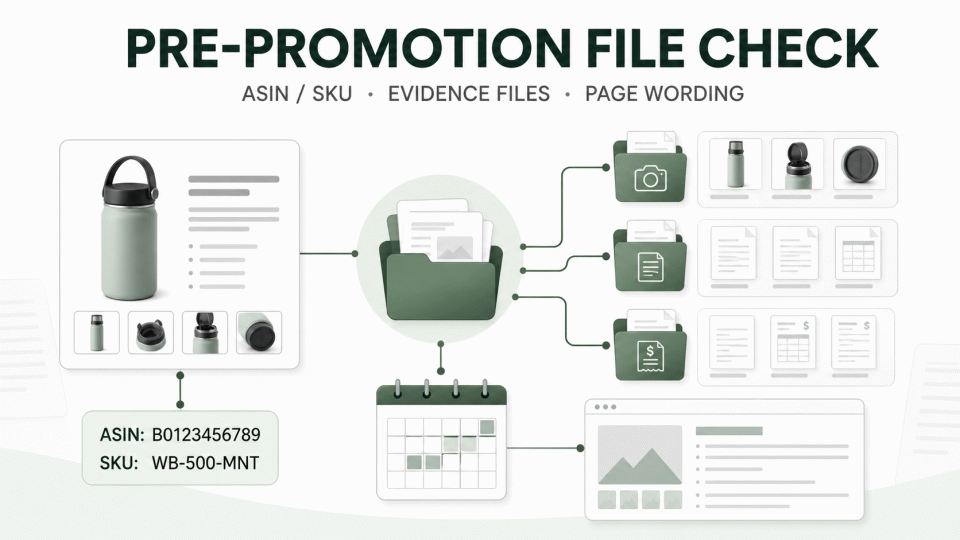
Promotion readiness is not a matter of placing generic certificates in one folder. Each ASIN or seller SKU should be linked to the actual product, responsible parties, destination marketplace, supporting records, and wording used on the listing. Amazon may request different product-compliance information depending on the product and category; marketplace requests do not replace legal obligations in the destination market.
This reference page offers a pre-promotion review framework for finding evidence gaps, preserving traceability, and checking listing changes before submission. It does not predict which documents will be requested for a particular ASIN and does not promise approval, listing, sales, customs, certification, or timing outcomes.
1. Start with an ASIN/SKU evidence index
List every ASIN and seller SKU in the promotion scope, together with model or variant, brand, marketplace, manufacturer, and importer or other responsible party where relevant. Confirm separately whether differences in color, capacity, bundle, formulation, material, or packaging affect document coverage. A brand or factory name is not a substitute for product identification.
Useful index fields include document name and version, linked ASIN/SKU, model, country or marketplace, issuing entity, issue date, cited standard or rule, samples and parameters covered, source-file location, reviewer, and review date. If a document does not clearly identify the covered product, record it as “pending confirmation” instead of assuming that it applies.
2. Organize four evidence groups
Product and responsible-party records: specifications, model information, BOM or formulation, packaging and label versions, brand authorization, and entity details. Names, models, and roles should match the current product record.
Applicable requirements: record the rules, standards, marketplace programs, and buyer requirements considered for the product category, use, and destination. Keep legal duties, marketplace requirements, and private buyer requirements in separate fields; one does not automatically replace another.
Testing and supporting documents: retain complete reports, certificates, or declarations rather than a first-page screenshot. Check the sample, model, test items, result wording, laboratory or issuer, dates, signatures, and identifiers. Validity and retesting requirements vary by the applicable rule, issuing document, and current marketplace request; do not apply a blanket “24-month” assumption.
Supply-chain and change records: retain purchasing, batch, material or packaging source, transport, and traceability records where relevant. Reassess coverage after a supplier, factory, material, formulation, critical component, package, or production-site change.
3. Break every page claim into a reviewable statement
List each environmental, safety, material, performance, or certification statement appearing in the title, bullets, description, images, A+ content, and promotion materials. For each statement, record its object, scope, supporting file, supporting fields, conditions of use, and review conclusion. If the evidence covers one model, component, or batch, the wording should be limited to the same scope.
“A document was submitted,” “the document reports a test,” and “a program asks for a document” are different from “Amazon approved the product,” “the product meets every requirement,” or “the listing will not be restricted.” Remove unsupported outcome, ranking, traffic, customs, certification, or fixed-timeline language, or replace it with a verifiable process description.
4. Pre-promotion review checklist
For each ASIN/SKU, confirm that product images, specifications, packaging, and model references match; responsible parties and roles are recorded; the marketplace and source requirements are identified; each document can be linked to the product and version; original files open and retain page numbers, signatures, and identifiers; listing statements stay within the evidence scope; and changes, reviewer conclusions, and open items are logged.
When Amazon Seller Central shows a Product Compliance request for an ASIN, use the product, document type, and submission route displayed in that request, and retain the submitted version and response record. Amazon’s own guidance also states that its information is guidance only; sellers must verify the laws and obligations applicable to their destination markets.
5. Keep the boundary visible
A promotion does not change the product’s regulatory scope, but additional listing, image, and customer-facing statements can create more review points. Recheck the index after a new product, variant, package, supplier, marketplace request, or rule-version change. Any work by 绿色方舟(深圳)认证有限公司 should remain within the agreed scope, the documents actually verified, and the applicable market; it does not replace a marketplace or authority decision.
Sources: Amazon Product Compliance guidance; Amazon explanation of document submission for products with compliance requirements. Product, marketplace, and timing details should be checked against the applicable rule text and the current Seller Central request.


